Eleven months of the qualification assessment: 46 judges of low integrity retained their positions, and 30 were recommended for dismissal

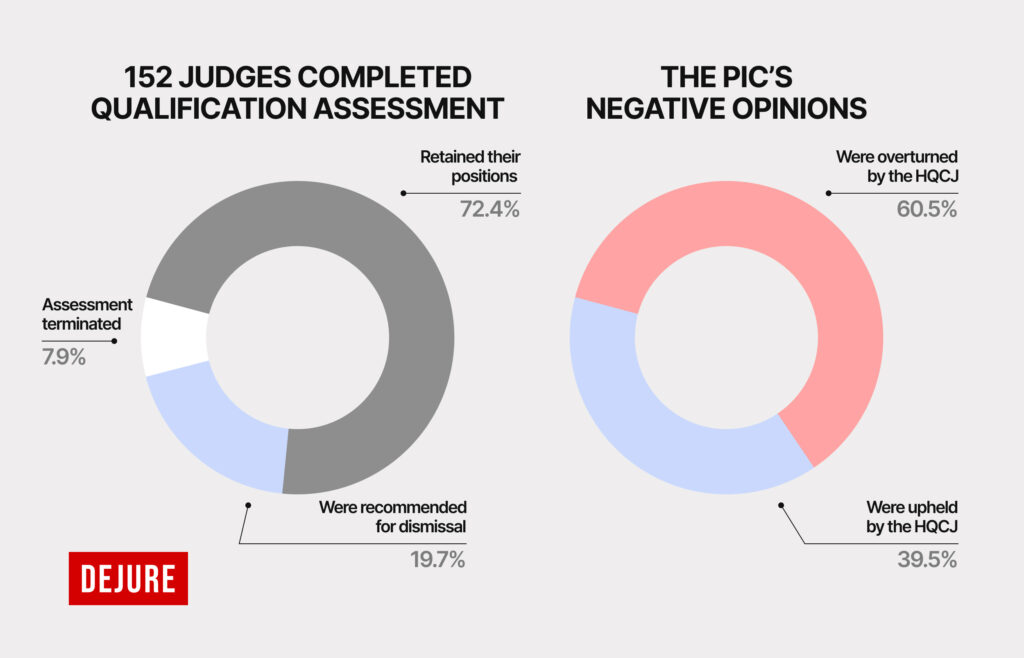
Almost eleven months have passed since the start of the qualification assessment. During this period, the High Qualification Commission of Judges (HQCJ) has finalised the assessment of 152 judges.
110 judges (72.4%) have passed the evaluation and will retain their positions, while 30 judges (19.7%) were recommended for dismissal by the High Council of Justice (HCJ).
Regarding 12 judges (7,9%), the HQCJ made alternative decision, such as termination of the qualification assessment as a result of voluntary dismissal, mobilisation, refusal to undergo the assessment, etc).
The HQCJ and the Public Integrity Council (PIC) still hold divergent views on integrity issues, although the Commission’s support of the PIC’s negative opinions is slowly increasing. To illustrate this, out of 76 PIC’s negative opinions reviewed by the Commission, only 30 judges (39.5%) were recommended for dismissal. Conversely, in 46 cases (60.5%), the HQCJ overruled the PIC’s negative opinions, allowing judges of low integrity to retain their positions.
We welcome the Commission’s decision to include in its agenda the matter of judge Diana Kiblytska’s suitability for her position. She is among the judges whose qualification assessment has been jeopardised by the Grand Chamber of the Supreme Court (SC) ruling in the Judge Usatyi case. To recap, the Grand Chamber decided that some judges with the PIC’s negative opinions may avoid the entire Commission’s composition vetting, unlike other judges.
This list includes “Maidan judge” Oleksandr Lutsenko, who has been submitting medical leave certificates to the HQCJ since January 2024, yet immediately after the scheduled interview with the HQCJ he continues to hear cases in the Obolon District Court of Kyiv. We anticipate the inclusion of the interview with Lutsenko in the HQCJ’s schedule.
We hope that the ruling of the Grand Chamber of the SC will not hinder the judiciary cleansing process. We believe the HQCJ is capable of prioritising interviews with the 180 judges affected by the SC decision to promptly recommend the dismissal of those lacking integrity.