HQCJ Member Luhanskyi Suspected of Receiving Payments for a Fake Academic Degree
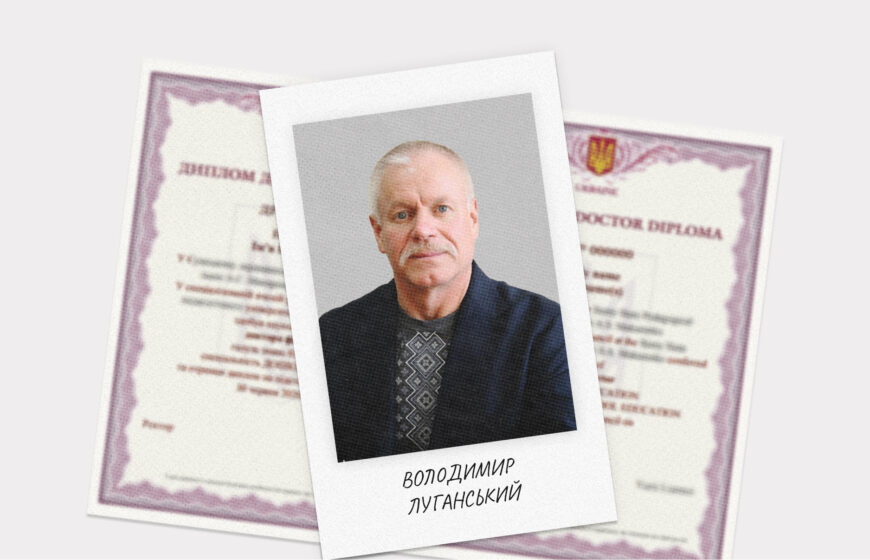
The National Anti-Corruption Bureau (NABU) and the Specialised Anti-Corruption Prosecutor’s Office (SAPO) have issued a formal notice of suspicion to Volodymyr Luhanskyi, a member of the High Qualification Commission of Judges (HQCJ), for receiving unlawful salary supplements based on a fraudulent academic degree. The Anti-Corruption Action Centre first uncovered the fake diploma.
Luhanskyi received a so-called PhD (“Doctor of Philosophy”) degree in 2011 from the Interregional Academy of Personnel Management (MAUP) — an institution that, at the time, was not authorized to award such a degree. According to NABU, while serving as a judge, Luhanskyi received approximately UAH 500,000 in bonuses based on this illegitimate diploma.
In autumn 2024, the HQCJ even created a working group, led by Ruslan Melnyk, to investigate the matter. However, no results from the group’s work have been made public to date.
Importantly, this suspicion differs from recent politically motivated investigations launched by the State Bureau of Investigations (SBI) against HQCJ members. Unlike those cases, Luhanskyi’s involves genuine legal grounds. In fact, the SBI only opened its case after NABU had already launched its own investigation.
The SBI’s role appears to be that of an enforcer for the judicial elite, aiming to disrupt the evaluation of low-integrity judges from the District Administrative Court of Kyiv (DACK), Pechersk Court, and others — and more broadly, to freeze HQCJ operations. And they may succeed. If Luhanskyi and another member of the HQCJ (either a sitting judge or a retired judge) are forced to leave, the Commission would lose its quorum, triggering the need for a new selection process for Commission members.
Compounding the risk is the fact that the mandate of international experts in the Selection Commission for HQCJ expires on June 1. Without an urgent extension of their tenure, new members may be selected by discredited institutions. For instance, the Ukrainian Bar Council, led by Lidiia Izovitova, a known associate of Viktor Medvedchuk, would gain the right to nominate candidates.
This creates a serious risk that a pro-old system majority could be formed in the HQCJ. Such a majority would shape the outcome of critical integrity evaluations, control appointments for over 2,000 vacant positions in local and appellate courts, and influence selections to higher courts. If this happens, it could entrench low-integrity judges for decades, rendering future reform efforts nearly impossible to reverse.