Not noticed anything: The High Qualification Council of Judges allowed low-integrity judges Kovalenko and Kovalchuk to retain their positions
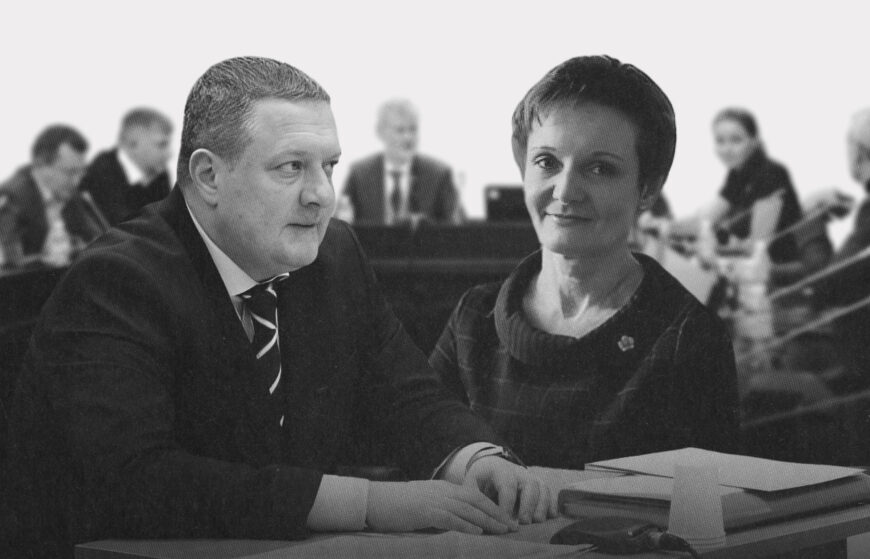
The High Qualification Commission of Judges (HQCJ) continues to overturn negative opinions of the Public Integrity Council (PIC), allowing low-integrity judges to retain their positions: today, 10 out of 14 Commission members voted to keep Pavlo Kovalenko and Olena Kovalchuk in their positions.
According to the opinion of the PIC, there are many questions regarding the property of Pavlo Kovalenko, a judge from the Tokmak District Court of Zaporizhzhia Oblast. In particular, the judge’s mother and mother-in-law, lacking a verified income, built houses, bought apartments, and premium-class cars, such as the BMW X-5. As a classical scheme, the judge and his wife use these properties, as declared by Kovalenko. Despite such “generosity” of relatives, they consistently refused to disclose the value of those assets for the judge’s declaration.
Furthermore, in 2016, the judge’s spouse purchased an apartment at an exceptionally low price—174 thousand hryvnias or 7 thousand dollars, 4 times lower than the market price. How this happened, and whether the judge explained it during the interview, is unknown, as the HQCJ closed the broadcast. For more details, see the opinion of the PIC.
Regarding judge Olena Kovalchuk of the Khmelnytsky District Administrative Court, last year, she defended her dissertation and obtained PhD in Law. But there is one catch: the judge wrote about amnesty in Italy and Ireland and referred to a source… which doesn’t mention either. Instead, it delineates amnesty exclusively in the Russian Federation. Additionally, the judge deemed it appropriate to incorporate Russian sources in her work, including those published after the beginning of Russia’s armed aggression.
Concerns about the authorship of the dissertation emerged during the interview. It turned out that the judge was unfamiliar with international academic research databases and did not use them, although there is at least one reference to them in the dissertation. When asked how she worked with long English texts, the judge replied that she “translated in Chrome,” which, however, does not have such functionality. For more details, see the opinion of the PIC.
Nonetheless, the HQCJ concluded that both Kovalchuk and Kovalenko meet the high standards expected from judges and can retain their positions.