60% of Ukrainians do not trust the Supreme Court and prioritise judicial system renewal — survey - 7F8D0
Back

60% of Ukrainians do not trust the Supreme Court and prioritise judicial system renewal — survey

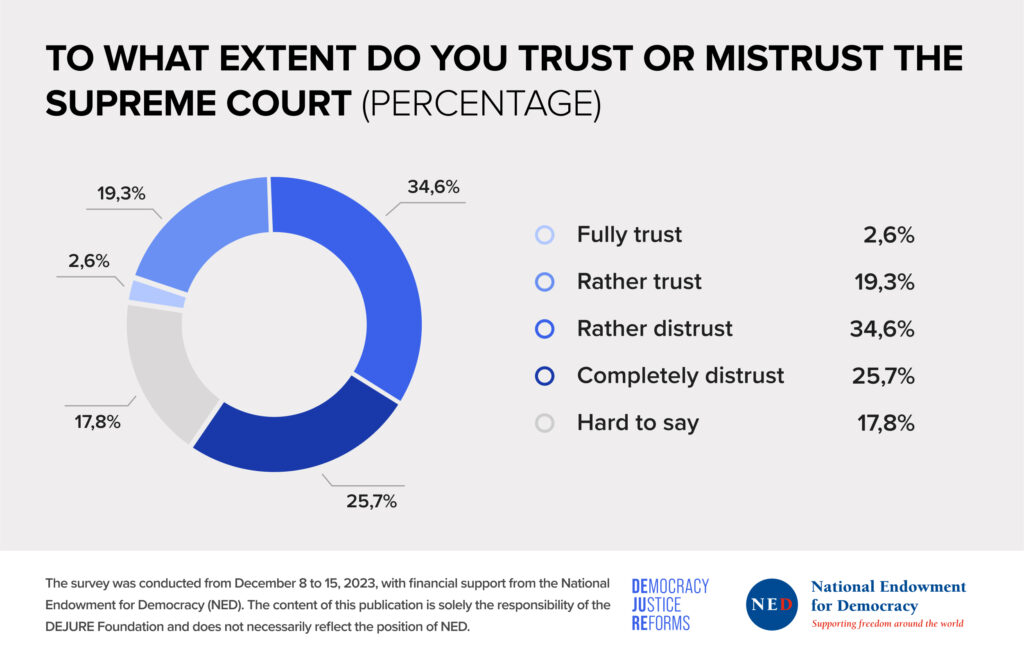
The majority of Ukrainians surveyed, 60%, do not trust the Supreme Court. Trust in the Supreme Court is shared by only 22% of respondents. Distrust towards the Supreme Court is consistent regardless of the respondent’s region or financial status. This data comes from a survey conducted by the Ilko Kucheriv Democratic Initiatives Foundation in collaboration with the Razumkov Center’s sociological service from December 8 to 15, 2023, commissioned by the DEJURE Foundation.
60% of Ukrainians do not trust the Supreme Court and prioritise judicial system renewal — survey - CB26A

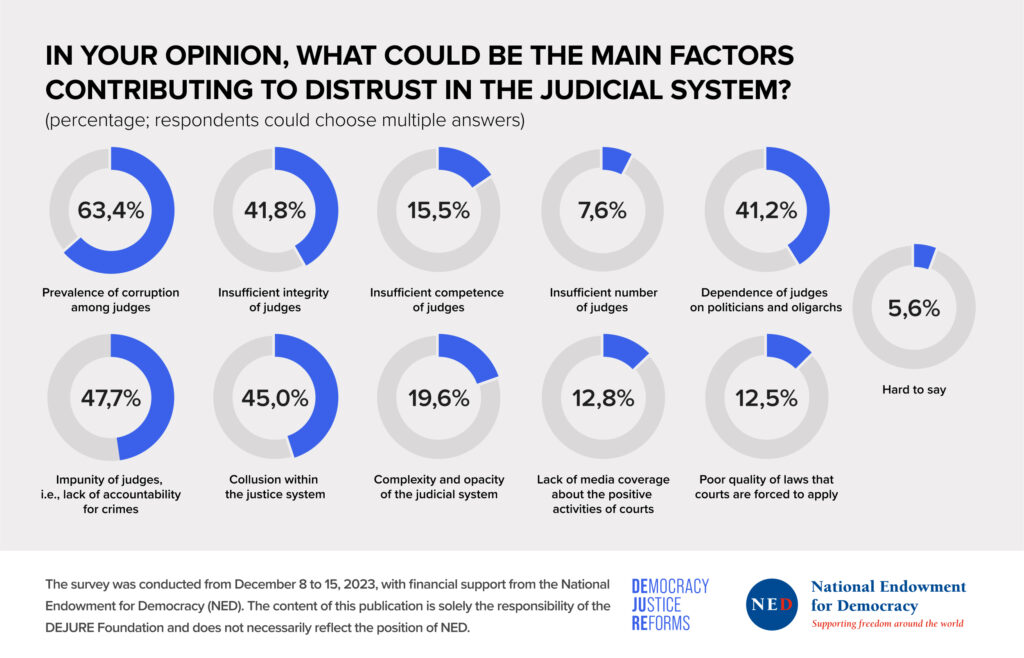
The primary factors contributing to distrust in the judiciary include widespread corruption among judges, impunity, a system of mutual protection within the judiciary (45%), lack of judicial integrity (42%), and judges’ dependence on politicians and oligarchs (41%).
60% of Ukrainians do not trust the Supreme Court and prioritise judicial system renewal — survey - BDDCB

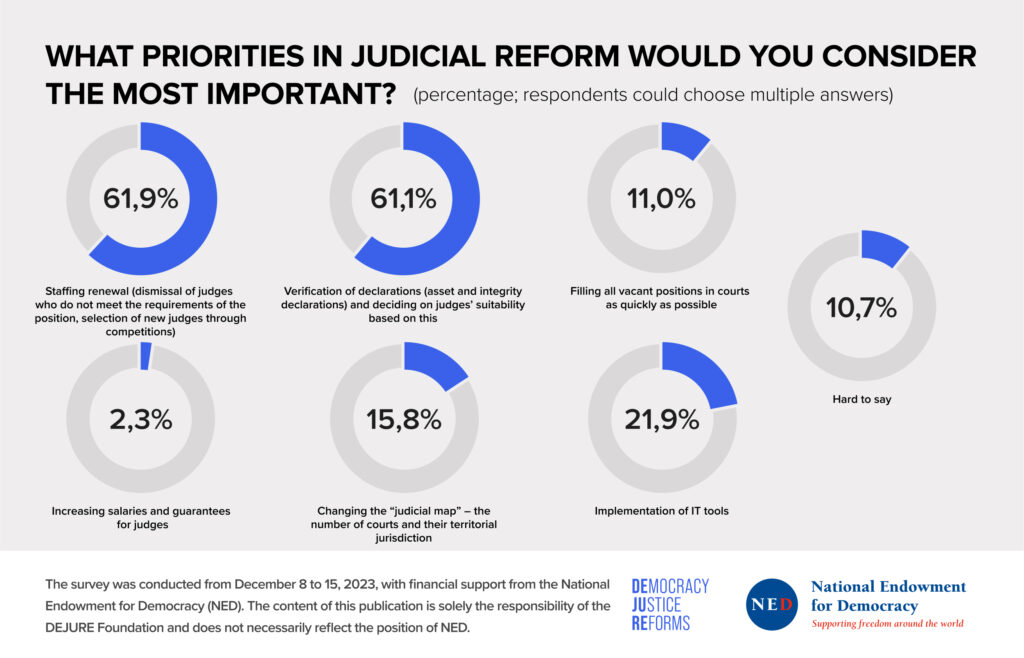
For more than 60% of respondents, the most important priorities in judicial reform are staff renewal and vetting of judges’ declarations, followed by decisions on their continuation in office. The least prioritised issues for respondents were the urgent filling of all judicial vacancies (11%) and increasing judges’ salaries and benefits (2%).
60% of Ukrainians do not trust the Supreme Court and prioritise judicial system renewal — survey - 3FEAA

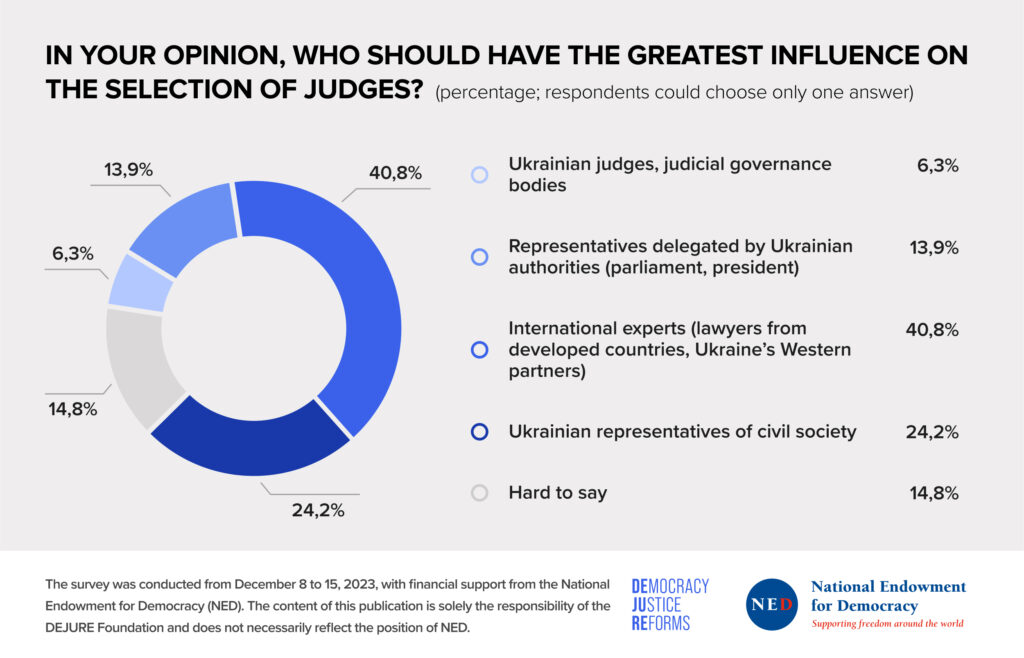
41% of Ukrainians believe that international experts should have the greatest influence on the selection of judges. Nearly a quarter (24%) prefer this role to be held by Ukrainian civil society representatives. The least trust is placed in Ukrainian judges and judicial governance bodies to handle this function.
60% of Ukrainians do not trust the Supreme Court and prioritise judicial system renewal — survey - 9E2A2

The survey was conducted with financial support from the National Endowment for Democracy (NED). The content of this publication is the sole responsibility of the DEJURE Foundation and does not reflect the position of NED.


Other news
To the section
New rules bring new risks. What the draft law on the selection of HCJ members changes

The government’s draft law submitted to the Venice Commission for consideration, in addition to a new procedure for forming the HQCJ, also substantially changes the procedures for electing (appointing) members of the High Council of Justice (HCJ). The proposed changes may create new risks for...

The government proposes a “broken bicycle” for international experts in the commission selecting HQCJ members

The High Qualifications Commission of Judges (HQCJ) is a body that can recommend a person for the position of judge or recommend their dismissal. That is, whoever decides your case, should you suddenly have to go to court, depends on the HQCJ’s assessment. Judges over judges, so to speak. Logi...

DACK cases and judges can end up in the same court again

The High Qualifications Commission of Judges (HQCJ) has recommended transferring 6 judges of the liquidated DACK to the Kyiv District Administrative Court (KDAC). All the cases of the liquidated DACK had previously been transferred to the KDAC as well. In other words, the nameplate has changed, but...

Special by topic
To the section
Supreme Court Unmasked: Corruption, Opposing Reforms and Russian Passports
Judicial reform roadmap