A year of the qualification assessment of judges: the majority of low-integrity judges remain in office
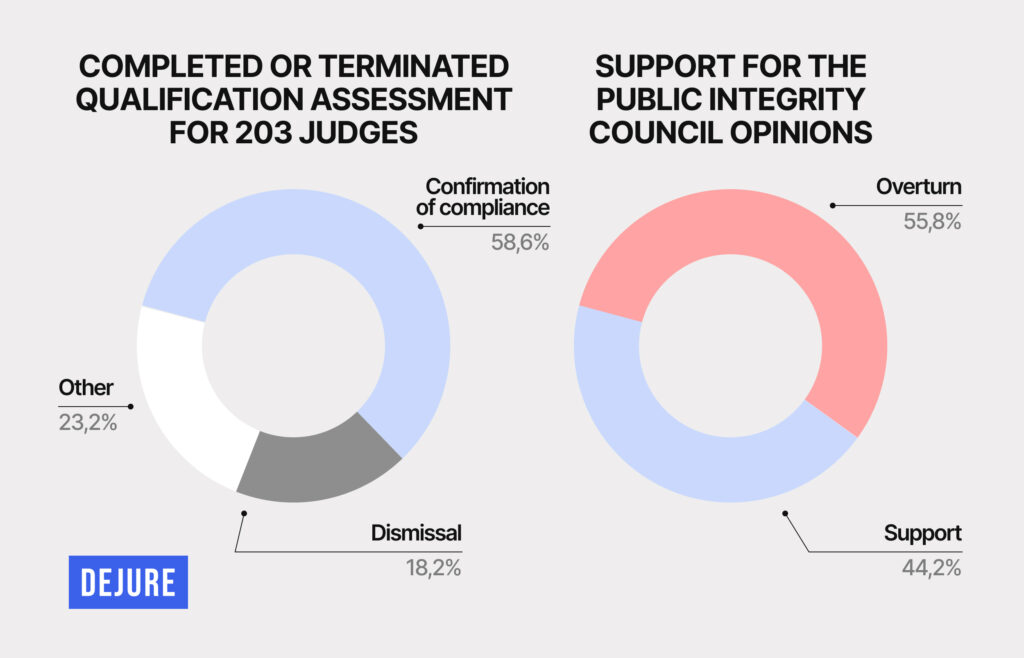
A year ago, in November 2023, the qualification assessment of judges resumed. Since then, the High Qualification Commission of Judges (HQCJ) has assessed 203 sitting judges. Here’s how the judiciary’s “cleansing” process unfolded in numbers:
- 119 judges (58.6%) successfully passed the qualification assessment and will remain in office.
- 37 judges (18.2%) were recommended by the HQCJ for dismissal to the High Council of Justice (HCJ).
- 47 judges (23.2%) received other decisions, including 2 judges who failed to confirm their ability to administer justice, 29 who took honorary retirement, 7 who resigned voluntarily, and 2 who refused to undergo the qualification assessment.
Notably, the HQCJ’s support for the Public Integrity Council’s (PIC) negative opinions has increased. Of 86 negative opinions reviewed on their merits, the HQCJ:
- Recommended dismissal in 36 instances.
- In 2 instances, the PIC’s opinions were upheld during the qualification assessment of judges’ ability to administer justice.
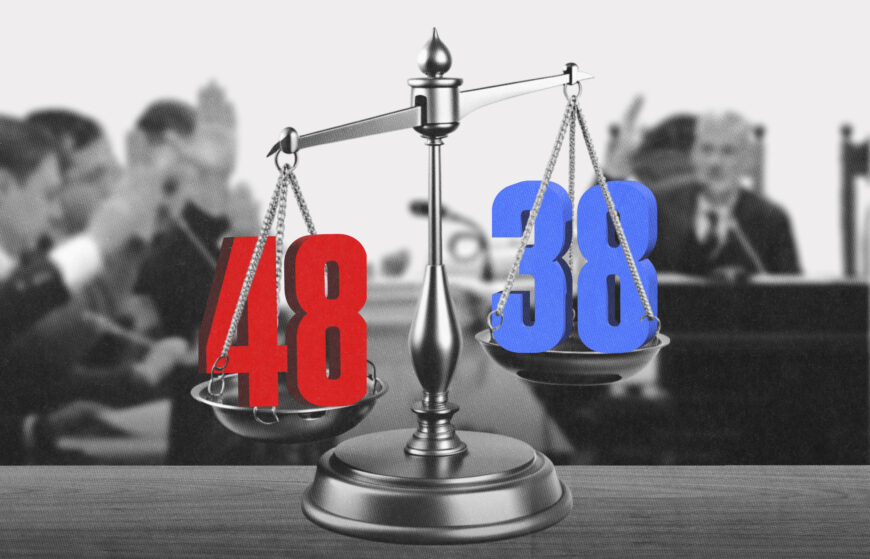
- Overturned PIC’s opinions in 48 instances.
This means the HQCJ agreed with PIC’s opinions in 44.2% of cases, while 55.8% of judges with integrity issues remained in office. However, over the past six months, this ratio has levelled to 50-50.
DEJURE Foundation welcomes the continuation of HQCJ interviews with judges whose evaluations were jeopardized by the Supreme Court’s Grand Chamber decision in the Usaty case. For example, on Monday, November 18, the HQCJ agenda included interviews with four judges from this group, including Oleksandr Lutsenko and Pavlo Horbasenko.
With these actions, the HQCJ has reaffirmed its stance on the so-called “List of 180” judges. DEJURE Foundation hopes that the HCJ will continue to support the HQCJ’s recommendations for dismissal, as it did in dismissing Inna Otrosh from the Kyiv Commercial Court.