What should be done with the draft laws on the liquidation of the District Administrative Court of Kyiv?
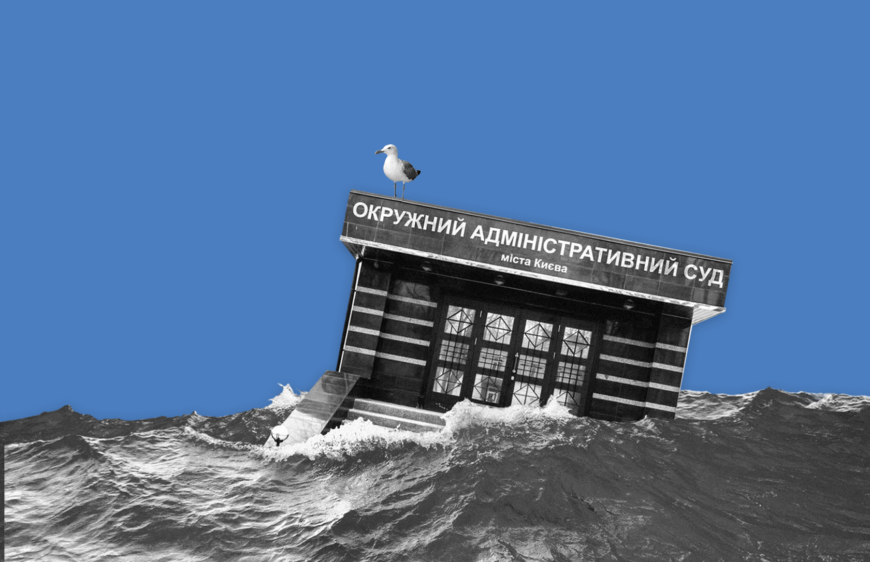
From the moment of the publication, we have been analyzing the President’s draft laws on the liquidation of the District Administrative Court of Kyiv (DACK). We believe that this initiative of the President should be unequivocally supported, despite the fact that it does not provide enough to completely solve the problem with the District Administrative Court of Kyiv. Here we explain the matter in more detail.
In our article “5 steps to living without the DACK” we have already explained that the problem of the court is complex and needs a comprehensive solution. In particular, to neutralize the unlawful activities of the court it is necessary:
- To neutralize the DACK judges so that they cannot adopt new unlawful decisions;
- To determine which court will temporarily consider cases instead of the DACK;
- To take away excessive authority from the new court so as not to create a new judicial monster;
- To prevent Pavlo Vovk or other judges of low integrity from entering the new court;
- To dismiss Vovk and his minions.
Thus, draft laws №5369 and №5370 address the first two issues: the District Administrative Court of Kyiv will cease to administer justice as soon as the law enters into force, and its cases will be considered by the Kyiv District Administrative Court (KDAC) until a new court is established. Although this is not a complete solution to the DACK problem, it is already the first positive step. Therefore, in our opinion, the draft laws №5369 and №5370 should be adopted as soon as possible.
What should be done after the DACK is liquidated?
If nothing is done, the KDAC can become a new DACK indefinitely. The demand for judicial outrage is great, so the new corrupt judges will be ready to provide their “services”.
It is necessary to take away from the DACK and its temporary “successor” KDAC the competence to consider cases of the national level and transfer them to the Supreme Court. Only local Kyiv cases should be temporarily handed over to KDAC. Restrictions on the excessive authority of the DACK are provided for in another presidential draft law №5067, but not to a sufficient extent, so it needs significant amendments.
However, the question remains: Who will be the judges of the new administrative court of Kyiv? And here we need to dive deeper into the legal texts.
The general procedure for filling vacancies, including in newly formed courts, is a competition to be held by the High Qualifications Commission of Judges (HQCJ) (Article 79 of the Law on the Judiciary and the Status of Judges) when it is created.
Both current judges (including judges of the DACK) and other lawyers can participate in the competition. Candidates will compete with their points obtained as a result of the “most honest” qualification assessment conducted by the previous HQCJ, which it was dissolved for.
The High Qualification Commission of Judges will collect documents, issue a rating, give preference to judges (the law gives preference to sitting judges in case of the same number of points) and form a recommendation for the High Council of Justice (HCJ). That is, the competition will consist solely in the ranking of documents by grades, the objectivity of which is in serious doubt. Therefore, in order to ensure that only honest judges enter the new administrative court of Kyiv, it is necessary to define a separate procedure for selecting judges to this court with the involvement of the Public Integrity Council (PIC), which will have a veto in regard to judges of low integrity.
Finally, what about Pavlo Vovk and his partners from the DACK?
In accordance with the transitional provisions of the Constitution (sub-clause 5 of clause 16-1), they may take part in the competition for the vacant position of a judge, or resign. That is, theoretically, they can take part in the competition to the new administrative court of Kyiv and get selected to it, if they have good grades. And although there is a ton of evidence to prove the incompatibility of Pavlo Vovk and his partners from the DACK with the judge position, everything will depend on the HQCJ and the HCJ.
They will have three alternatives:
- to appoint judges to the new administrative court of Kyiv based on the results of the competition;
- to allow their resignation (with a lifetime allowance);
- to dismiss judges for non-compliance (without any payments).
Alternatively, the HCJ and HQCJ can try to push DACK judges to the position of a judge on the basis of part 3 of article 82 of the Law on the Judiciary and the Status of Judges. This provision allows a judge to be transferred to a judicial position without competition if the court in which he worked was liquidated (this is exactly the situation with the DACK).
That is why the fate of the new administrative court in Kyiv and the fate of Pavlo Vovk and his partners will depend solely on the composition of the new HQCJ and whether the HCJ will be cleared of members of low integrity. These bodies can potentially become high-quality and independent if the draft laws №3711-д and №5068 are amended accordingly, as required by public experts and international partners such as IMF and the EU.
In order for Carthage-DACK to be completely destroyed and have no chance of reincarnation in any form, it is essential:
- To adopt the draft laws №5369 and №5370 and immediately liquidate the DACK;
- To qualitatively finalize and adopt the draft law №5067 in order to deprive DACK and the new administrative court of Kyiv of excessive authority;
- To qualitatively finalize the draft laws №3711-д and №5068 in order to form an independent HQCJ with the involvement of international experts and to clear the HCJ, which will prevent the creation of the DACK-2.