Judicial selection: what two years of the renewed HQCJ have shown
Since November 2023, 297 judges have completed the qualification assessment. The High Qualification Commission of Judges (HQCJ) assessed judges’ legal knowledge, psychological resilience, and integrity.
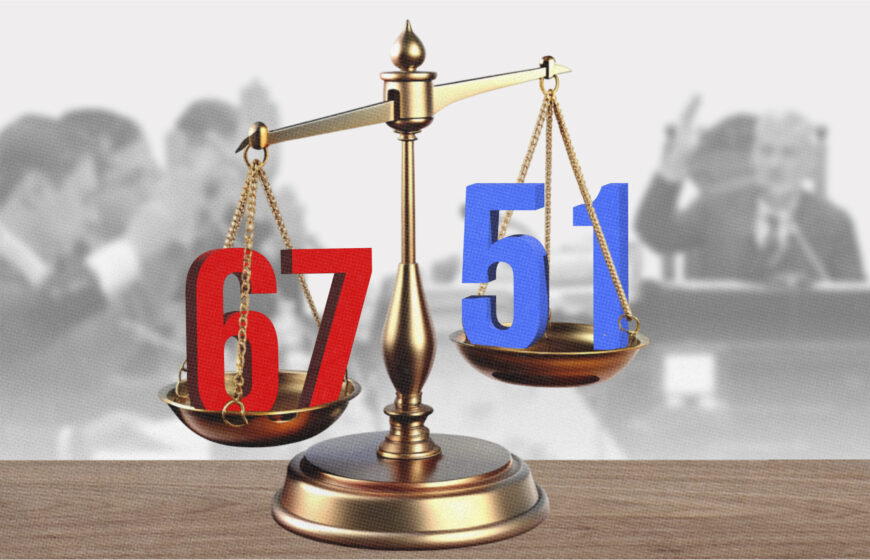
HQCJ members reviewed 120 negative opinions issued by the Public Integrity Council (PIC). The Commission recommended the dismissal of 51 judges with negative opinions. Twice, HQCJ members upheld PIC opinions during competition procedures, in particular by not recommending Pavlo Vovk to the Supreme Court. However, in 67 cases, the Commission found judges fit for office despite PIC’s position.
HQCJ’s rate of support for PIC conclusions has stabilised at 43% and is unlikely to change significantly, as qualification assessments for compliance with the office are almost on hold due to the active involvement of both HQCJ and PIC in competitions for appellate courts.
Overall, since the start of the qualification assessment:
-
161 judges (54.2%) passed successfully and will remain in office;
-
51 judges (17.2%) were recommended for dismissal to the High Council of Justice;
-
In the case of 85 judges (28.6%), the Commission made other decisions. In particular, HQCJ terminated the assessment of 53 judges because the High Council of Justice allowed them to take honorary retirement before the integrity check was completed.
June 1 marked two years of the renewed HQCJ. Key achievements include:
-
generally high-quality selection for local courts;
-
granting PIC full access to judges’ dossiers;
-
agreeing with almost every second negative PIC opinion;
-
improving competition procedures;
-
openness of the Commission’s work.
This progress is currently a bright spot in judicial reform, but as of June 1, the participation of international experts in the Selection Commission, which chose the current HQCJ members, has ended. In the future, members of this body will, among others, be selected by representatives of the National Bar Association (headed by Lidiya Izovitova — an associate of Medvedchuk) and the Council of Judges (headed by Bohdan Monich — an associate of Pavlo Vovk from the District Administrative Court of Kyiv). There is no hope for high-integrity candidates from these bodies.
We call on the Verkhovna Rada to adopt a law extending the participation of international experts in the selection of HQCJ members.