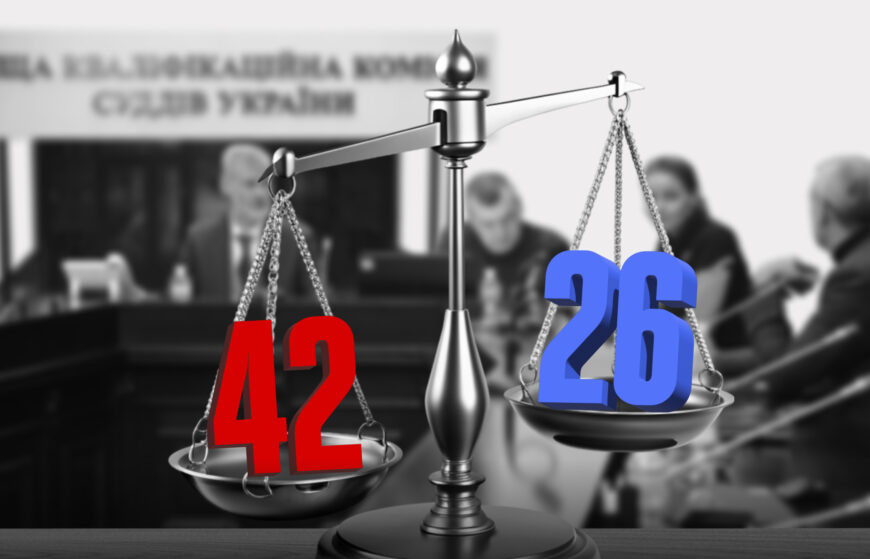
Nine months of the qualification assessment: 42 judges of low integrity retained their positions, and only 26 were recommended for dismissal.
Almost 9 months have passed since the start of the qualification assessment. During this time, the High Qualification Commission of Judges (HQCJ) reviewed 152 judges, 99 of them had negative opinions of the Public Integrity Council (PIC).
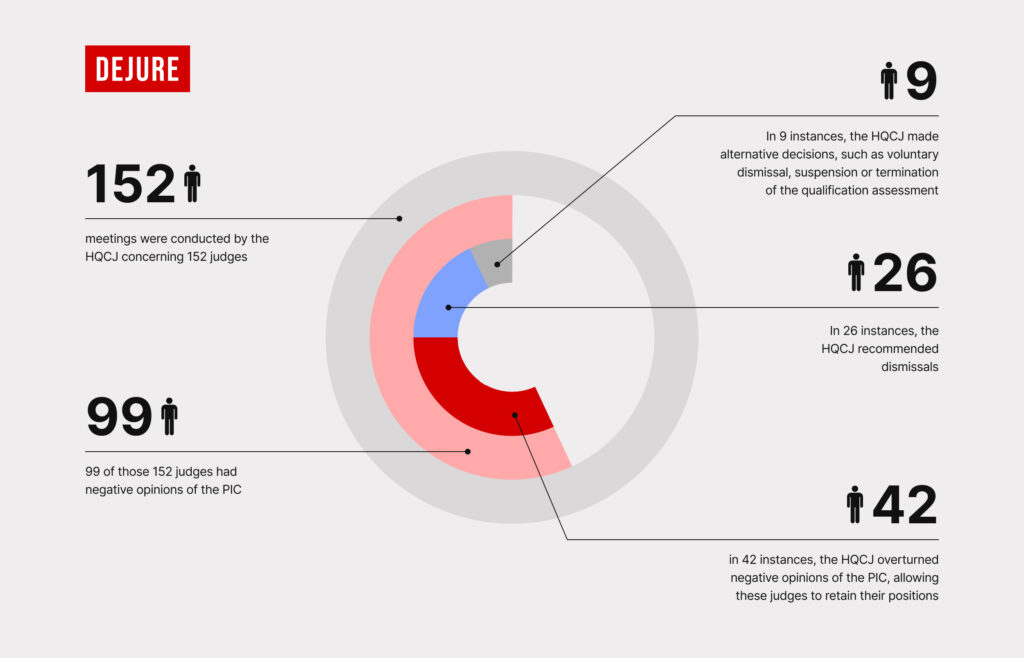
The HQCJ continues to keep in office judges who do not meet the established integrity criteria – the Commission considered 42 judges with negative opinions suitable for their positions despite the public’s concerns.
Thus, the trend of the HQCJ overturning the opinions of the PIC remains negative. In only 26 cases, the HQCJ recommended dismissals of judges by the High Council of Justice (HCJ), constituting 38% of the judges whom the PIC deemed to be of low integrity. Therefore, the HQCJ overturned 62% of the negative opinions of the PIC. Such a low percentage of dismissals is unacceptable, as every judge with a negative opinion who successfully passes the qualification assessment retains the position.
In 9 cases, judges either resigned voluntarily, or their qualification assessment was suspended or terminated.
The decision of the Grand Chamber of the Supreme Court negatively impacted the assessment process. It jeopardised the assessment by the full composition of the Commission of judges who had PIC’s negative opinion but the positive decision of a panel (3 members of the HQCJ) until 2024.
For instance, a “Maidan judge” Oleksandr Lutsenko from the Obolon District Court of Kyiv has been avoiding the qualification assessment for over 8 months, allegedly due to health reasons, and recently requested an honourable retirement. The last meeting was scheduled for August 5 but did not occur.
DEJURE Foundation expects that with the election of new leadership, the HQCJ will establish effective cooperation with the PIC, in particular, improving the process of granting access to judges’ dossiers for PIC members and optimising the hearing schedules.