Ukraine’s Rule of Law Reforms in Focus: Civil Society Presents Shadow Report in Brussels
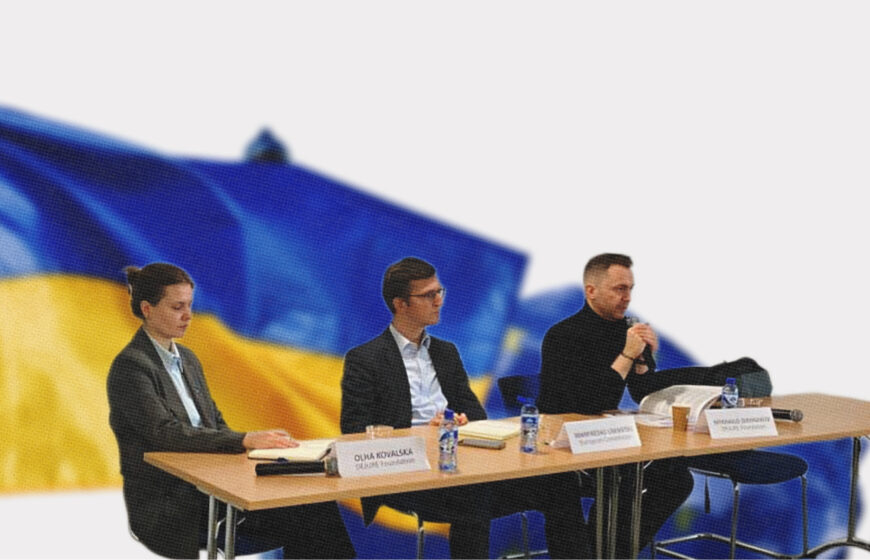
16 October 2025, Brussels.
As Russia’s full-scale invasion nears its fourth year and Ukraine’s EU accession talks remain politically stalled, the European Endowment for Democracy (EED) and the DEJURE Foundation co-hosted a discussion “Rule of Law in Ukraine: Between Russia’s War and Stalled EU Negotiations.”
The event brought together representatives of European institutions, EU member states, and think tanks, including leading Ukrainian experts and civil society representatives, to discuss the state of reforms in the judiciary, anti-corruption, and fundamental rights — key areas for Ukraine’s European integration.
During the event, Ukrainian civil society organisations presented their second independent Shadow Report on Chapters 23 and 24 of the EU accession negotiations, assessing progress in justice and fundamental rights. The report was prepared by the DEJURE Foundation, Anti-Corruption Action Centre, Automaidan, MEZHA Anti-Corruption Centre, Institute of Mass Information, Media Initiative for Human Rights, and independent expert Andrii Mikheiev.
In his remarks, Mykhailo Zhernakov, Executive Director of DEJURE Foundation, stressed that the EU must continue using reforms as a lever of positive influence on the Ukrainian government — a demand strongly supported by Ukrainian citizens themselves.
“According to survey, 73% of Ukrainians want the EU to keep pressing their government to advance reforms. Even as accession talks are blocked by Orban’s veto, the EU should make full use of existing tools — and find new ones — to sustain reform momentum. This is especially crucial amid the negative trends we’ve seen in 2025, culminating in the attacks on NABU and the public protests in July. Ukraine has already made significant progress in building independent anti-corruption institutions and cleaning up its judiciary. But sustaining this progress requires strong political will — both in Kyiv and in Brussels.”
Together with its partners, DEJURE and other NGOs have prepared a joint Shadow Report and shared its findings with the European Commission and other institutions to demonstrate how the situation has evolved over the past year and to highlight where EU engagement is most critical and urgently needed in the short term.
Read the full text of the second independent Shadow Report on Chapters 23 and 24 of the EU accession negotiations