(Un)cleansing the judiciary? The HQCJ continues to ignore the opinions of the Public Integrity Council
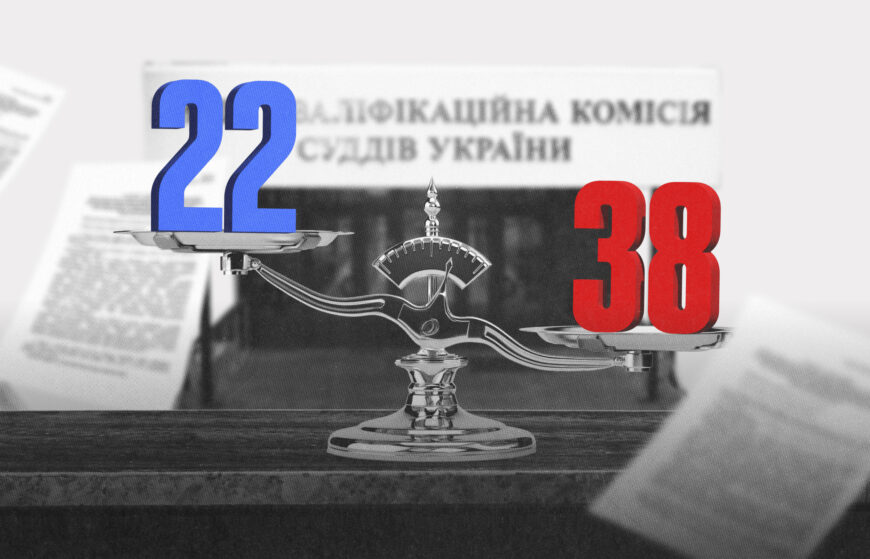
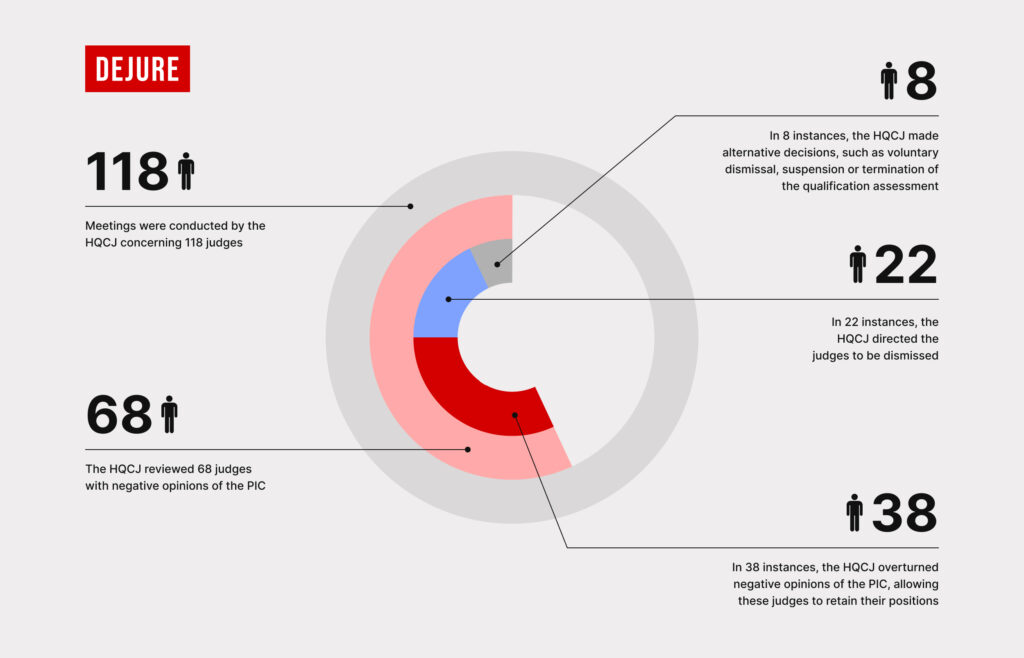
As the sixth month of judicial qualifications assessments progresses, the High Qualification Commission of Judges (HQCJ) has evaluated 118 judges. However, despite 68 of these judges receiving negative opinions of the Public Integrity Council (PIC), the HQCJ has often overturned these opinions:
- In 38 instances, the HQCJ overturned negative opinions of the PIC, allowing these judges to retain their positions.
- Only in 22 instances did the Commission recommend that judges be dismissed by the High Council of Justice (HCJ).
- In 8 instances, the HQCJ made alternative decisions, such as voluntary dismissal, suspension or termination of the qualification assessment.
Significant concerns arose on April 22 when the HQCJ endorsed Judges Khaydarova, Babiy, Zheliaskov, and Kravchenko, all of whom received negative opinions of the PIC. The reasons behind these approvals remain undisclosed.
Specific issues have been noted with certain judges. For example, Inna Khaidarova, a judge from the Kherson District Court, resided in Crimea in 2014-2015 during its temporary occupation and had discrepancies in her declarationsthe alleged non-declaration of the car, and the unclear source of funds for the purchase of property. Despite this, only one member of the HQCJ voted against her suitability.
In 2014-2015, the judge of the Kherson District Court of the Kherson Region, Inna Khaidarova, lived in the territory of the temporarily occupied Crimea. She also had inconsistencies in the declarations: the alleged non-declaration of the car, and the unclear source of funds for the purchase of property. Also, the judge did not mention in the declaration of integrity that she was brought to responsibility. Only 1 member of the HQCJ voted “against” recognising Khaidarova as suitable for her judicial position.
Similarly, reservations surround judge Serhiy Babiy of the Pavlohrad District Court of the Dnipropetrovsk region regarding his property declarations. Interestingly, because of the property issues, the Ethics Council earlier recognised judge Babiy as of low integrity. However, these concerns were not enough for the HQCJ, with only three members opposing his continued tenure.
Additionally, judges Oleh Zhelyaskov of the Ananyiv District Court of the Odesa Region and Tetiana Kravchenko of the Zvenyhorod District Court of the Cherkasy Region were both endorsed as high integrity despite property-related concerns.
A particularly controversial decision occurred during the last plenary session when оudge Pavlo Kovalenko of the Tokmak District Court of the Zaporizhia Region was approved despite allegedly hiding property through relatives. It remains to be seen how the HQCJ will address these serious allegations of integrity breaches in its official decision.
This pattern suggests that the new HQCJ members are repeating the oversight failures of their predecessors, undermining the principal goal of the reform to cleanse the judiciary. Instead, their actions aim at whitewashing the reputations of those ill-suited to uphold justice.
As the qualification assessment is expected to intensify in June, we call on the HQCJ to improve the quality of its work and prevent justice from being administered by judges who do not meet the criterion of integrity.