President Zelenskyi endangers his own election promises in the judiciary
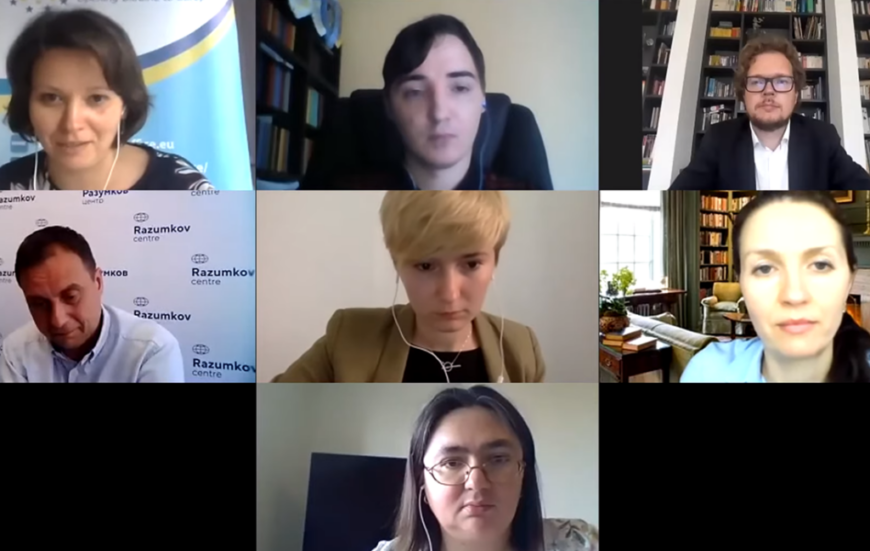
On 15 July 2020, the Ukrainian Think Tanks Liaison Office in Brussels in cooperation with the European Endowment for Democracy and with the support of the International Renaissance Foundation organized an online-webinar “Ukraine Today: From 1 year of Zelensky to Covid-19 to Upcoming Local Elections”.
Panelists and participants of the event discussed the achievements and failures of the first year of the new Ukrainian authorities; recent political developments within the country; the impact of Covid-19 on the social and economic development of Ukraine; the pace of judicial reform and upcoming local elections planned for October 2020.
Iryna Shyba, DEJURE Foundation Executive Director, participated in the event and shared the latest updates on judicial reform. We publish the key points of Iryna’s speech.
A year ago the President inherited a corrupt judiciary, which was entrusted by less than 8% of citizens. Zelenskiy, in his campaign, mentioned many times that Poroshenko failed the judicial reform. Members of his political party “Sluha Narodu” agreed that reform of the judiciary should be a priority.
However, there was a lack of a clear vision and a strategy on this matter. Therefore the number of NGOs, including DEJURE Foundation came up with the Agenda for Justice. That included reform of the High Qualification Commission of Judges (HQCJ) and the High Council of Justice (HCJ) with the participation of the international experts. The involvement of the international experts already proved to be an effective mechanism in the selection of the High Anti-Corruption Court judges and head of other Ukrainian anti-corruption institutions, as they managed to break the circles of judicial corporatism and self-preservation. The Agenda for Justice was supported both by the President and his party.
The draft law that included these ideas was one of the first ones introduced in the Parliament by Sluha Narodu last autumn, and shortly after adopted. Members of the HQCJ were immediately dismissed from the position, and two commissions with the international experts should have been established.
The HCJ members started to use all possible instruments to block the reform that threatened their positions. And they succeeded: commissions were never created.
To unblock the reform, last month the Office of the President submitted a new draft law, which provides for a new competition for the HQCJ. Although the participation of the international experts in the selection commission is envisaged, the HCJ can completely undermine their role or even appoint other experts nominated by the Ombudsperson. The HCJ will also determine the number of judges of the Supreme Court.
In short, more power for the HCJ, and no hint of its cleansing, as required by the IMF in the Memorandum, which was signed recently. According to the Memorandum, the HCJ should be reformed by the end of October in order Ukraine can get the second tranche of financial aid.
Civil society organizations strongly criticized the draft law. The G7 ambassadors expressed their position on the draft law in a diplomatic form – they will delegate their experts to the Selection Commission to the HQCJ if the real reform will be implemented.
The MP from the “Holos” party Yaroslav Yurchyshyn submitted an alternative draft law, which includes the recommendations developed by DEJURE Foundation, AntAC, CPLR, and Avtomaidan. This bill is a step forward in implementing the reform. It provides a mechanism for cleansing the HCJ and conducting integrity checks of all future HCJ members.
The Parliament did not consider this bill during the previous session. Verkhovna Rada will continue its work in September.
Read more on how Zelenskyi’s attempted to reform the judiciary, why the reform stalled, and what is the status quo for the rule of law reform after Zelenskyi’s first year.
Among the other participants of the event were: Martin H. Mühleck, Policy Officer of the European Commission; Viktor Zamiatin, the Director of Political and Legal Programmes at Razumkov Centre; Veronika Movchan, Academic Director of the Institute for Economic Research and Policy Consulting; Anton Avksentiev, Expert for Observatory of Democracy.
Olena Carbou, Executive Director of the Ukrainian Think Tanks Liaison Office in Brussels, moderated.
You can find other speakers’ keynotes and webinar records at the link.