“Should not usurp the role of the legislature,” – Venice Commission on the decision of the Constitutional Court on e-declaration
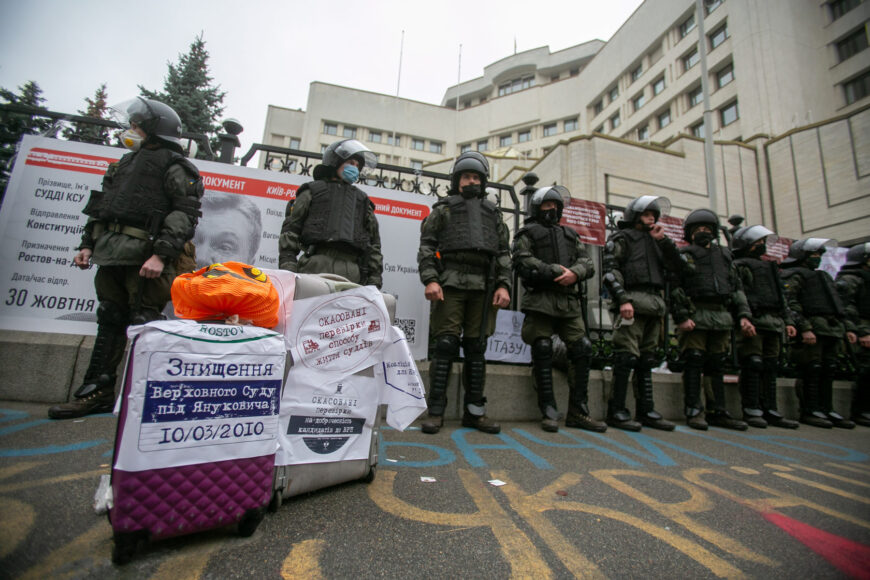
Today, the Venice Commission (VC) has published its conclusions on the consequences of the decision of the Constitutional Court (CC) on electronic declarations.
How did the Venice Commission evaluate the decision of the CC?
The Venice Commission acknowledged that the Constitutional Court’s decision on e-declarations lacked clear reasoning, had no firm basis in the international law and was probably tainted with a major procedural flaw – an unresolved question of a conflict of interest of some judges of CC.
In the Commission’s opinion, this decision not only had an immediate negative effect on the fight against corruption in Ukraine, but also undermined public trust in the constitutional justice process in general.
How does the Venice Commission propose to overcome the crisis?
The Commission noted that the role of the Constitutional Court, whatever its decision may be, must be respected and complied with. At the same time, the VC stressed that the Verkhovna Rada should implement the decision of the CC by interpreting it in light of the constitutional foundations of the country and applicable international standards and preserving public interests such as the fight against corruption, including in the judiciary.
According to the Venice Commission, “it is important to keep the duty of public officials (including judges of ordinary courts and of the Constitutional Court) to submit financial declarations“, to maintain the efficient mechanism of verifying such declarations and to establish appropriate sanctions for the intentional failure to submit or submission of false information.
The Venice Commission invited the Verkhovna Rada to consider the following solutions to the crisis:
- Restore criminal liability for the submission of knowingly false declaration or failure to submit one. At the same time, the parliament can specify in greater detail different sanctions corresponding to the different degrees of misconduct. For example, the sanction of imprisonment may be imposed for cases above a certain threshold and for perpetrators acting with deliberate intent;
- Restore the NAPC’s authority to verify electronic declarations (other than judicial ones), as it is unaffected by the reasoning used by the Constitutional Court in its judgment;
- With regard to the powers of the NACP vis-à-vis judges, the Commission proposed to introduce additional safeguards to protect them from potential abuses:
- to define more precisely and narrowly the investigative powers of the NACP, or to establish additional safeguards for their work;
- in order to protect judges from potential abuses by the NACP, the law may provide a supervision mechanism for overseeing the NACP’s actions against judges in the form of complaints or regular reporting by the NACP to an appropriate judicial body.
The VC recommends that the High Qualification Commission of Judges of Ukraine (HQCJ) should be appointed as such a body, as it already has the legal authority to verify declarations of integrity of judges in Ukraine. However, the Venice Commission stressed that “this solution is possible only once the HQCJ is re-established and only if it is composed of professional, honest and independent members“.
“Now the Venice Commission has recognized that the decision of the Constitutional Court is not properly substantiated and obviously adopted with a conflict of interest. And this is not surprising, since most judges of the Constitutional Court are politically dependent and appointed without any open selection procedure.
In addition to the recommendations of VC, the parliament must urgently introduce a transparent procedure for the selection of judges of the Constitutional Court. Only a body that meets the criteria of integrity can protect us from further crises. We look forward now to the next conclusion which will be about the Constitutional Court itself and shall be the coming in a few days,”
commented Stepan Berko, advocacy manager of the Foundation DEJURE