157 million for inaction. How judges of the liquidated District Administrative Court of Kyiv are still receiving payments from the state budget
Yaroslav Kuzyshyn, Anton Zelinskyi, and Karyna Hasymova for Ukrainska Pravda.
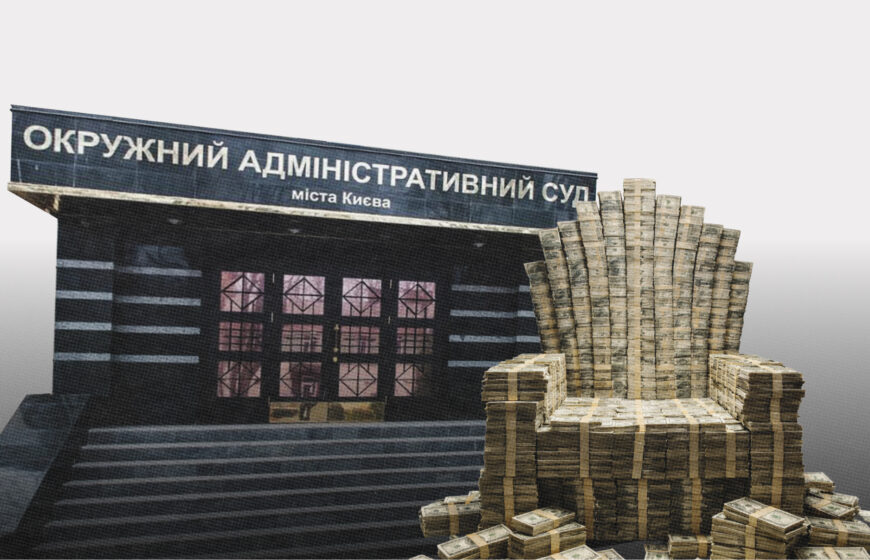
UAH 157 million — that is how much has been spent from Ukraine’s state budget over the past three years on judges of the District Administrative Court of Kyiv (DACK), which was liquidated three years ago.
At one time, this court was a symbol of corruption and mutual cover-ups. Through its rulings, its judges banned protest actions during the Revolution of Dignity, halted judges’ qualification assessments, overturned decommunization measures, massively reinstated unattested police officers, and even prepared a scenario for Viktor Yanukovych’s return to power during Russia’s full-scale invasion, among other actions.
After the National Anti-Corruption Bureau of Ukraine published the “Vovk’s tapes” from the office of DACK’s head, Pavlo Vovk, the country learned with what cynicism he and judges close to him decided the fate of the most important court cases and influenced key judicial institutions.
The final straw was when NABU detectives exposed Vovk’s own brother taking a USD 100,000 bribe intended for transfer to DACK judges. Only then did the President submit a draft law on the liquidation of DACK, which the Verkhovna Rada adopted on 13 December 2022.
At present, Vovk and several other judges of this court are defendants in a case concerning the creation of a criminal organisation aimed at taking control of key judicial governance bodies. Vovk himself was dismissed only in 2025, yet he has a serious chance of returning to office due to a Supreme Court decision. More than 40 other DACK judges still retain their judicial status and receive substantial remuneration. Some seek to escape into an “honourable retirement” with generous lifetime payments, others maintain their influence within the system, or wait for a convenient moment to return to adjudicating cases.
Criminal cases
The materials from the “Vovk’s tapes” formed the basis of at least two criminal proceedings that have reached the trial stage.
1) The key case (No. 991/2030/22), heard by the High Anti-Corruption Court, concerns attempts by a group of DACK judges to influence state decisions and judicial governance. Among the defendants are Pavlo Vovk, Yevhenii Ablov, and Ihor Pohribnichenko, whose names also appear in the second proceeding.
Prosecutors completed the investigation back in 2021, but the defence did everything possible to delay the case. For example, the accused DACK judges involved a visually impaired lawyer and demanded that 220 volumes of written case materials be translated into Braille. The court then limited the defence’s access to the materials until the summer of 2022, when NABU and the Specialised Anti-Corruption Prosecutor’s Office submitted the indictment to the High Anti-Corruption Court.
Thereafter, standard delaying tactics followed: recusals of judges, replacement of lawyers, systematic non-appearances at hearings, and a flood of various motions. At times, it became absurd — one hearing did not take place because a defence lawyer took his children to a water park. In 2025, there was “ping-pong” between instances: the defence maximally appealed procedural decisions, alternately overloading the Appeals Chamber of the High Anti-Corruption Court and the Supreme Court. The next hearing in this case is scheduled for 29 January 2026. At the current pace, there is a risk that first-instance proceedings will last up to three years, followed by appellate review — meaning the final outcome may be a long way off.
2) The second proceeding (No. 757/21651/24-k) concerns the blocking of the work of the High Qualification Commission of Judges and pressure on judicial bodies. It involves Pavlo Vovk, Yevhen Ablov, Ihor Pohribnichenko, as well as Ivan Shepitko, a judge of the Suvorov District Court of Odesa.
This case wandered for a long time among judges of the Pechersk District Court of Kyiv due to self-recusals. Only at the end of 2025 was it transferred to the Podilskyi District Court, where hearings finally began. At the same time, there is no real prospect of punishment here: the statute of limitations leaves the court no room to hold those responsible accountable.
Thus, even under the most optimistic scenario, decisions in the cases against Vovk and other DACK judges will only be seen in several years. Judges know better than anyone how to delay proceedings, so with current procedural possibilities, justice will not be restored soon.
Who has already been dismissed, and how to dismiss the others
A judge may be dismissed by the High Council of Justice following the outcome of two separate procedures: qualification assessment and disciplinary proceedings. These procedures are significantly faster and simpler than criminal proceedings, as they involve a lower standard of proof. They are also autonomous — they do not depend on whether there is a criminal conviction.
Since 2023, the HCJ has managed to definitively dismiss only three of nearly 50 DACK judges: Tetiana Sheiko, who failed the qualification assessment, and Pavlo Vovk and Alyona Mazur through disciplinary proceedings. Submissions for dismissal were also made regarding Yevhenii Ablov, Volodymyr Keleberda, and Kostiantyn Pashchenko. However, the HCJ cannot finalise disciplinary cases against them due to the lack of a quorum.
After the launch of the Service of the Disciplinary Inspectors in 2025, the HCJ opened a considerable number of disciplinary cases, but with the exception of proceedings against Keleberda, they have not progressed beyond the opening stage. Many cases have not even been opened — despite being priorities, such as four complaints against Ihor Pohribnichenko, one of Vovk’s closest associates. Such delays indicate that DACK judges retain their influence within the judiciary, and that HCJ members at least fear encroaching on their “immunity.”
Another dismissal mechanism is judges’ qualification assessment, which DACK judges massively sabotaged back in 2019 on Vovk’s instructions. They continue to evade testing to this day, often through the old scheme of going on sick leave. For instance, Ihor Kachur and Vitalii Amelokhin failed to appear for the exam twice in 2019, four times in 2024, and once again in 2025.
Over two and a half years of work by the renewed High Qualification Commission of Judges, only four DACK judges have been recommended for dismissal based on qualification assessment results: Tetiana Sheiko, Petro Kovzel, Liubov Marulina, and Maryna Boiaryntseva. For all except Sheiko, the HCJ has yet to issue a final decision. Thus, they still have a chance for honourable retirement and lifetime payments.
Another 18 DACK judges have completed all preliminary stages of qualification assessment required by law, and only the interview remains. Importantly, the HQCJ may conduct an interview without the judge if he or she systematically fails to appear. However, certain rapporteur members of the HQCJ do not even schedule interview dates, again suggesting the influence of DACK judges or fear of them.
Especially puzzling are delays regarding judges Sanin and Ohurtsov, who, together with Vovk, are defendants in a criminal case. Or the case of Oleksandr Karmazin — in 2025 he already failed a competition for appellate courts, information about him has been reviewed by the Public Integrity Council, yet the HQCJ is in no hurry to assess his fitness for the position he holds.
A possible DACK comeback through the Supreme Court
Even the modest achievements of the High Council of Justice and the High Qualification Commission of Judges may be nullified by the Supreme Court. In 2025, the Grand Chamber of the Supreme Court took up a series of cases that could restore robes to the most notorious judges, including former DACK head Pavlo Vovk, whose case is currently under consideration (the next hearing is scheduled for 29 January 2026).
Vovk is challenging his dismissal, arguing that materials from covert investigative actions may allegedly be used only within criminal proceedings, and that the HCJ had no right to assess them. The established Supreme Court practice is that such materials may be used.
However, the Supreme Court may change its position in Vovk’s interest. If the court sides with him, it will send a signal: even after a court’s liquidation and dismissal for obvious violations, one can return through influence in the Supreme Court.
The consequences would be catastrophic: dozens of disciplinary decisions where materials from criminal proceedings were used would come under threat. Defence lawyers for corrupt judges would only need to say: “The High Council of Justice relied on improper evidence, and therefore, the dismissal is unlawful.”
This would open the door for the return of judicial robes not only to Vovk, but also to dozens of other judges of low integrity. Vovk’s associates who appeared on the tapes would also avoid dismissal. As a result, the efforts of the renewed HCJ and HQCJ to cleanse the judiciary would be nullified by the Supreme Court.
The use of materials from criminal proceedings in disciplinary cases against judges is a common practice in EU member states.
New administrative courts instead of DACK: a chance that must not be wasted
Whether the story of “Vovk-style justice” will finally be closed depends not on time, but on concrete decisions — or their absence. The judiciary now faces a new challenge: instead of the scandal-ridden DACK, the Specialised District Administrative Court and the Specialised Administrative Court of Appeal are to begin operating. These higher specialised courts will consider disputes involving the most influential state bodies: the Cabinet of Ministers, ministries, the National Bank, as well as decisions of commissions selecting the heads of NABU, SAPO, NACP, and others.
The creation of these two administrative courts is not an act of goodwill by the authorities, but a strict requirement of the IMF and the European Union, set in the Ukraine Facility. Without this, Ukraine will not fulfil part of its European integration commitments and will not receive funding. By the end of 2026, both courts must be fully operational.
Currently, the High Qualification Commission of Judges has announced a competition for 27 positions in these two courts. 268 candidates have applied. Selection will be conducted by the HQCJ and an Expert Council consisting of three Ukrainian experts and three international experts, with a casting vote. This body, with the participation of international experts, must select only judges of integrity and independence and prevent the creation of a “hand-controlled” court like DACK.
***
After DACK’s liquidation, its judges have not disappeared from the system, retaining all privileges and regularly receiving substantial judicial remuneration from the state budget — funds that could instead have been spent on tens of thousands of strike FPV drones or thousands of interceptors that save Ukrainian cities from Russian UAVs every day. Those primarily responsible are the High Council of Justice and the High Qualification Commission of Judges.
If the HCJ and HQCJ continue to ignore qualification assessments and disciplinary complaints against these judges, the situation will only worsen. DACK judges will calmly wait until they acquire the required length of service, then retire honourably with lifetime payments — at taxpayers’ expense and without any real accountability.
An additional threat comes from the Supreme Court, which, through its decisions, may roll back even these fragile attempts at cleansing the system, restoring robes to already dismissed judges and preventing the dismissal of the remaining figures from the “Vovk’s tapes.”
For three consecutive years, the European Commission has emphasised the need to reform the Supreme Court, to be carried out with the involvement of independent experts nominated by international partners.
The renewal of the Supreme Court is among the ten priority reforms within the EU accession process. However, there has been no progress in this direction to date.
The story of DACK is not over. It continues in payroll statements, in blocked disciplinary cases, in courts of various instances, and in the chance for a new, fair court to replace it. Only sustained public attention and a principled stance by Supreme Court judges and members of the HCJ and HQCJ can prevent this story from ending in a revanchist comeback.