50+ Ukrainian civil society organisations appeal: Strong EU Conditionality for Reinforcing Ukraine’s Resilience and Defence
Kyiv, February 10, 2026
We, representatives of Ukrainian civil society organisations advocating for the rule of law, democracy, and transparency, are sincerely grateful to the European Commission for its unceasing leadership in supporting Ukraine amidst Russia’s brutal full-scale war.
We particularlywelcome the Commission’s decision to propose a €90 billion Ukraine Support Loan for 2026–2027, fast-tracked by the European Parliament. We also stress the high importance of the Ukraine-EU ten-point priority reform agenda for 2026. At a moment of extreme pressure for Ukrainian society and institutions, these decisions reaffirm the EU’s long-term commitment to Ukraine’s survival and democratic European future.
This support comes as Ukraine endures its most severe winter since 2022. Russian forces are deliberately targeting infrastructure, leaving millions of Ukrainians without electricity, water, or heating in sub-zero temperatures. These heinous attacks reveal Russia’s real intent, unchanged since 2022 — to suppress and destroy our resistance and inflict insurmountable living conditions on Ukrainian society. In this context, European financial assistance is literally life-sustaining.
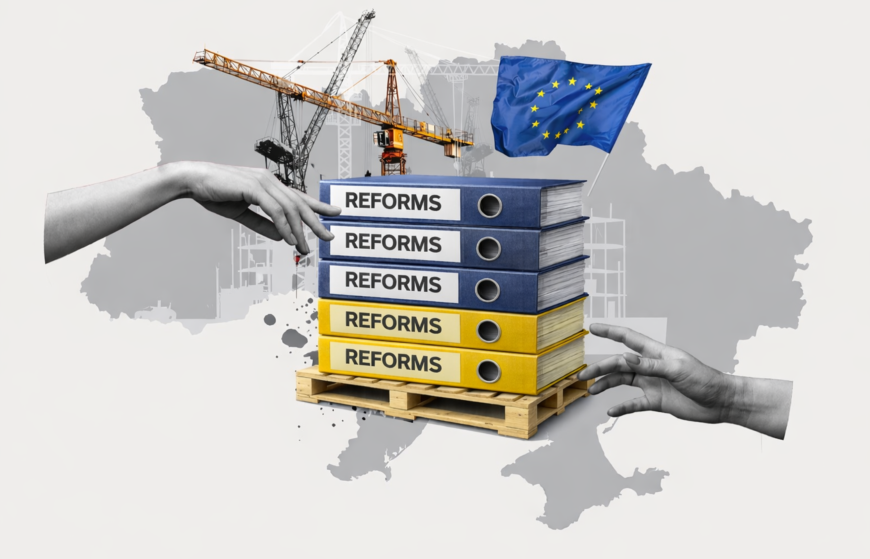
Yet Russia’s strategy also relies on weak governance: whenever institutions are undermined, scarce wartime resources are spent less effectively and public trust erodes. As the stakes are so high, the effectiveness of the Ukraine Support Loan’s budgetary part depends on its firm linkage to meaningful rule-of-law reforms. We therefore call on the European Commission and EU Member States to set the ten reform priorities as a basis for the €30 billion budget assistance package. Channelled through the Ukraine Facility framework, which has previously proven its efficiency, financial support and reform commitments within the EU integration track, will mutually reinforce one another.
Strengthening this framework with more robust monitoring mechanisms will help ensure that conditions are met duly, fully, and on schedule, reinforcing predictability for both Ukraine and its partners.
Ukraine’s experience leaves little room for ambiguity: clear and enforceable EU conditionality delivers results. Today, these lessons are especially urgent. Wartime governance and prolonged martial law, while necessary for defence, carry systemic risks, such as weakened institutional checks and balances. The July 2025 crisis and the recent top-corruption scandal in the energy sector reiterated that only strong independent institutions can effectively address internal governance challenges, which are essential for Ukraine’s resilience in the face of Russia’s genocidal war. Ukraine’s fulfilment of the ten-point reform plan can thus help bring us closer to EU accession while also restoring international partners’ trust after the crisis.
Importantly, Ukrainians’ appetite for reform remains steady and strong — recent public-opinion data show that two out of three Ukrainians welcome robust EU support for rule-of-law reforms in Ukraine. Channelling this popular demand and trust towards the EU into tangible, time-bound progress will both deepen governance reforms and advance Ukraine’s EU integration without overburdening the reform agenda.
We therefore call on the European Commission to ensure that budget support for Ukraine in 2026–2027 is linked to concrete and measurable benchmarks from the ten-point priority plan, including:
- safeguarding the independence and operational capacity of anti-corruption institutions (NABU, SAPO, High Anti-Corruption Court);
- decisive participation of independent international experts in selections for key rule-of-law bodies, including in the selection commission for the High Qualification Commission of Judges;
- genuine judicial renewal through transparent vetting and merit-based appointments, including to the Supreme Court;
- reform of the Prosecutor’s General appointment and dismissal procedures, as well as an overhaul of the State Bureau of Investigation to prevent political influence;
- and zero tolerance for pressure on civil society, journalists, reformers, and whistle-blowers.
By firmly linking macro-financial assistance to the 2026 reform priorities, the European Union can ensure that its support helps Ukraine not only survive the war but also emerge from it stronger and closer to the EU.
Signed by (open for signatures):
- DEJURE Foundation.
- Anti-Corruption Action Centre.
- Centre for Economic Strategy
- MEZHA Anti-corruption Center
- All-Ukrainian Association Automaidan
- Human Rights Protection Group “SICH”, civic organization
- CHESNO Movement
- Bihus.Info
- StateWatch Think Tank
- Euromaidan Press
- NGO GEN Ukraine
- Institute of Legislative Ideas
- Campaign for Ukraine
- Anti-Corruption Headquarters
- Civil Control Platform
- Centre for Policy and Legal Reform
- ANTS Network
- National Transport Business League
- NGO “HeroU”
- Future Development Agency
- Steps of future
- Ukrainian Capital Markets Association
- NGO “Rivne Social Partnership Center”
- NGO “Nezalezni”
- Zero Waste Lviv, NGO
- ГО “Український світ”
- NGO UkraineNow.org
- Center for reforms and local development, NGO
- NGO “Fishermen Club of Ukraine”
- Charity organisation “International Development Foundation “
- NGO Ukrainian LGBT Military for equal rights
- Open Dialogue Foundation
- Civic organization “Dobrochyn Centre”
- NGO “Chernihiv Centre for Human Rights”
- NGO “PROACTIVE COMMUNITY”
- HIGHER NGO
- “Detector Media”, NGO
- NGO Center “Women’s Perspectives”
- DiXi Group NGO
- “Center of Psychological Help “Confidence”
- The New Country Civic Platform
- NGO “Crimean Tatar Resource Center”
- NGO “RDA of Seversky region”
- Institute of Mass Information
- All-Ukrainian Charitable Organization “Ukrainian Legal Aid Foundation”
- NGO “European Democracy Youth Network Ukraine” (EDYN Ukraine)
- Charitable Organization “100 PERCENT LIFE”
- NGO “Center of Social Transformations”
- Independent Anti-Corruption Commission – NAKO
- Charitable organisation “Patients of Ukraine”
- Anti-Corruption Research and Education Centre (ACREC)
- Dialogue, Mediation and Alternative Dispute Resolution Institute, NGO