A judge who sabotaged qualification assessment on Vovk’s orders – will the Supreme Court overturn her dismissal?
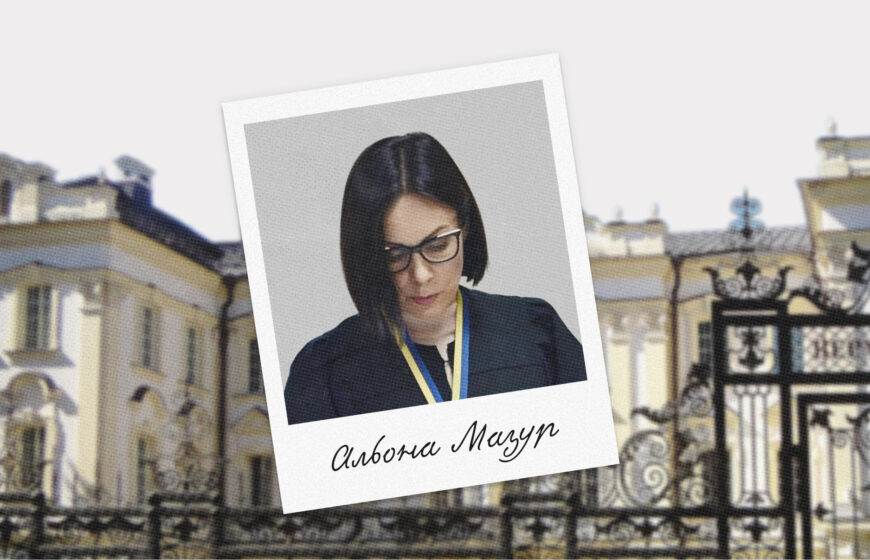
On October 9, the Grand Chamber of the Supreme Court will consider a case challenging the High Council of Justice’s (HCJ) decision to hold judge Aliona Mazur of the now-liquidated District Administrative Court of Kyiv (DACK) disciplinarily liable. The hearing will take place in written proceedings.
Why is this important?
- The First Disciplinary Chamber of the HCJ established that in 2019, judge Mazur, together with other DACK judges, sabotaged the qualification assessment by “falling ill” on the instructions of the court’s head, Pavlo Vovk. She also failed to report Vovk’s interference in her work to the HCJ or the Prosecutor General.
- The new HCJ has so far dismissed only three DACK judges, while cases against others have dragged on for years. This Thursday, the Grand Chamber of the Supreme Court may pave the way for the reinstatement of two of the three dismissed judges. If that happens, what “achievements of judicial reform” can be spoken of, when DACK judges continue to evade accountability and return to their robes with impunity?
- The cancellation of the HCJ’s decision to hold Mazur disciplinarily liable (dismissal) and her potential reinstatement would be the clearest evidence that the Supreme Court acts in the interests of low-integrity judges — and therefore itself requires reform.
What is known about Aliona Mazur?
A service apartment without need
In 2016, the judge received a two-room service apartment in an elite new building in Pechersk, even though she already owned property in Kyiv. Shortly before that, her father purchased another large apartment, 118 m² in size. Despite this, Mazur justified the need for official housing by claiming she lived with her mother — although, as the Public Integrity Council (PIC) discovered, her mother actually lived in the Vinnytsia region. Three months after receiving the apartment, the judge filed a lawsuit to remove it from the list of service housing — and won the case.
Questionable wealth
According to Mazur’s declarations, she lived in an apartment purchased by her retired father for over one million UAH, who also bought a parking space for 330,000 UAH. Meanwhile, his official income over two years (2015–2016) did not exceed 100,000 UAH.
Rulings that raise questions
-
The Surkis family and PrivatBank case.
In 2017, Mazur, as part of a panel of judges, ruled in favour of the Surkis family and ordered PrivatBank to pay them over 1 billion UAH. The full text of the ruling was classified, despite the law providing no such option. In 2020, the Grand Chamber of the Supreme Court overturned this decision as unlawful.
-
Overturning PIC conclusions.
Mazur annulled PIC’s conclusions, finding judges to be of low integrity, even though such conclusions are not subject to judicial review. She changed her position only after the President submitted a draft law to liquidate DACK.
-
Withholding information.
In 2021, Mazur rejected a lawsuit filed by journalists seeking access to information about the closure of a drunk driving case involving the husband of the head of the Darnytskyi court staff — thereby helping to conceal potential misconduct.
-
Supporting “Vovk’s schemes.”
Mazur handled a case related to the unlawful dismissal of HQCJ member Stanislav Shchotka — an episode featured in the NABU “Vovk tapes.” She sided with Vovk, but her decision was later overturned as unlawful.
-
Legalising reappointments to the HCJ.
In 2019, she ruled that lawyers Pavlo Hrechkovskyi and Oleksii Malovatskyi, who had been appointed to the HCJ for a second consecutive term, had not violated the Constitution. Afterwards, Hrechkovskyi repeatedly reviewed disciplinary complaints against Mazur herself and refused to open proceedings.
-
Sabotaging the qualification assessment.
In 2019, Mazur was among the judges who twice failed to appear for the qualification exam, citing “temporary incapacity.” According to NABU tapes, this was coordinated with Vovk to derail the assessment process.
-
Mutual cover-up.
In 2020, the DACK staff released a statement defending judges under NABU investigation, claiming “foreign control over the courts.” Mazur did not deny her participation in this statement, which the PIC regarded as a manifestation of corporatism and contempt for integrity principles.
The decision of the Grand Chamber of the Supreme Court in Mazur’s case will be yet another test of whether the Court is prepared to support the cleansing of the judiciary, or once again cover up low-integrity judges.