Another manipulation by the Vlasenko-Buzhanskyi Temporary Investigative Commission aimed at undermining the work of the Public Integrity Council
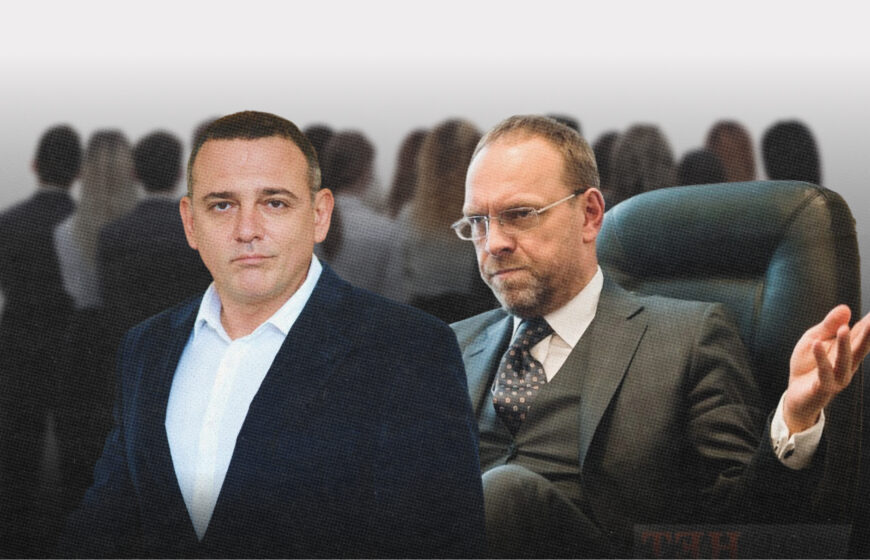
The Vlasenko-Buzhanskyi Temporary Investigative Commission is once again using its powers to pressure independent institutions and civil society. The DEJURE Foundation received an invitation for its Executive Director to attend the Commission’s meeting on 24 November. We officially informed the Commission that Mykhailo Zhernakov would be lecturing at the Poltava Law Institute of Yaroslav Mudryi National Law University at that time. The letter included his teaching schedule and ticket, standard proof of work-related obligations.
Nevertheless, members of the Commission ignored this letter and conducted the meeting as if they had received nothing. During the session, MPs revealed their real intentions: to initiate a criminal case allegedly regarding the falsification of the Public Integrity Council’s elections. To do this, they “need to interrogate Zhernakov.”
The group of MPs (Vlasenko, Buzhanskyi, and Mamka) who assembled into this Temporary Investigative Commission of the Verkhovna Rada and decided they would “investigate corruption” in courts and law enforcement bodies, have been “hunting” civil society and using all available resources for this purpose. They show no interest in corruption in the Pechersk or Supreme Courts, nor in the fact that their own member, Hryhoriy Mamka, appears in a NABU investigation known informally as the “Mindich tapes.” At the same time, Serhii Vlasenko is a well-known anti-reformer, and Maksym Buzhanskyi promotes Russian narratives, especially regarding language.
This Commission targets independent anti-corruption bodies, the High Qualification Commission of Judges, and the Public Integrity Council. The latter two institutions do not fall under the Commission’s mandate at all. Officially, it was created “to investigate abuses in law enforcement bodies and courts,” as stated in the resolution establishing it. In reality, however, several MPs with questionable reputations have decided they are all-powerful. The moral and ethical aspects of the Commission members’ behaviour have been recorded on video — a separate episode on our YouTube channel is dedicated to this.
On 18 November, the Vlasenko-Buzhanskyi Commission decided to use the police to pressure and forcibly bring Mykhailo Zhernakov to its meeting. Crucially, this was done without any official notice of the meeting or any formal invitation. The only source of information was a Telegram post by lawyer Rostyslav Kravets, who appears in a “Schemes” investigation into lawyers receiving funding from Russia.
After this, the DEJURE Foundation again came under an information attack by anonymous Telegram channels and several media outlets willing to participate in smear campaigns against civil society. We emphasise that the organisation did not receive any requests or inquiries for comments, and all manipulative content is being spread as if copied from a single template.
We call on Members of Parliament not to mislead society and the police, and urge Ukrainians to evaluate information widely disseminated by unreliable sources critically.