“I will soon become a multi-millionaire”: how former Supreme Court Chief Justice Knyazev profited from selling court decisions
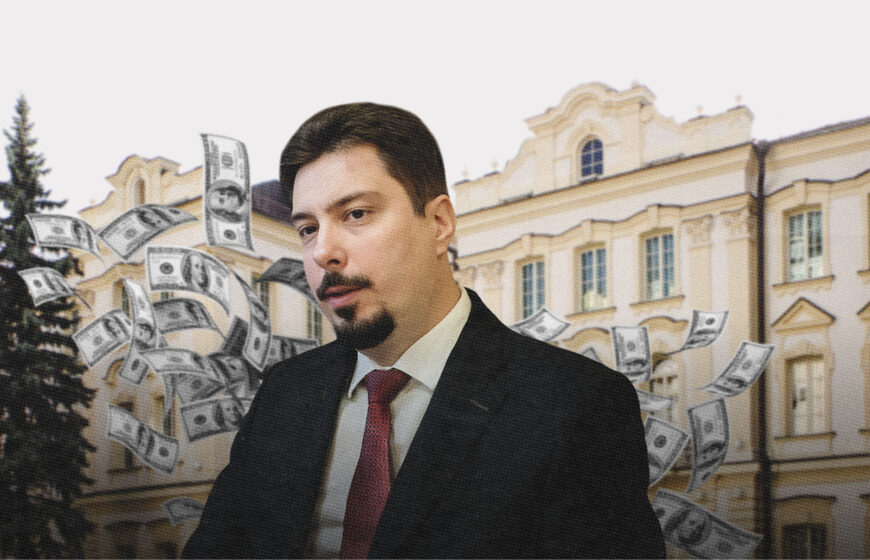
Oleksii Honchar, known as the “cashier” of former Supreme Court Chief Justice Vsevolod Knyazev, in an interview with Bihus.info, revealed details about corruption schemes in Ukraine’s highest judicial body. According to him, Knyazev did not shy away from “side earnings” early in his career, but the real multi-million inflows began after his election to the Supreme Court. At that time, Knyazev openly declared that he would “soon become a multi-millionaire” and offered Honchar to continue helping him find clients.
Selling decisions: from Russian business to Kliuiev
- One of the most high-profile cases was that of a Russian oligarch regarding the Illichivsk port. Honchar claims that although Russian investors lost in all other courts, Knyazev transferred the case to the Grand Chamber and secured a ruling in favour of the Russians. According to Honchar, when Knyazev was asked about this case at a public event, he replied that he was “very proud of such a ruling, as it proved the rule of law exists in Ukraine.”
-
Another striking episode involves the estate of Andriy Kliuiev, the former Secretary of the National Security and Defence Council under Yanukovych, who was allocated 20 hectares of land in Koncha-Zaspa. According to Honchar, for $400,000, Knyazev guaranteed Kliuiev’s representative the required outcome. To achieve this, he ensured that judges who could vote “the wrong way” were absent from the Grand Chamber hearing, sending some on business trips, others on leave. As a result, the land remained with Kliuiev.
-
Another case concerned Donbasenergo. The company supplied electricity to railway stations in the temporarily occupied territories and billed Ukrainian Railways for about 74 million UAH. They needed at least half of the Grand Chamber judges (a total of 21) to support their claim. Knyazev helped “persuade” another seven judges, with the price of one vote being $20,000–25,000. While it may have seemed unprofitable for the claimant to pay so much just to recover the debt, what really mattered was creating a precedent: Donbasenergo had other lawsuits worth 300–400 million UAH in total. With such a precedent, further rulings in the company’s favour would “automatically follow.”
Knyazev also “complained” that some of his colleagues were principled and resisted pressure, forcing him to “neutralise” their presence in critical cases.
One of the record bribes in Ukrainian justice
In 2023, Knyazev was caught taking a bribe of nearly $3 million. According to investigators, the money had been packed into black bags in cash, presumably to be distributed among judges of the Grand Chamber. Yet to this day, none of the judges who might have received part of this record sum have been formally charged, even though marked bills were found in the homes of two of them during searches.
The story of Knyazev is only the tip of the iceberg. The Supreme Court continues to undermine the achievements of judicial reform. Judges issue rulings that shield low-integrity colleagues from dismissal, derail qualification assessments, and block changes. From the very beginning, during the formation of the Supreme Court, civil society raised concerns about the integrity of half of the judges who entered the body. Subsequent scandals at the Supreme Court only confirmed these issues. Unsurprisingly, 69% of Ukrainians do not trust this institution. We wrote more about this here.
The European Commission has repeatedly emphasised that cleansing the Supreme Court and appointing new judges to vacant positions with the involvement of international experts must become a key stage of judicial reform. Without this, corruption in Ukraine’s highest judicial body cannot be overcome.