More than 51% of Supreme Court judges raise integrity concerns

As of 2025, over 51% of the current judges of the Supreme Court may be of low integrity, according to negative opinions and information from the Public Integrity Council (PIC).
Experts from DEJURE Foundation analysed available data on 153 sitting Supreme Court judges. Among them, 34 have received negative opinions of the PIC, while concerning another 44, information exists suggesting potential low integrity. Such information includes journalist reports on a candidate’s connections, issues with asset declarations, or questionable court rulings. In some cases, PIC members were unable to verify these concerns using available tools and forwarded them to the High Qualification Commission of Judges (HQCJ) for further review.
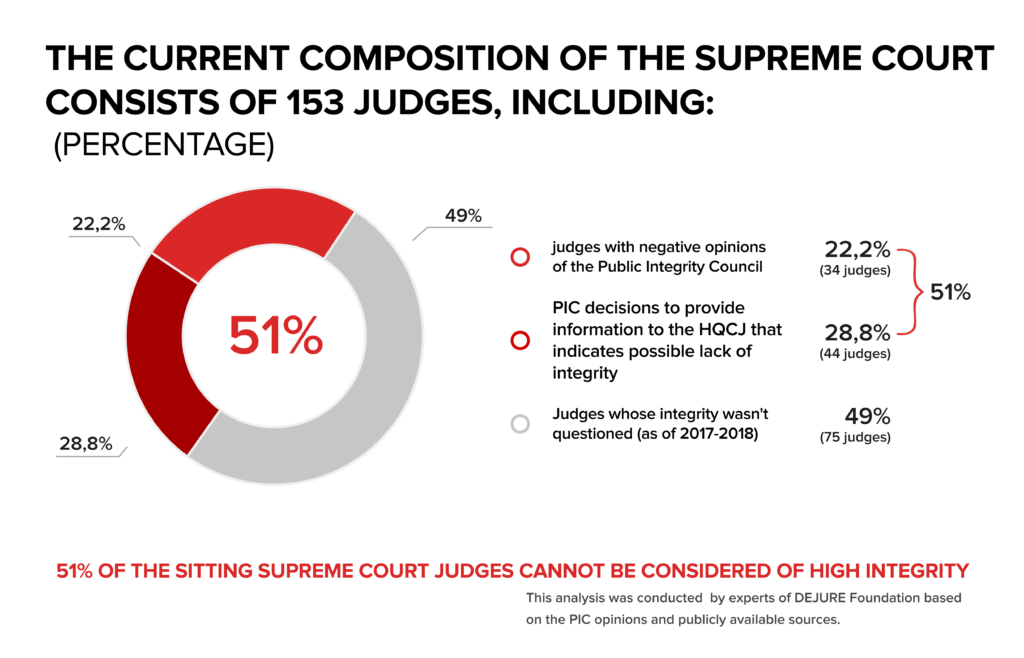
The PIC assessed the integrity of Supreme Court judges between 2017 and 2019. At that time, around 25% of candidates received negative opinions, while nearly half were flagged with information raising doubts about their ethical suitability for the position.
This means that from the outset, the Supreme Court included a number of judges with integrity reservations, some of whom even held Russian passports.
Even if a judge received no negative opinion or information at the time of their appointment, this did not guarantee a lack of future problems. A striking example is Supreme Court judge Serhii Zhukov, whom journalists exposed for owning an undeclared estate with lakes and vineyards worth $1 million.
Instead of upholding the rule of law and delivering justice, the highest court in the country has been plagued by corruption scandals, obstruction of judicial reform, and a culture of mutual cover-ups among Supreme Court judges and judges from other courts.
The actual number of judges with integrity concerns is likely much higher. This confirms that the 2017–2018 reform failed, making an urgent cleansing of the Supreme Court necessary. Without a decent Supreme Court, Ukraine’s future, judicial reform, and European integration are at risk. Find out how to solve this problem here.