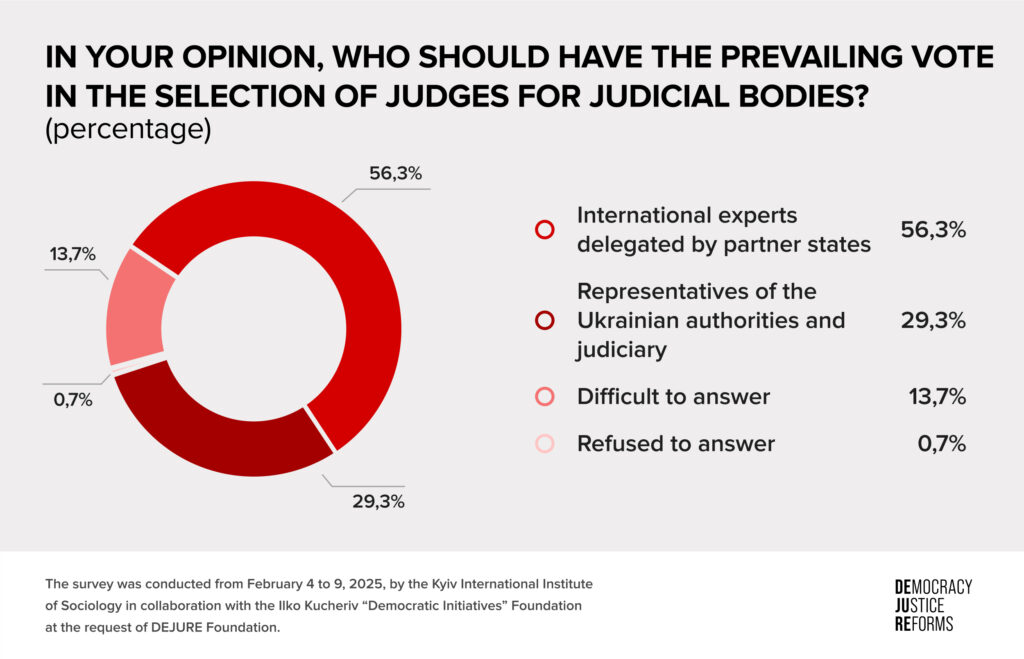
More than 56% of Ukrainians believe that international experts should have a casting vote in the selection of judges and judicial bodies

More than half of Ukrainians believe that nternational experts delegated by partner states should have a casting vote in the selection of judges and judicial bodies. These findings are based on a nationwide survey conducted from February 4 to 9, 2025, by the Kyiv International Institute of Sociology in collaboration with the Ilko Kucheriv “Democratic Initiatives” Foundation at the request of DEJURE Foundation.
At the same time, nearly one-third of citizens believe that this casting vote should belong to representatives of the Ukrainian authorities and the judiciary.
A total of 1,034 telephone interviews were conducted, with a statistical margin of error not exceeding 4.1%. The survey targeted Ukrainian citizens aged 18 and older residing in government-controlled territories at the time of the survey. Residents of temporarily occupied territories were excluded from the sample, and the survey did not include Ukrainians who had left the country after February 24, 2022.
This is not the first time that more than half of Ukrainian society supports prevailing voting of international experts in the selection of judges and judicial bodies. In particular, ahead of the Constitutional Court competition under the updated procedure in March 2023, more than 51% of Ukrainians believed that independent international experts should have the preferential voting right in the selection of Constitutional Court judges.
The participation of international experts in the selection of judges and judicial bodies. has already shown effective results. For instance, the Public Council of International Experts (PCIE) was crucial in advancing judicial reform. During the formation of the High Anti-Corruption Court, the PCIE ensured that almost no candidates with integrity reservations were appointed.
The right of international experts to have a casting (prevailing) vote in selection commissions for judicial bodies has become the “gold standard” today. It guarantees truly independent competition and increases public trust in the system. Furthermore, the continued establishment of courts with the meaningful involvement of international experts in the judge selection process is among Ukraine’s commitments to the EU and other international partners.
However, the Ukrainian government also seems to oppose the participation of international experts in these processes. For example, in early December 2024, Deputy Prime Minister for European Integration and Minister of Justice Olha Stefanishyna announced that Ukraine would abandon this practice as part of its European integration efforts.
At the same time, controversial MPs from Batkivshchyna and Opposition Platform – For Life are attempting to strip international experts of their voting rights in selection commissions for state bodies. On December 20, they submitted a request to the Constitutional Court to examine the constitutionality of international experts’ participation in the formation of state bodies. They aim to challenge several provisions that establish commissions and supervisory boards with the involvement of international experts. This includes the Laws of Ukraine “On the Constitutional Court of Ukraine,” “On the High Council of Justice,” “On the High Anti-Corruption Court,” “On the Prevention of Corruption,” and many others.