Not cosmetic changes: roundtable on legal education reform highlights urgent need for structural overhaul
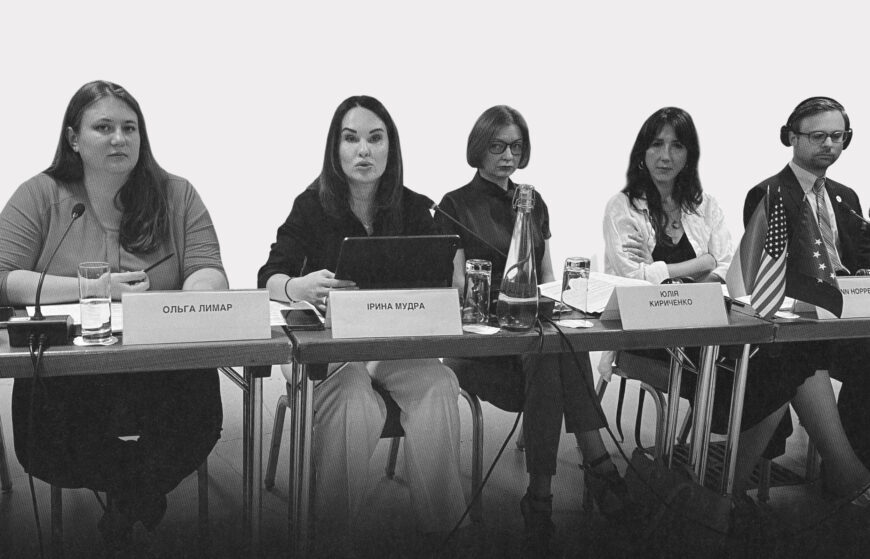
On August 30, the Reanimation Package of Reforms Coalition (RPR), in partnership with DEJURE Foundation, organised a roundtable, “Legal education reform: delineation of legal education and law enforcement training”. The event focused on the findings of a report with the same title.
Experts in legal education, representatives of the government, international partners, the academic community, and the public sector participated in the roundtable. The main topic was the implementation of the European Union (EU) and G7 ambassadors’ requirement for the institutional delineation of legal education and law enforcement training: lawyers should be educated exclusively in civil universities under the Ministry of Education and Science, while law enforcement officers should be trained by institutions subordinate to these agencies. Unlike Ukraine, no EU member states train lawyers in police academies.
The report was prepared based on the results of three expert discussions involving 58 experts. It outlines the main experts’ points, specifically the stages, actions, resources, and compensatory mechanisms necessary for implementing institutional delineation. Notably, most experts expressed that the delineation has to begin promptly. In contrast, the Ministry of Internal Affairs (MIA) representatives argued that the issue should be addressed in the post-war period.
The majority of the roundtable participants support the institutional delineation of legal education and law enforcement training. “We do not need cosmetic repairs, but radical reforms in legal education” was the opinion repeatedly heard during the discussion. Serhiy Holovatyi, a former Constitutional Court judge, indicated that legal education reform has been a topic of consideration for many years but has yielded no results. Mykhailo Vynnytskyi, Deputy Minister of Education and Science, also highlighted excessively slow changes and the evolutionary transformation in this area. According to Mr Vynnytskyi, “It is obvious that the next step is the institutional separation of law and law enforcement training. We must find a balance between these two specialities, understanding that they are fundamentally different.”
Iryna Mudra, Deputy Head of the President’s Office, noted that legal education reform is one of the priorities for the President’s Office and for her personally. She added that we have to develop a roadmap for the reform, where the delineation is one of the actions, but certainly not an end. Ms. Mudra also mentioned that it is advisable to conduct an audit of positions in government bodies that require a legal education. As a result, the legal education requirement should be eliminated for positions that do not belong to the legal profession and whose professional duties do not require specialised legal knowledge. The requirement for legal education should be eliminated for positions that are not reasonably classified as legal professions and whose professional duties do not require specialised legal knowledge.
Viktor Dubovyk, Head of the Legal Policy Directorate at the President’s Office, stated that they are working to ensure the institutional delineation is enshrined in the President’s decree on the Strategy for the Development of the Judiciary for 2024-2029.
Who is against the delineation?
Despite numerous attempts by the roundtable’s organisers to engage the MIA in the discussion, the Ministry ignored the event.
The MIA is known as the main opponent of institutional delineation. Read our study for more details on the state of legal education in institutions with specific training conditions subordinate to the MIA.