Supreme Court Against Transparency: A New Harmful Ruling
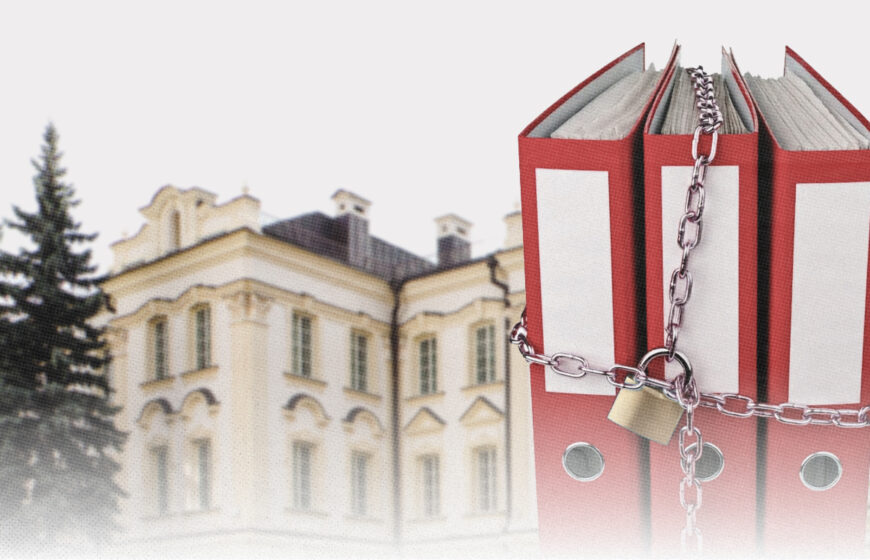
The Cassation Administrative Court (acting as a court of first instance) has ruled that information from judges’ and judicial candidates’ family ties and integrity declarations is confidential and allowed authorities to stop updating the relevant open data set. This decision was made in case No. 990/406/24. What is the case about, and why is the ruling harmful?
Marta Bereza, an expert of the DEJURE Foundation, filed a lawsuit against the High Qualification Commission of Judges (HQCJ) for failing to update the open data set “Register of Declarations of Family Ties and Integrity” for 2023–2024. This dataset must be published in accordance with the Law “On Access to Public Information” and Cabinet of Ministers Resolution No. 835 of October 21, 2015.
However, since the beginning of Russia’s full-scale invasion, the HQCJ has stopped updating this data set, citing security risks. Yet it has no legal grounds to do so, as the legislation requiring regular updates has not changed. Moreover, the Commission’s security concerns appear artificial, given that declarations submitted before 2022 remain publicly available, and some declarations from 2023 and 2024 can be found on other unofficial public resources. Additionally, the website of the National Agency on Corruption Prevention (NACP) still provides access to judges’ asset declarations, which may also contain partial information about their family members.
Despite this, the Cassation Administrative Court sided with the HQCJ and issued a ruling extremely harmful to the sphere of public access to information. The panel of judges decided that even if information is defined by law as public, it may be temporarily restricted if it contains confidential data (such as personal information) — and if such restriction is justified by urgent necessity and meets the legality, necessity, and proportionality criteria defined in Article 6, Part 2 of the Law “On Access to Public Information” (the so-called “three-part test”).
This interpretation contradicts the spirit and logic of Ukrainian access-to-information legislation. The openness of these declarations is enshrined in the Law “On the Judiciary and the Status of Judges.” Moreover, anyone who has ever seen family ties declarations understands that they do not contain confidential information in the usual sense. They typically include data such as who the judge’s relatives are, what positions they have held, and during which periods, especially if they worked in legal professions (e.g., courts, law firms, notary offices). This information is vital for identifying potential conflicts of interest — the very purpose of these declarations. Integrity declarations do not contain any personal data at all (except for the judge’s name), but the court chose not to engage with that.
Even more troubling, in justifying the refusal to update the dataset, the court referred to the Unified State Register of Legal Entities, Individual Entrepreneurs, and Public Organisations, which also hasn’t been updated since the full-scale invasion. However, the situation with the Unified State Register is similar — the Ministry of Justice is violating the law by not updating it. In effect, the court used one illegal restriction of public data as precedent to legitimise another.
Although these declarations are necessary for DEJURE Foundation, other civil society organisations, and journalists to conduct public oversight of judges, particularly those participating in selection procedures, the Supreme Court decided that the plaintiff failed to prove that the absence of real-time data significantly impedes her civic activities. As a result, the court shifted the focus from whether the HQCJ’s inaction was lawful to whether the law violation significantly disrupts the plaintiff’s work.
It’s worth noting that the reporting judge in this case, Ihor Dashutin, previously received the DEJURE Foundation’s “Dishonour of the Week” award for a decision in which he and his colleagues ruled that Ukrainians do not necessarily need to know who receives weapons from the Ministry of Defence and why.
This decision is another step toward dismantling transparency under the guise of “security” — this time with particularly cynical justification. But we will appeal the ruling and, if necessary, take the case to the European Court of Human Rights.