The Bar reform involves an MP convicted by the High Anti-Corruption Court and suspected by NABU
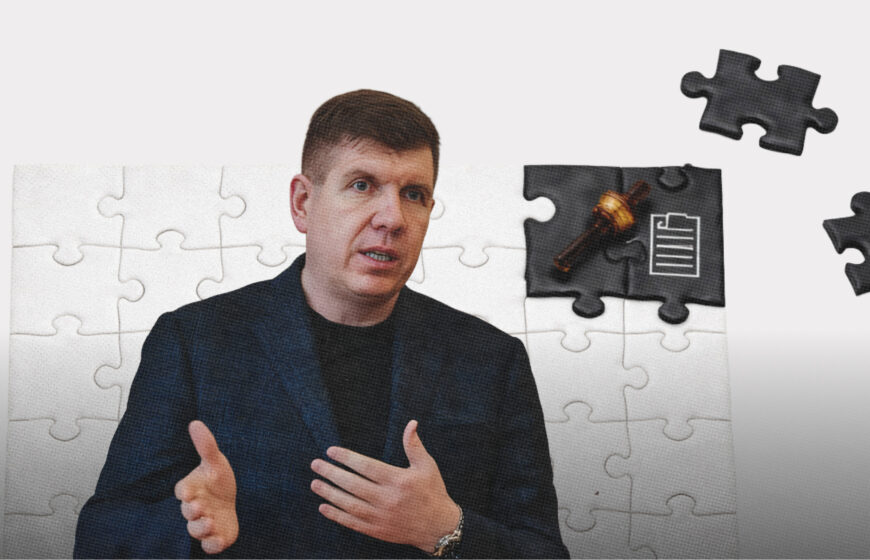
The government has involved a Member of Parliament who has a conviction from the High Anti-Corruption Court and a suspicion notice from NABU in the reform of the Bar. This concerns Anatolii Hunko, who will now work within a working group tasked with preparing amendments to legislation on the legal profession.
In August 2023, NABU and SAPO exposed Anatolii Hunko and two of his accomplices for receiving USD 85,000 from a businessman. After the notice of suspicion was announced, the MP was promptly expelled from the Servant of the People faction.
Later, the court established that Hunko, who at the time headed the temporary investigative commission of the Verkhovna Rada on corruption in the structures of the National Academy of Agrarian Sciences (NAAS), had incited a representative of a private company to give a bribe. The money was intended to ensure the transfer to the private company of land plots of about 1,700 hectares that were in the permanent use of NAAS. The total agreed amount was USD 221,000, and the MP was detained while receiving part of the money. The High Anti-Corruption Court sentenced Hunko to seven years of imprisonment with confiscation of all his property. The case is currently being reviewed by the Appeals Chamber of the High Anti-Corruption Court, which is why Hunko formally remains a Member of Parliament.
In addition, a few days after being included in the working group on Bar reform, Anatolii Hunko received a new notice of suspicion from NABU and the Security Service of Ukraine. According to the investigation, he is involved in organising a scheme to misappropriate NAAS property worth more than UAH 30 million.
Another MP included in the working group is Roman Babii, known for the so-called “Babii loophole.” Because of this loophole, dozens of judges of low integrity were able to receive submissions for permanent appointment without completing the qualification assessment. As a result of the Babii loophole and a decision of the Supreme Court, the scandalous judge Inna Otrosh Jr. retained her judicial position.
Bar reform in Ukraine has remained blocked for years. Among the key problems are the lack of rotation in the leadership of the Bar self-governance bodies, refusal to hold elections under the pretext of martial law, corruption risks in access to the profession, financial opacity, and ineffective and closed disciplinary procedures. This undermines trust in the Bar and does not meet European standards.
Concrete solutions to these problems are set out in the Bar Reform Roadmap prepared by the DEJURE Foundation together with the Anti-Corruption Action Center, the Centre of Policy and Legal Reform, and a group of lawyers. In December 2025, we also presented a relevant analytical brief. Proposed steps include electronic voting in elections to Bar self-governance bodies based on the principle “one lawyer — one vote,” a transparent and unified qualification exam, abolition of the monopoly of the High School of the Bar, introduction of independent disciplinary bodies with an open register of decisions, and an annual external audit of Bar finances. These points from our Roadmap coincide with the provisions of the draft Anti-Corruption Strategy of the National Agency on Corruption Prevention for 2026–2030.
At the same time, proper renewal of the Bar self-governance bodies requires the creation of an independent commission with international experts to verify the integrity of candidates to national-level Bar bodies. This mechanism has already proven effective during the reboot of judicial governance bodies.
The involvement in the Bar reform working group of a politician with a conviction by the High Anti-Corruption Court and a new suspicion notice is unlikely to help achieve the goals declared by the government. The working group includes recognised experts from civil society. However, the presence of individuals with a corrupt background and questionable legislative initiatives creates reputational risks. This is not the first time that people with problematic reputations have been involved in selection or reform bodies. Earlier, Prosecutor General Kravchenko appointed the scandalous lawyer Oleksii Shevchuk to the commission selecting the leadership of the Specialised Anti-Corruption Prosecutor’s Office.
As a result, the participation of Anatolii Hunko in the Bar reform working group calls into question the sincerity of the government’s intentions in this area. Under such circumstances, it is difficult to expect systemic changes that would meet public demand and European standards.