The Supreme Court may reinstate Pavlo Vovk — come to the hearing on October 9
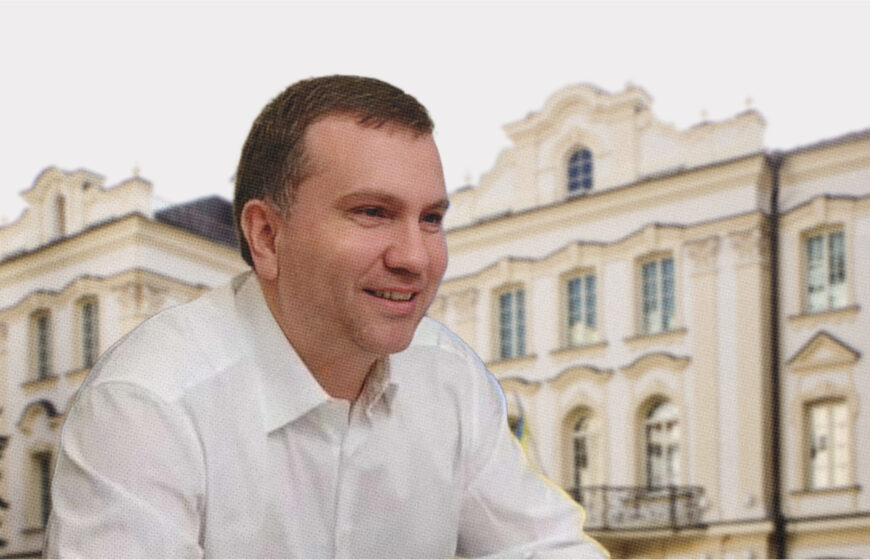
– Pasha, what are we going to do, how will we seize power?
– The main thing is not to lose it, Ihor.
NABU tapes from Pavlo Vovk’s office, in the original language.
On October 9 at 11:00, the Grand Chamber of the Supreme Court will consider a lawsuit filed by Pavlo Vovk, in which he challenges the decision of the High Council of Justice to dismiss him from his position as a judge. This is Vovk’s last chance to return to the system through Ukrainian courts. We urge the public and the media to attend the hearing and closely follow its proceedings.
Why is this important?
- Vovk is likely challenging in the Grand Chamber the admissibility of using pre-trial investigation materials (NABU’s audio recordings from his office) outside criminal proceedings — that is, their use in a disciplinary case. If the Supreme Court rules that the High Council of Justice had no right to use the “tapes” to hold Vovk disciplinarily liable, it would save not only Vovk but also other judges dismissed by the HCJ based on investigative materials — for example, Vovk’s associates from the District Administrative Court of Kyiv (DACK), Yevhen Ablov and Volodymyr Keleberda, or judges caught taking bribes.
-
The established practice of the Grand Chamber has been that materials from covert investigative actions (CIAs) can be used in disciplinary proceedings. However, there are attempts to change this practice. In the case of Iryna Hryshchenko, the Grand Chamber upheld its previous position, but 9 of the 19 judges who made the decision opposed it. Given that judges with questionable reputations were recently elected to the Grand Chamber, the risks are increasing that during Vovk’s case, the Supreme Court may change its practice and deem the use of investigative materials, including CIA protocols, inadmissible.
-
If the Grand Chamber reinstates Vovk, it would mean effectively cementing his influence over the judicial system for years to come.
-
Vovk’s potential reinstatement would be the clearest evidence that the Supreme Court acts in the interests of low-integrity judges — and that it itself needs reform.
Pavlo Vovk is the former head of the notoriously corrupt District Administrative Court of Kyiv (DACK), whose name became synonymous with judicial lawlessness. His career began under the shadow of notorious politicians, including Serhiy Kivalov, for whom Vovk worked as an assistant.
Apartment schemes
During Vovk’s tenure at DACK, nine of his subordinates received service apartments, most of which were quickly privatized through “unsuitability schemes” — new buildings were declared to require “capital investments.” Vovk himself also benefited from housing privileges twice: he privatised one apartment back in 2004 and received another as a judge, which he later sold.
Lavish lifestyle and questionable wealth
According to the Public Integrity Council (PIC), in just three years (2012–2015), Vovk made 33 trips abroad, including to world-class resorts such as the Maldives. In some cases, the cost of one vacation could reach $50,000. His ex-wife made 31 trips. Part of the family’s wealth was explained as “gifts and lottery winnings.”
“It’s hard to find a criterion of low integrity that does not apply to him,” the PIC said of the judge back in 2020.
Criminal cases and NABU recordings
Vovk is accused of creating a criminal organisation with the goal of seizing power, issuing unlawful rulings, and obstructing the work of the High Qualification Commission of Judges. The main evidence consists of NABU recordings from his office, where he discussed “arrangements” for resolving cases before DACK judges. Parts of the recordings were made public by journalists from Slidstvo.Info in the films Deliberation Room and Deliberation Room 2.
- DACK, under Vovk’s leadership, prepared a scenario for the return of Viktor Yanukovych to power during Russia’s full-scale invasion. This was confirmed by both officials and journalists. Yanukovych filed two lawsuits with DACK to restore his presidential status.
- The recordings also confirmed Vovk’s close relationship with former SBU deputy head Dmytro Neskoromny, suspected of ordering a murder. Vovk helped in cases at Neskoromny’s request and also assisted Ihor Kolomoiskyi in finding a judge handling the oligarch’s lawsuit against the NBU and PrivatBank.
- Another episode concerns a $100,000 bribe that was to be “shared” among DACK judges, Vovk, and his brother, lawyer Yuriy Zontov. Detectives searched DACK, homes, and law offices. In one of the offices, they found the bribe money along with $3.7 million, €840,000, £20,000, ₴230,000, and 100 shekels.
Vovk systematically ignored summonses from NABU and the High Anti-Corruption Court (HACC), went into hiding, publicly threw away subpoenas, and ran from detectives. The HACC issued six orders for his compulsory appearance — all unsuccessful.
The Vovk case is a test of whether Ukraine’s justice system can cleanse itself of the most notorious figures who, for years, turned the courts into tools of political manipulation and corruption. If Vovk regains his judicial robe, it will be a verdict not on him, but on the entire judicial reform — proof that the Supreme Court remains a hostage of the old system.