A “promotion” instead of punishment: Ihor Dashutin joins the Grand Chamber of the Supreme Court
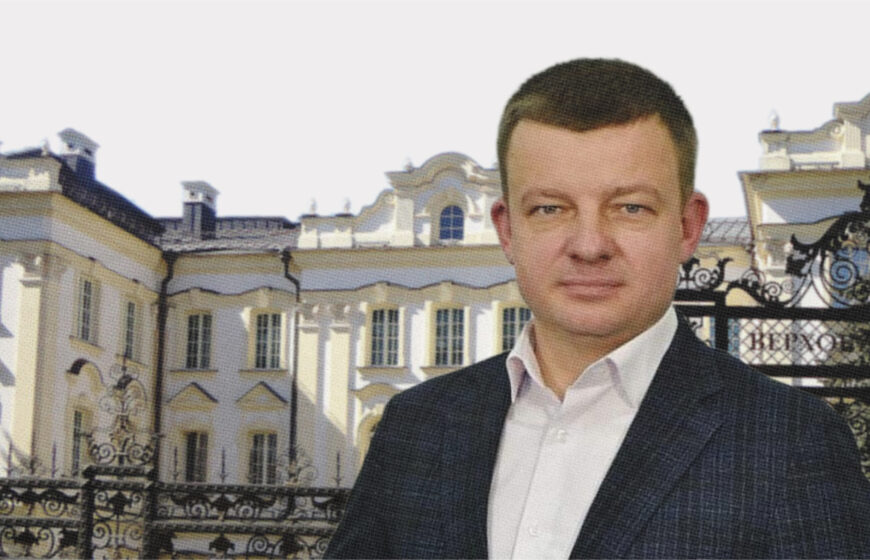
The judges of the Supreme Court’s Administrative Court of Cassation (ACC SC) have elected Ihor Dashutin to the Grand Chamber of the Supreme Court. The judge has been the subject of journalistic investigations and is a consistent opponent of transparency.
What is known about Ihor Dashutin?
In October 2024, Bihus.Info published an investigation revealing that although the judge does not declare any property owned by his family, he uses luxury real estate registered in the names of relatives:
In 2020, the judge’s mother purchased a 190 m² apartment in an elite residential complex in Kyiv worth over $200,000. Immediately after the purchase, Dashutin moved into the apartment.
The judge’s mother-in-law owns a cottage in Kyiv valued at over $300,000. The judge did not declare his residence in this house. However, according to journalists, both Dashutin and his wife were frequently seen there.
The DEJURE Foundation filed a complaint against Judge Dashutin with the High Council of Justice, but the case was never opened. The HCJ did not examine whether the judge had committed a disciplinary offence by failing to declare his right to use the house, citing the fact that the National Agency for Corruption Prevention (NACP) had not yet completed its lifestyle monitoring of the judge.
In addition, Dashutin was part of the panel of judges that gave Hanna Zhuk a second chance to become a judge. Before 2017, the candidate had shared disparaging anti-Ukrainian posts and memes on the Russian social network VKontakte, mocking the Revolution of Dignity, and she lacked sufficient official income to purchase an apartment. Therefore, the High Council of Justice refused to appoint her. However, the Supreme Court panel that included Dashutin decided that only the NACP should verify her declaration, that VKontakte posts were not evidence, and that verification through a VPN was beyond the authority of both the HCJ and the Supreme Court. This case is now being considered by the Grand Chamber of the Supreme Court.
The judge has also repeatedly been involved in rulings that contradict the principle of openness. For example, Dashutin was the reporting judge in case No. 990/406/24, in which the court decided that information from judges’ family ties and integrity declarations is confidential and allowed the open data set containing it to remain unupdated.
Earlier, Dashutin received DEJURE Foundation’s “Dishonour of the Week” award for a ruling in which he and his colleagues decided that Ukrainians do not need to know who and for what merits receive weapons from the Ministry of Defence.
It appears that appointing questionable judges to the Grand Chamber is becoming a trend. In June, two other judges with significant property concerns were appointed to the Grand Chamber — Anatolii Yemets and Nadiia Stefaniv, who lives in an apartment registered to a citizen of the Russian Federation.
These appointments are even more alarming because the Grand Chamber is now considering the lawsuit of former DACK head Pavlo Vovk seeking reinstatement as a judge. Each judge’s vote in the Grand Chamber could be decisive, and a decision in favour of Vovk would mean a victory for the judicial mafia and the impossibility of building an integrity-based judiciary without reforming the Supreme Court.