Walking toward censorship? What’s wrong with Draft Law No. 14057
Imagine a law that, under the guise of “protecting honour,” prohibits mentioning the names of officials without a court verdict — such a document recently appeared in the Verkhovna Rada. On September 21, Draft Law No. 14057 was registered in the parliament, introducing large-scale amendments to the Civil Code. Although the authors present it as an instrument for “protecting honour and privacy,” in reality, the draft law contains provisions that open the door to censorship and put independent journalism and public oversight at risk.
Among the initiators are about 180 MPs, the vast majority of whom are from the “Servant of the People” party, as well as the Speaker of Parliament, Ruslan Stefanchuk, and MPs with scandalous reputations. For example, Maksym Buzhanskyi, known for his pro-Russian statements, or Roman Kaptielov, whose undeclared Moscow apartment was written about by “Schemes” journalists. This only reinforces distrust in the real motives of the initiative.
Let’s take a detailed look at the key risks of the draft law and the threats it poses to freedom of speech.
Ban on criticism without a court verdict
The biggest risk of Draft Law No. 14057 is the introduction of a so-called “ban on criticism before a court verdict”:
“Criticism of an individual must not violate the presumption of innocence, the principle of objectivity, and must comply with good morals (boni mores).”
This means that journalists and activists will not be able to write about the corrupt actions of officials before a court verdict is delivered, as it has not yet been proven.
At this point, it is worth diving into legal categories and emphasising that the “presumption of innocence” is a legal principle characteristic of criminal law. Since criminal cases involve the punishment of a person by the state, guilt must be proven beyond a reasonable doubt. In cases of honour, dignity, and business reputation, however, it is not about criminal liability, but about balancing personal rights and freedom of expression.
The use of the criminal standard here is incorrect because it automatically makes any publications about potential abuses “unreliable” without a court verdict, leading to censorship and making journalistic investigations impossible. Since criminal verdicts take years, it would simply be impossible to cover possible abuses and criticise certain actions.
A question arises: what exactly do the authors of the draft law mean by the requirement to “comply with good morals”? Does this mean that only positive writing will be allowed? If so, this completely negates the very mission of journalism and public oversight — to tell the truth even when it is unpleasant.
By the way, a similar provision applies to legal entities:
“Criticism of a legal entity must not violate the presumption of good standing of the legal entity, unless otherwise proven by a court.”
Thus, one should not write about them either before a verdict.
“Presumption of falsity” of any information
“Information shall be deemed unreliable if it does not correspond to reality and/or is presented untruthfully. Information shall be deemed unreliable if it violates the presumption of innocence, until the person’s guilt is proven in the manner prescribed by law and established by a court conviction that has entered into force.”
Any information about a possible crime will be considered unreliable until a conviction is obtained. In fact, this means that journalistic investigations, even built on documents and public sources, will automatically be labelled “unreliable.”
Anyone who believes that their “good name” has been harmed by such information receives a guaranteed right to demand a retraction and compensation for moral damages. Even if the court later formally establishes guilt, journalists still violated the law if they wrote about it earlier. Officially, this is about “protecting honour and dignity,” but in practice, the provision will harm the fight against corruption and give corrupt officials a convenient way to hide from public criticism.
Value judgments now come with a price
Currently, Ukrainian legislation clearly distinguishes between “facts” and “value judgments”: one cannot be held liable or forced to retract value judgments, since these are personal opinions. However, Draft Law No. 14057 effectively nullifies this guarantee.
According to the draft law, if a value judgment is expressed in a “demeaning form for dignity, honor, and reputation,” the journalist or activist who disseminated it may be obliged to compensate for moral damages. How exactly “demeaning form” will be determined remains an open question. Obviously, for those featured in investigations, any negative mention will be demeaning.
This opens a convenient tool for investigation subjects: instead of responding to revelations, they will be able to demand money for “insults.” That is, it is about legalizing SLAPP lawsuits — cases whose goal is not to establish the truth, but to intimidate or exhaust an editorial office. While the EU adopts anti-SLAPP directives to protect journalists, Ukrainian MPs are instead creating conditions for their flourishing.
Right of reply in any case
Another dangerous innovation is the “right of reply” regardless of the accuracy of the information. This means that anyone mentioned in a journalistic piece may demand the publication of their own comment. Currently, this right exists only for those about whom false information was disseminated. MPs propose that this possibility should exist even if accurate information was published.
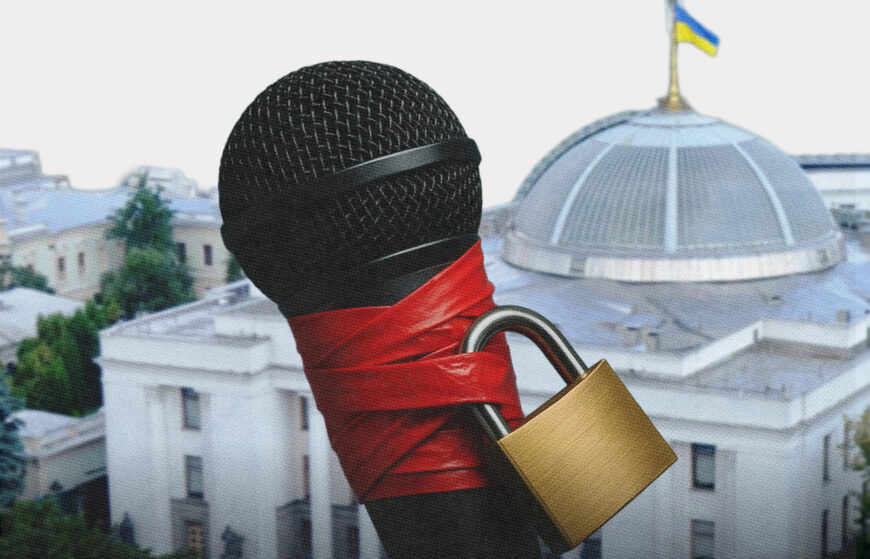
As Oksana Romanyuk, director of the Institute of Mass Information, notes, this destroys editorial independence and turns media into “microphone stands that will be obliged to provide airtime to anyone who was mentioned even briefly and indirectly, but who believes that a mention in the media violates his or her ‘personal rights.’” This approach risks turning independent outlets into platforms for broadcasting an “alternative” version of events even in relation to accurate material.
Contesting materials without direct identification of a person
Another risk lies in expanding the circle of people who will be able to file lawsuits to declare information unreliable. Currently, this right belongs only to the person about whom information was disseminated. And this is logical, since only such a person knows whether the information is true and whether it affects their honor and dignity. However, lawmakers propose that this could also be done by those not directly named:
“Information is considered disseminated about a person if it is possible to reliably establish that it concerns a specific person or this person is included in the circle of persons to whom the information relates.”
Thus, if journalists or activists expose abuses of a “group of persons” (for example, MPs or law enforcement officers), any member of this group will be able to file a lawsuit, even if the information does not directly concern them.
It appears that the proposed changes will not only complicate the work of the media, but also become a tool of protection for corrupt politicians and business groups.
The editorial office of Bihus.Info publicly declared that the draft law increases legal liability for criticism and threatens the very existence of investigative journalism. After criticism from media lawyers and Bihus.Info, the chair of the parliamentary Committee on Freedom of Speech, Yaroslav Yurchyshyn, who initially signed the draft law, publicly acknowledged the risks of certain provisions and withdrew his signature, initiating consultations on amendments.
According to him, consultations have already begun with experts and with the initiator of the draft law, Ruslan Stefanchuk, to develop compromise wording and remove risky provisions.
Draft Law No. 14057 in its current version poses significant threats to freedom of speech, the work of civil society organizations, and independent media. The document requires thorough revision, because without eliminating the risky provisions it may become a step backward for Ukrainian democracy. DEJURE demands removing the harmful provisions and revising Draft Law No. 14057.