Who will select the future members of the HQCJ, and why judicial reform will be at risk without international experts
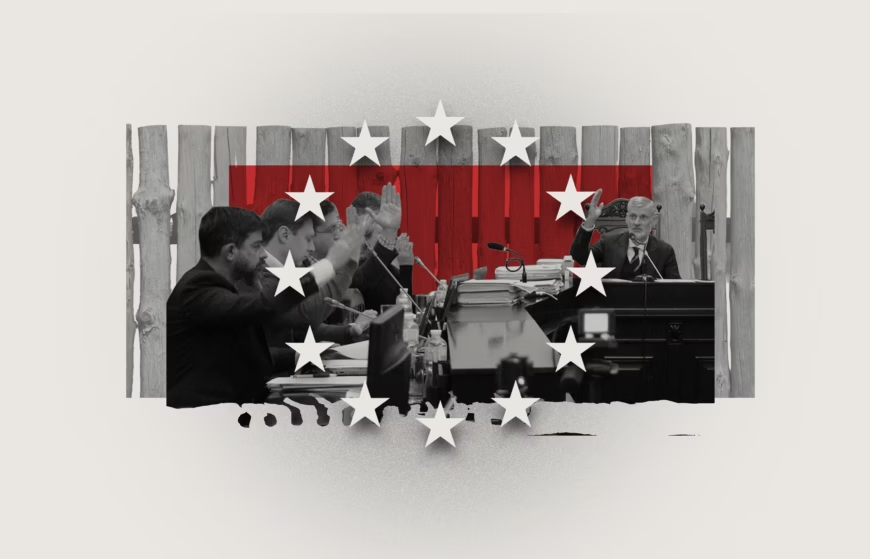
Who ends up on the Selection Commission will determine the future composition of the HQCJ — and therefore, who will go on to select and assess Ukrainian judges. On July 21, the Council of Judges of Ukraine (CoJ) announced an additional round of selection of candidates to the Selection Commission, which will carry out the selection of future members of the High Qualifications Commission of Judges. Applications will be accepted until September 25. The Council explained this decision by citing the risk that the current HQCJ’s powers could expire before the formation of the new one begins.
Experts at the DEJURE Foundation have repeatedly drawn attention to this risk. But the problem also lies in who will control the selection of the people on whom the appointment, career advancement, and evaluation of Ukrainian judges will subsequently depend.
In 2025, only three candidates competed for the three seats allocated to the CoJ: retired judge Andrii Hryhorov, Oleksandr Kotkov, a judge of the Commercial Court of the City of Kyiv, and Volodymyr Petrov, a judge of the Commercial Court of Odesa Oblast. In other words, the Council of Judges had no real choice among alternative candidates.
Our analysis has revealed a number of circumstances that raise doubts about the candidates’ integrity. Kotkov and Petrov have both issued court rulings in Russian in the course of their practice. Questions have also arisen about Oleksandr Kotkov in connection with a ruling in the “Bilotserkivmaz” case, which was later overturned by the Supreme Court, as well as over the declared value of his wife’s land plot. Petrov headed a court beyond the term established by law, understated the value of assets in his declarations, and failed to declare information about his wife, whose car he used. In addition, her income from entrepreneurial activity grew significantly during the full-scale war.
More details on the candidates put forward by the Council of Judges can be found in a piece by the DEJURE Foundation.
The announcement of the additional recruitment round does not, in itself, remove the main threat. Under the current model, once the special transitional mechanism ends, three members of the Selection Commission are delegated by the Council of Judges, and one more each by the Council of Prosecutors, the Council of Attorneys, and the National Academy of Legal Sciences. There is no independent external component in this arrangement. As a result, Ukraine risks weakening one of the key mechanisms of judicial reform and failing to fulfil its EU integration commitment to continue the participation of independent international experts.
A legislative solution has already been proposed. Draft law No. 13382, registered on June 18, 2025, by Anastasiia Radina and a group of members of parliament, proposes preserving the model with three international experts and their decisive vote, and extending it until June 2028. As of today, however, the draft law is still being worked on in a parliamentary committee.
In early July, then-Deputy Prime Minister Taras Kachka stated that the government was working with the European Commission on draft laws to implement the Rule of Law Roadmap and planned to submit them during the third and fourth quarters of 2026. However, a separate government draft law on the HQCJ Selection Commission has not yet been presented publicly.
So the question to the Cabinet of Ministers remains open: where is this draft law, and when will the public see it?
The Verkhovna Rada must urgently consider draft law No. 13382 or an equivalent government bill and preserve the decisive role of international experts in the selection procedure. Ukraine needs a Selection Commission formed in time, one capable of carrying out an independent selection process conducted with integrity.
Why, without independent international experts, the structure of judicial reform risks turning into a house built on sand — more in the analysis by Kyrylo Sydorchuk and Anastasiia Kokalko.
Who checks Ukrainian judges today, and why the composition of judicial governance bodies matters — we explain in a video by the DEJURE Foundation: