With EU support, a coalition of Ukrainian civil society organizations launches a project to safeguard justice sector reforms

On Thursday, April 16, the DEJURE Foundation, the Anti-Corruption Action Center (AntAC), MEZHA, and AutoMaidan presented a new EU-funded project on monitoring justice sector reforms during the conference “Operation European Integration: Reforms in the Justice Sector.”
The project, titled “Civic Engagement for the Protection of the Rule of Law and Institutional Integrity,” strengthens the role of civil society in safeguarding rule of law reforms in Ukraine amid the war and the EU accession process. Implemented by a coalition of leading Ukrainian civil society organizations, the project includes monitoring legislation, protecting the independence of anti-corruption and judicial institutions, assessing the performance of justice and law enforcement bodies, and conducting integrity checks during key public appointments. Through legal analysis, advocacy, public communication, and cooperation with international partners, the project will contribute to accountable public governance, strengthen democratic oversight, and support Ukraine’s progress toward European integration.
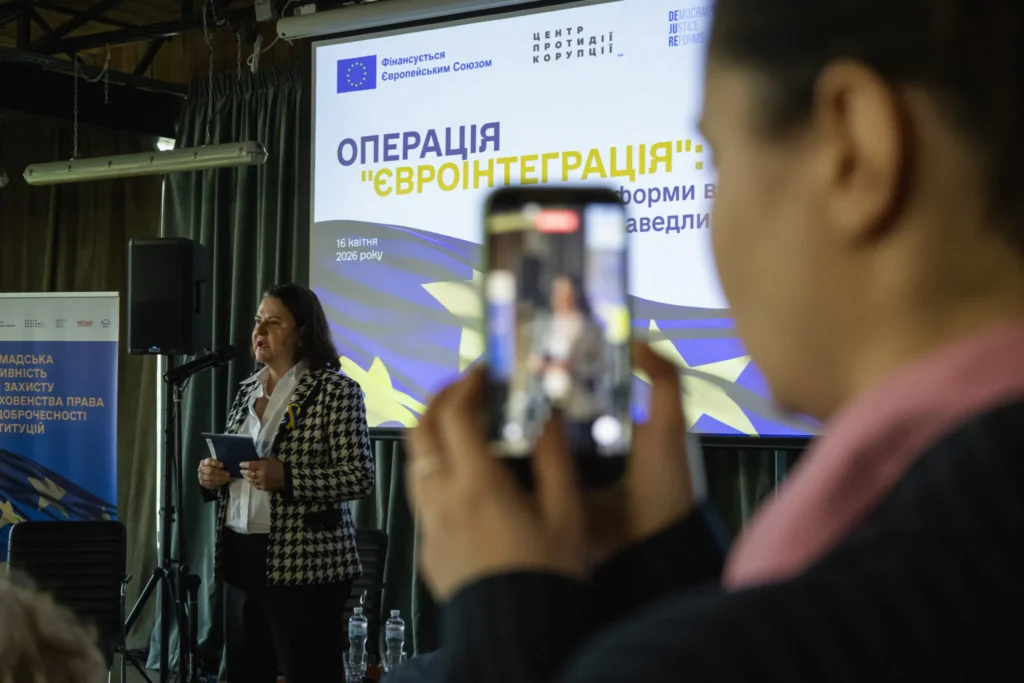
The event brought together representatives of the Ukrainian government, the EU diplomatic corps, and leading civil society experts to discuss the critical package of reforms required for Ukraine’s accession to the European Union.
In her opening remarks, the European Union Ambassador to Ukraine, Katarína Mathernová, reaffirmed the EU’s unwavering support for Ukraine’s European integration aspirations and emphasized the importance of civil society participation in monitoring reforms.
“Rule of law reform lies at the heart of Ukraine’s path toward EU membership, and today’s discussion demonstrates that the Ukrainian authorities and civil society are ready to work on this together. The European Union is proud to support the coalition led by the Anti-Corruption Action Center together with the DEJURE Foundation, AutoMaidan, and MEZHA, who monitor progress in implementing agreed reform priorities and help Ukraine advance on its accession path,” said European Union Ambassador to Ukraine Katarína Mathernová.
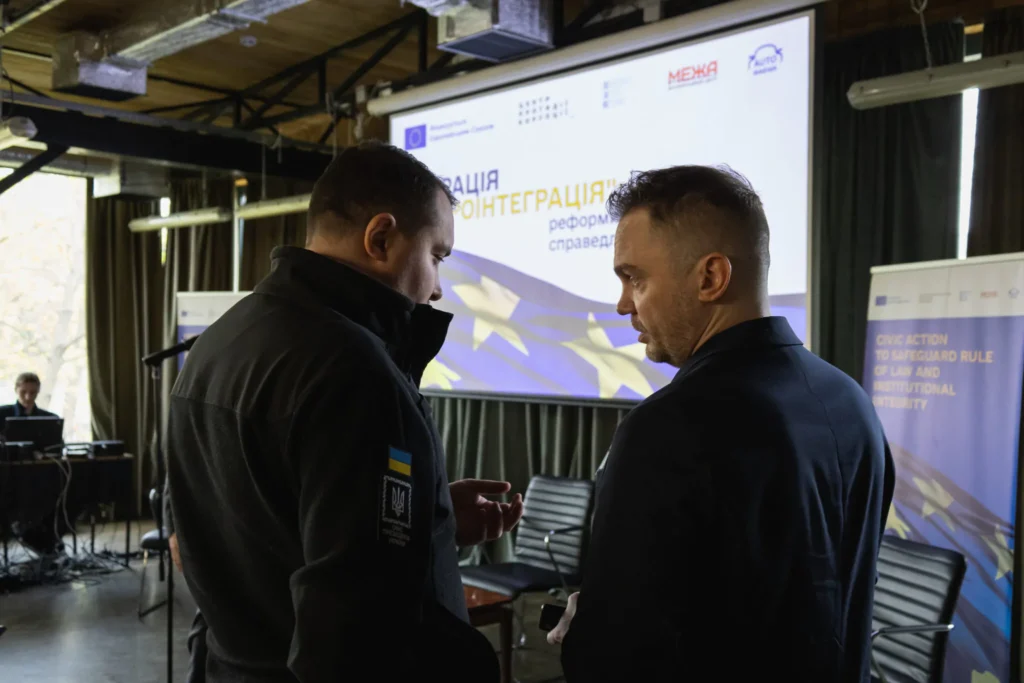
The opening of the event was also attended by the Head of the Office of the President of Ukraine, Lieutenant General Kyrylo Budanov, and Deputy Prime Minister Taras Kachka.
“Corruption begins where large-scale manual control begins. Because where everything functions according to the rule of law, rules, and legislation, the space for corruption is limited. I am very grateful to everyone gathered here for understanding that the issue of the rule of law and combating corruption remains, unfortunately, a major challenge for Ukraine and a matter requiring constant attention. Without broad involvement of civil society, we will probably not overcome these problems. As Head of the Office of the President, I invite all of you to cooperate, because you should also remember that without engagement from the authorities, you will not be able to implement what you may develop now. But together we can do it. Corruption, especially during wartime, is no longer merely a matter of criminal law. It is a matter of national security and the survival of the state,” said Head of the Office of the President Kyrylo Budanov.
“The importance of the joint statement by Marta Kos and myself lies in the fact that it defines ten key steps necessary to achieve tangible progress already this year. This helps us consolidate efforts within Ukraine’s movement toward membership in the European Union. At the same time, the issue of the rule of law will remain constantly at the center of our attention. That is why European integration is not merely an ‘operation.’ It is the evolution of the state and its institutions,” noted Deputy Prime Minister Taras Kachka.
The discussion focused on Ukraine’s implementation of ten priority reforms within the “Fundamentals” negotiation cluster, which the state committed to implementing during 2026. These are core reforms in the fields of law enforcement and anti-corruption, and their implementation is essential for preventing regression and the imitation of reforms.
“Implementing the rule of law reform package is crucial for preserving democracy and the system of checks and balances in a country at war. It is our ticket to the EU and the foundation for building a just state for people — a state where one can live with dignity, not merely survive,” said Daria Kaleniuk, Executive Director of the Anti-Corruption Action Center, during the opening of the event.
Key discussion topics:
Law enforcement reform. Participants of the first panel discussed protecting the independence of the National Anti-Corruption Bureau of Ukraine (NABU) and the Bureau of Economic Security (BES). NABU First Deputy Director Denys Hiumahomedov and BES Deputy Director Yurii Bielousov emphasized the need to establish effective safeguards against political influence.
Prosecutorial independence. The second panel focused on changing the procedure for selecting the Prosecutor General and preventing their influence over the Specialized Anti-Corruption Prosecutor’s Office (SAPO). Head of SAPO Oleksandr Klymenko and Member of Parliament Yaroslav Yurchyshyn stressed that this reform requires clear and transparent competitive procedures in order to prevent interference in the selection process.
Judicial reform. During the third panel, participants discussed the role of international experts in appointing members of the High Council of Justice (HCJ) and the High Qualification Commission of Judges of Ukraine (HQCJ). HCJ member Roman Maselko and representatives of leading civil society organizations emphasized that the involvement of international experts is a necessary and reliable instrument for cleansing the judiciary that has already proven its effectiveness.
The event served as a platform for direct dialogue between government representatives and civil society, laying the groundwork for further cooperation on implementing European integration reforms in the justice sector.
The event was organized by the Anti-Corruption Action Center, MEZHA, the DEJURE Foundation, and the AutoMaidan within the framework of the project “Civic Engagement for the Protection of the Rule of Law and Institutional Integrity,” funded by the European Union. The views expressed during the event are those of the participants and may not coincide with the official position of the European Union.