13 months of the qualification assessment: 45% of judges found unfit by the PIC were dismissed
Thirteen months have passed since the High Qualification Commission of Judges (HQCJ) and the Public Integrity Council (PIC) began their joint effort to cleanse the judiciary:
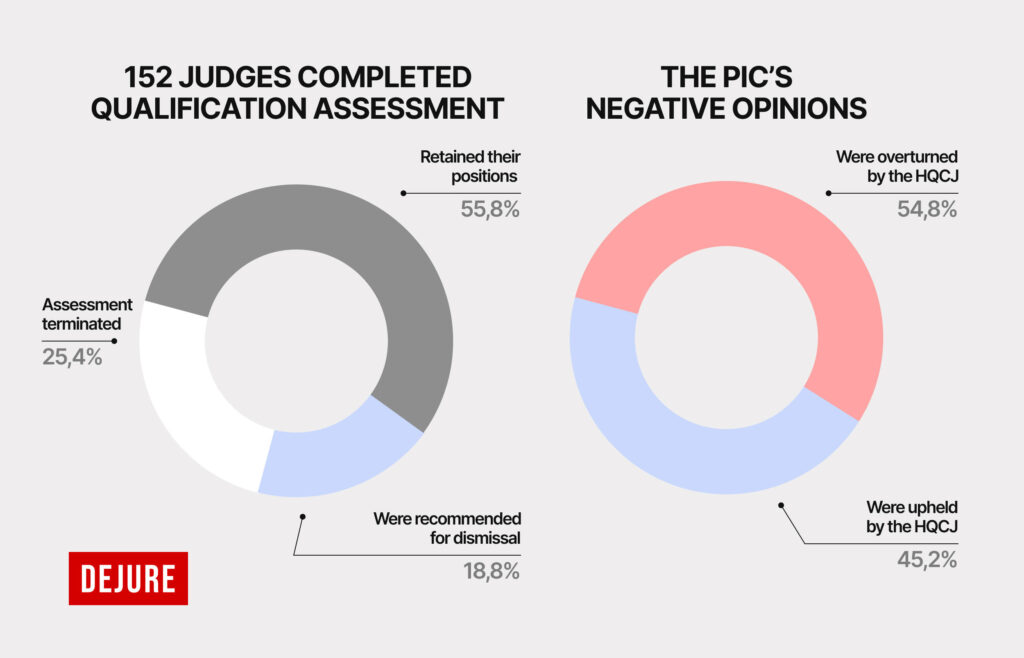
- 125 judges (55.8%) successfully passed the qualification assessment and remain in their positions.
- 42 judges (18.8%) were recommended for dismissal by the HQCJ to the High Council of Justice (HCJ).
- 57 judges (25.4%) faced other outcomes:
Furthermore:
- 36 took honorable retirement,
- 8 resigned voluntarily,
- 4 were declared to have not acquired judicial status,
- 3 withdrew from the qualification assessment process,
- 2 failed to confirm their ability to administer justice.
The HQCJ’s level of support for the Public Integrity Council’s (PIC) opinions regarding judges’ non-compliance with integrity criteria has increased.
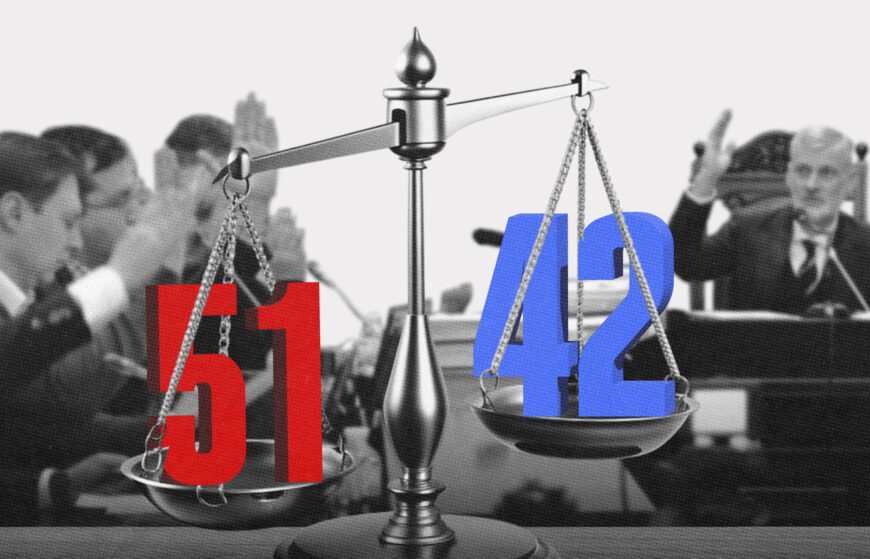
Of the 93 negative opinions issued by the PIC and fully reviewed by the HQCJ:
• In 40 cases, the HQCJ recommended the dismissal of judges.
• In 2 cases, PIC opinions were upheld during qualification assessments.
• In 51 cases, the HQCJ overturned PIC opinions.
This means the HQCJ agreed with the PIC’s findings in 45.2% of cases. However, 54.8% of judges deemed unfit by the PIC remain in office. For instance, despite indisputable evidence of misconduct outlined by the PIC, Pavlo Horbasenko, a judge from the infamous “list of 180”, managed to evade accountability.
DEJURE Foundation welcomes the HQCJ’s recently approved draft amendments to internal regulations, which aim to grant the PIC and the Public Council of International Experts (PCIE) better access to judges’ dossiers. If finalized, these changes will enable the PIC and PCIE to process information more efficiently, accelerating qualification assessment and competition procedures.