A draft law has been registered in the Rada to make judges’ disciplinary liability more effective

Draft Law No. 15374 has been registered in the Verkhovna Rada. It is intended to prevent the High Council of Justice’s work from grinding to a halt in the spring of 2027 and to make judges’ disciplinary liability more effective and predictable.
The adoption of this draft law is one of Ukraine’s commitments to the European Union under the Rule of Law Roadmap. The document is also intended to close the legislative gaps identified by the European Commission in its 2025 report.
What does the draft law propose?
- Prevents the work of the High Council of Justice from stalling in 2027. In January 2027, the terms of office of eight HCJ members appointed under the quota of the Congress of Judges come to an end. If the Council becomes unable to function as a result, HCJ members whose terms have expired will be able to continue working for no more than three months.
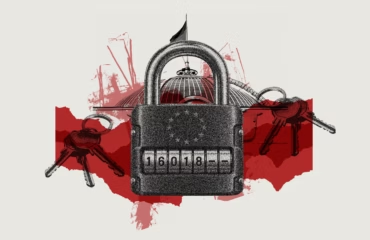
The current law requires that all eight vacant positions have 16 candidates at once. Previous competitions have shown that finding a sufficient number of candidates with integrity for even two vacant positions at the same time is difficult. The draft law therefore proposes filling each vacancy separately. This will make it possible to appoint at least some new HCJ members and allow the Council itself to continue its work, including appointing judges and hearing disciplinary cases.
- Clarifies the grounds for judges’ disciplinary liability. The draft law more clearly defines the wording of disciplinary offences and takes into account the HCJ’s practice over recent years. In particular, in line with GRECO’s recommendations, the document elaborates on the substance of one of the main disciplinary offences for which a judge may be dismissed — “conduct that discredits the title of judge or undermines the authority of justice.”
- Establishes the possibility of using materials from criminal proceedings in disciplinary cases. The draft law proposes to expressly provide in law for the approach already applied by the HCJ and the Supreme Court: materials from criminal proceedings may serve as evidence in disciplinary cases against judges.
On the basis of such materials, the HCJ has already dismissed or filed for the dismissal of more than 50 judges who lack integrity, including the former head of the District Administrative Court of Kyiv, Pavlo Vovk. Enshrining this rule in law will reduce the risk that the Supreme Court might suddenly change its approach and allow many judges to escape liability. A similar situation already arose after the decision in the case of Judge Usatyi, when the assessment of 180 judges with questionable integrity was put at risk. -
Restricts the possibility of “fleeing into retirement.” The draft law is meant to close off the path to retirement for judges who are suspects or defendants in a crime, who may be dismissed through disciplinary proceedings, or who have failed the qualification assessment.
At present, retirement with lifetime payments serves as a means of avoiding liability. It is enough for a judge to submit an application, and they can obtain retirement even when they have failed the qualification exam, been recommended for dismissal, or are suspected of committing a crime. Recently, this mechanism has been actively used by judges of the liquidated DACK. The draft law proposes extending the period for reviewing a retirement application to six months. Retirement may also be suspended for a judge if there are open criminal proceedings against them, an HQCJ submission for dismissal, or serious violations that could serve as grounds for dismissal.
- Obliges the HCJ to review judges’ asset-related violations on its own. At present, the HCJ can refer such matters to the National Agency on Corruption Prevention and wait years for a check to be conducted. The draft law proposes that the HCJ assess asset-related violations on its own, within the scope of its powers.
- Grants equal rights of appeal to all parties to a disciplinary case. Currently, a complainant can appeal a decision of the Disciplinary Chamber only with the special permission of that same chamber. In practice, such permission is generally not granted, especially if the decision is unfounded. The draft law proposes that an automatic right of appeal be granted not only to judges but also to the complainant, the disciplinary inspector, or the HCJ member who initiated the case.
- Reduces the risk of abuse of disciplinary penalties. At present, even a warning from the HCJ can bar a judge from participating in a competition for the HQCJ or HCJ, or from being transferred to another court. This creates a risk that a judge could be formally held liable for a minor or contrived violation in order to remove them from a competition. The draft law proposes that only a severe reprimand or a more serious disciplinary penalty should bar participation in competitions and selections.
Members of parliament should support draft law No. 15374. It closes specific gaps that allowed judges lacking integrity to escape liability, protects the HCJ from paralysis in 2027, and fulfils part of Ukraine’s commitments to the EU.