A judge from the Yanukovych-era elite may judge Ukrainians again
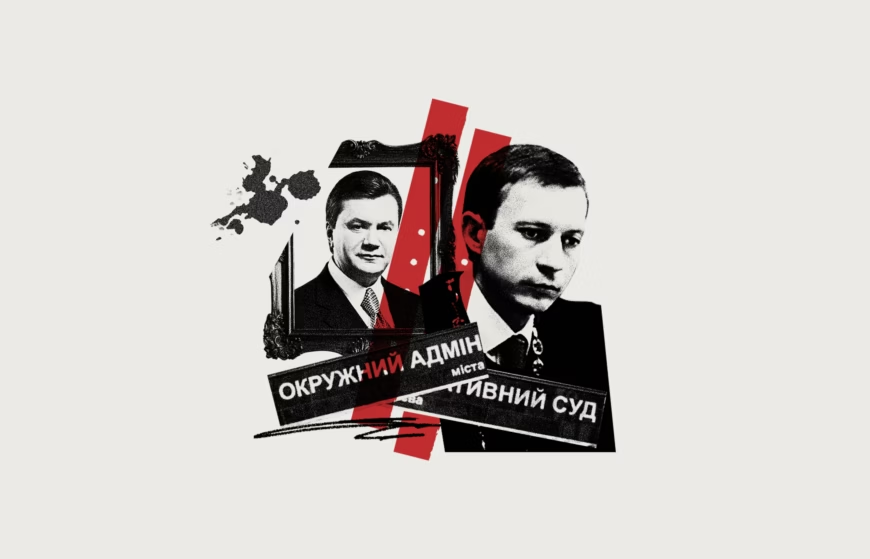
Another judge of the liquidated DACK may return to administering justice. The HQCJ has recommended transferring Kostiantyn Kobylianskyi to the Kyiv District Administrative Court.
Under Yanukovych, Kobylianskyi’s father sat on the High Council of Justice, headed the Council of Judges of Administrative Courts, and worked at the High Administrative Court. Kobylianskyi became a judge in January 2012, and less than five months later he was transferred to the elite DACK by a decree of Yanukovych.
In 2014, Kobylianskyi’s father reopened an already closed case concerning his son’s colleague, judge Bohdan Sanin. This made it possible to withhold the case files from the commission that was reviewing judges’ rulings against Maidan participants.
Other close relatives of Kobylianskyi also worked in the courts, the prosecution service, and the police. His former wife is a judge of the liquidated DACK; his brother is a former first deputy head of the Kyiv city prosecutor’s office; his uncle worked at the Prosecutor General’s Office; his cousin also worked in the prosecution service; and several more relatives worked at the High Administrative Court and in the police.
According to the PIC’s calculations, as of the end of 2017 Kobylianskyi and his family members owned or used property worth around USD 570,000. It included an apartment and parking spaces in the Park Avenue residential complex, a house, land, cars, a coin collection, jewellery, a work of art, and antiques. And this although, before his judicial career, Kobylianskyi worked as a courier and later as an assistant to an attorney and to a judge.
In 2019, the PIC concluded that Kobylianskyi does not meet the criteria of integrity and professional ethics. The grounds included unconvincing explanations of the origin of his property, problems with asset declarations, and academic dishonesty.
In particular, the PIC established that part of the abstract of Kobylianskyi’s dissertation was identical to the text of an article by his academic supervisor Serhii Kivalov, but carried no reference to it. Kivalov had earlier sat on the High Council of Justice (HCJ) together with Kobylianskyi’s father.
The assessment itself also raised questions. In 2019, Kivalov, Kobylianskyi, and HQCJ members Volodymyr Butenko and Taras Lukash together celebrated the birthday of DACK deputy head Yevhen Ablov. It was Butenko and Lukash who subsequently assessed Kobylianskyi. They did not recuse themselves, asked no questions about the PIC’s objections, and awarded the judge very high scores.
Kobylianskyi never went through an interview with the HQCJ in plenary composition, which was to consider the PIC’s conclusion on him. He became one of the so-called “Babii judges”, whom attempts were made to appoint without completing the assessment and without considering the PIC’s conclusions.
Incidentally, the same loophole in the law was used by Inna Otrosh, the daughter of the former head of the Pecherskyi court, who was also a member of the High Council of Justice under Yanukovych. One gets the impression that the Babii law was written precisely to rescue the children of the judicial elite of that time.
None of this hindered Kobylianskyi’s career: in 2021 he joined the Council of Judges of Ukraine (CoJ).
In 2025, following a report by Kobylianskyi, the CoJ came out against continuing the assessment of judges whom the HCJ had earlier recommended for appointment under the Babii law. This despite the fact that they had not completed their assessment. Kobylianskyi himself falls into this category. In March 2026, he was once again elected a member of the Council of Judges.
What can be expected from this judge, given his previous rulings?
📌 He blocked the special vetting of Maidan judge Alla Chala, who had sent an activist of the Revolution of Dignity into detention for 60 days. Kobylianskyi’s ruling was later overturned by the appellate court as unlawful.
📌 He ruled in favour of a former judge who held UAH 2.57 million in her accounts against a total income of UAH 576,000.
In both of these cases, Kobylianskyi’s rulings favoured fellow judges. There is therefore every reason to believe that corporate solidarity and the protection of the judicial system’s interests will always come first for Kobylianskyi.
The High Council of Justice has yet to analyse all these facts and decide whether to transfer Kobylianskyi to the court that now hears the former DACK cases.
At the same time, disciplinary cases against other DACK judges — some of whom have also been recommended for transfer — have remained unexamined at the HCJ for years. So before returning judges of the liquidated DACK to the administration of justice in new positions, the HCJ should give priority to completing the disciplinary cases of DACK judges.