Are We Doing Enough for an Efficient Judiciary in Ukraine? — Observations from International Partners
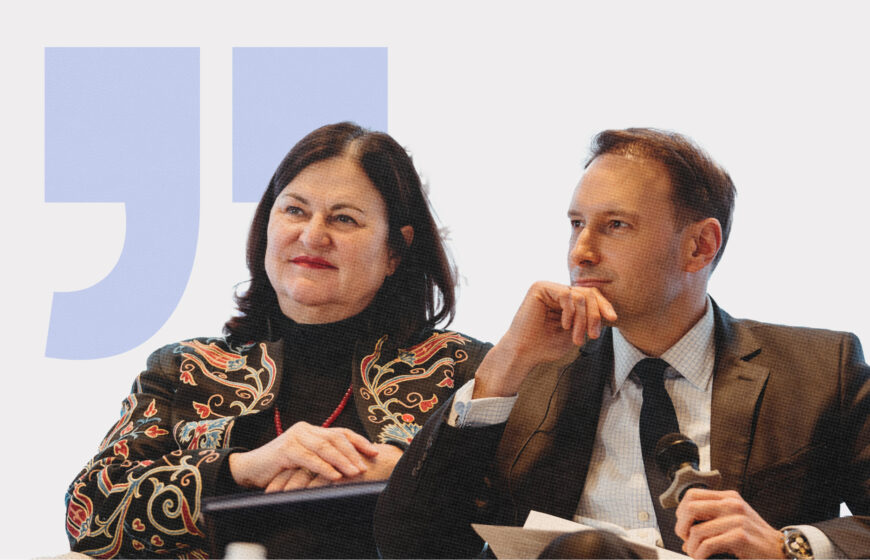
As part of the “Fair Courts: Are We Doing Enough?” conference, DEJURE Foundation brought together leading experts in the field of justice, civil society activists, government officials, representatives of the judiciary, international partners, and journalists on February 12 to discuss the progress of judicial reform in Ukraine. The focus was placed on current and future challenges in the justice reform process and further priorities. International partners discussed the efforts to ensure fair courts in Ukraine. Here, we share key thoughts of Katarína Mathernová, the European Union Ambassador to Ukraine, and Maximilian Rasch, Deputy Ambassador of Germany to Ukraine.
Maximilian Rasch, Deputy Ambassador of Germany to Ukraine:
The reform of the justice sector is one of the most important challenges Ukraine is facing at the moment, besides this terrible war. I’m very much impressed and humbled because I think for most countries it would be impossible to address such reforms whilst defending the country and defending our shared values at the same time.
We have seen so much progress in the last couple of years. I have had the pleasure of following Ukraine and politics since seven to eight years now and it’s quite remarkable what has been achieved. And that is important because the functioning justice sector is key for the rule of law, at not least for the stability of this country short term and long term.
Corruption in courts and judicial administration pose a significant risk and effective and equal access to justice for all is crucial. And then the functioning justice sector is also key on Ukraine’s path into the European Union. And certainly the advancement in EU accession will depend on progress in the justice sector and beyond that in the so-called fundamentals cluster. This is such an important prerequisite as it is specifically the justice sector, which further down the road will be the one that enforces the common set of laws of the European Union.
But in order to be successful and to finally open doors into the EU, you must also address those areas where reforms are difficult and run counter to the vested interests of some individuals here in Ukraine. And I think this is where we are counting on civil society to keep a watchful eye.
Katarína Mathernová, the European Union Ambassador to Ukraine:
A lot has already been accomplished, and today, Ukraine has a clearer and more structured judicial system. We have, for instance, relaunched the High Council of Justice and the High Qualification Commission of Judges. However, there are still other aspects of the rule of law that require further work.
The reforms that have been implemented so far were made possible thanks to:
- The determination of Ukrainian officials after the Maidan, who were committed to change.
- Strong pressure from organized civil society.
- Pressure from international partners pushing for a successful judicial reform in Ukraine.
Now, there is a fourth element—the EU accession process. A well-functioning judiciary is one of the key requirements for membership.
The Supreme Court was relaunched, but not perfectly. We all know what happened afterward. This is an issue you will hear more about from us. It is part of the European Commission’s enlargement report, and discussions on the Supreme Court will take place within the framework of the fundamental reforms cluster. There is clear determination to reform the Supreme Court—it won’t be easy, but we will get there.
The involvement of international commissions in judicial selection is a complex issue. I know that in Ukraine, whenever foreign involvement in selection processes is discussed, concerns about sovereignty arise. I don’t see this as a problem. In a situation where Ukraine needs support, including financial support, it is entirely legitimate to share responsibility for the outcome. This topic was hotly debated a few years ago. Within the EU and the European Commission, I advocated for the idea that we, as international partners, should be involved in the selection process—at least for the highest judicial leadership. While Ukraine’s judicial system is still undergoing transformation, international partners must assist in rebooting it. This process should continue until the judiciary and its leadership are fully established. International involvement also helps to increase the level of trust in Ukraine’s judiciary among the general public and business community, which still remains low. And trust is a critical component of a strong, resilient society.
One of the immediate outstanding reforms is the establishment of the new Specialised Administrative Court following a credible selection process for its judges with the involvement of independent experts. There are constructive discussion ongoing with the Ministry of Justice and the Verkhovna Rada regarding the reform and I believe this could serve as another milestone for consolidating Ukraine’s judiciary. However, I want to emphasize that this is about shared responsibility between European partners and Ukrainians for future judicial institutions, as a temporary measure.