Draft Law No. 7033-д: risks to the court register remain
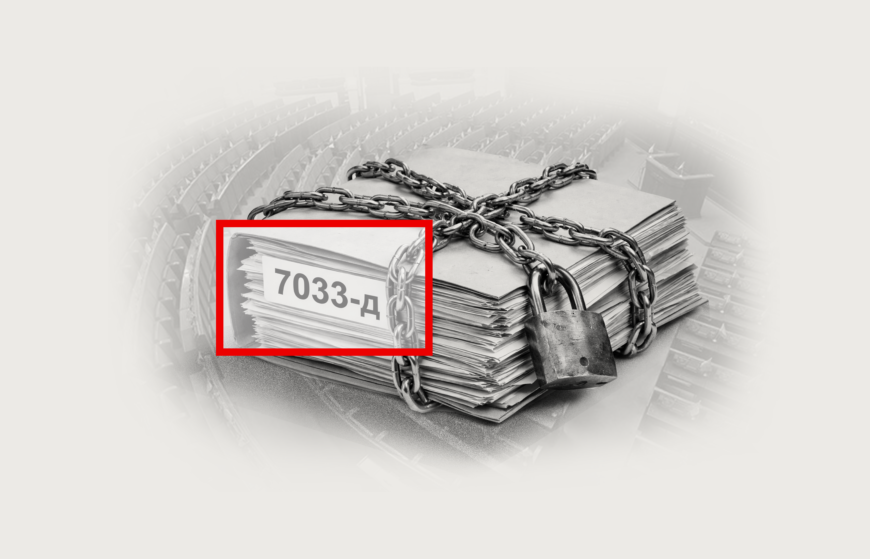
The Parliamentary Committee on Legal Policy will consider a new version of draft law No. 7033-д, which proposes amendments to certain laws of Ukraine on preventing the disclosure of specific information in the texts of court decisions.
This draft law had already raised public concern in March 2023. Following significant public backlash, it was removed from the parliamentary agenda.
In May 2024, the Committee on Legal Policy reconsidered the draft and recommended it for a vote in Parliament. The draft law was adopted in the first reading, with instructions to revise it for the second reading. The Committee has now prepared a new opinion, proposing to supplement the comparative table with a number of amendments for the second reading.
What risks remain in the document
The DEJURE Foundation, together with other civil society organisations, has already issued statements twice opposing the adoption of this draft law. The parliamentary committee revised the document and took into account some important recommendations from civil society. In particular, it removed provisions allowing court decisions to be hidden based on a resolution of an investigator or prosecutor, and adjusted the approach to judicial discretion regarding the removal of information that “may harm security.”
At the same time, the document still contains a number of problematic provisions that may restrict public access to socially significant information.
Key risks include:
- Disproportionate restriction of access to rulings in criminal proceedings
The draft law proposes to restrict general and full access to certain rulings in criminal proceedings for one year after they are entered into the Register. This concerns, in particular, rulings on asset seizure, temporary access to items and documents, searches, and authorization for covert investigative (search) actions.
This provision has two sides.
On the one hand, limiting access to such rulings may help prevent information leaks from criminal proceedings and reduce abuse of full access to the Unified State Register of Court Decisions by officials.
On the other hand, such a restriction is unjustified with respect to decisions adopted in open court hearings.
It is important to clarify that this provision should apply exclusively to rulings issued in closed court hearings, in order to prevent unjustified restrictions on access to court decisions.
- Concealment of information in decisions delivered in open court hearings
Courts would be granted the authority to determine, when submitting decisions to the Register, certain categories of information as non-disclosable — even if the decision was announced in an open court hearing.
Such an approach contradicts the principles of transparency. If information has already been made public during an open hearing, there are no grounds to restrict it in the text of the court decision. Moreover, existing legislation already provides the necessary mechanisms for protecting sensitive information.
Introducing additional judicial discretion in open cases creates risks of selective application and abuse.
For this reason, we propose removing this provision from the draft law.
In light of the above, the DEJURE Foundation calls on the Parliamentary Committee to take these recommendations into account when preparing draft law No. 7033-д for the second reading. In its current version, certain provisions pose risks to freedom of expression, access to public information, and the accountability of the judiciary.