Most Ukrainians Support Continuing Judicial Reform Despite Wartime Challenges, New Survey Finds

A new nationwide survey conducted by the Kyiv International Institute of Sociology (KIIS) at the request of the DEJURE Foundation shows strong public support for continuing judicial reform despite Russia’s ongoing war against Ukraine. The findings also reveal widespread dissatisfaction with the pace of reform, persistently low trust in the judiciary, and significant public support for a stronger role of international partners in advancing reform efforts.
The results come at a critical moment in Ukraine’s EU accession process, particularly as negotiations advance through the opening of thematic clusters. Judicial reform remains a cornerstone of the rule of law agenda and is essential not only for meeting EU accession requirements but also for ensuring equal access to justice and strengthening confidence in public institutions.
The survey indicates that most Ukrainians do not consider wartime conditions a valid reason to postpone reforms in the justice sector.
Strong Public Support for Judicial Reform
According to the survey, 82.9% of respondents believe Ukraine should continue judicial reform despite the war and other pressing challenges, including those affecting the energy sector. More than half (50.2%) said reform should definitely continue, while an additional 32.7% stated it should probably continue. Only 11.9% opposed further reform efforts.
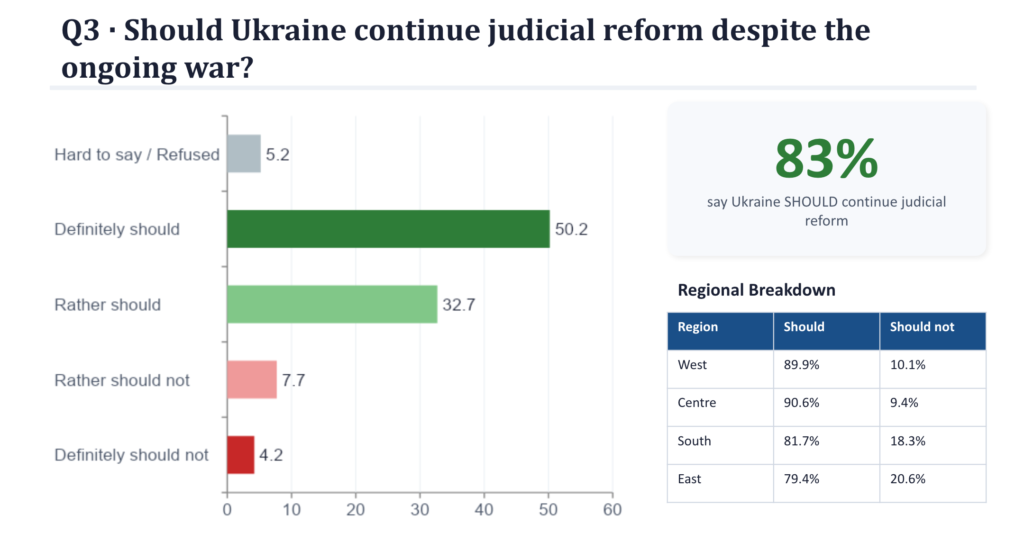
These findings suggest that public demand for a fair and effective justice system remains strong even amid heightened security and economic pressures. For Ukrainian policymakers, this underscores that the war is only strengthening the demand for justice and sets the bar higher for consistent and tangible judicial reform.
Majority Say Government Efforts Fall Short
The survey found that 71.1% of Ukrainians believe the authorities, including the President, are doing too little to bring the judiciary and broader justice system into line with EU standards. Of those surveyed, 30.5% described the government’s efforts as completely insufficient, while 40.6% said they were rather insufficient. Only 22.5% considered the current level of effort adequate.
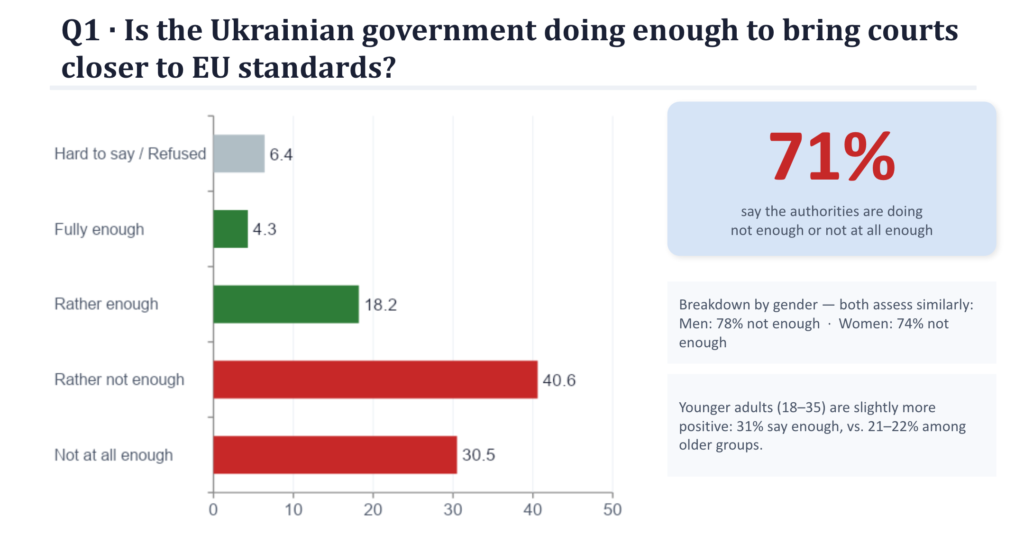
The findings point to a substantial gap between the government’s stated commitment to European integration and public perceptions of actual progress. The issue is not only the pace of decision-making, but also public confidence in the substance and quality of those decisions. Meaningful reform requires transparent and merit-based judicial appointments, effective qualification assessments, accountable governance by the HQCJ and HCJ, and safeguards against political interference.
Trust in Courts Remains Critically Low
Nearly three-quarters of respondents (73.9%) said they do not trust Ukrainian courts, including 30.5% who expressed no trust at all and 43.4% who said they rather do not trust them.
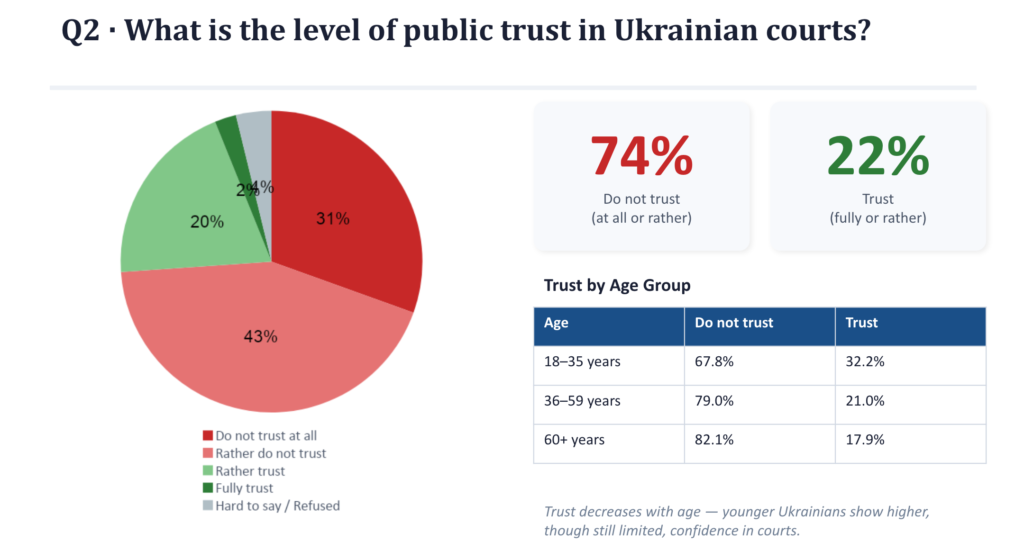
Only 22.3% reported some degree of trust in the courts, while just 2.3% said they fully trust the judiciary.
Although the survey did not examine the causes of this distrust, the results highlight a persistent institutional challenge. Rebuilding confidence will require systemic measures, including integrity-based judicial selection, effective vetting of sitting judges, and greater transparency across the judicial system.
Support for Greater International Engagement
A majority of Ukrainians (65.5%) believe that the European Union and other international partners should take a firmer stance in urging Ukrainian authorities to advance reforms, particularly in the areas of justice and anti-corruption. By contrast, 29% view such involvement as interference in Ukraine’s domestic affairs.
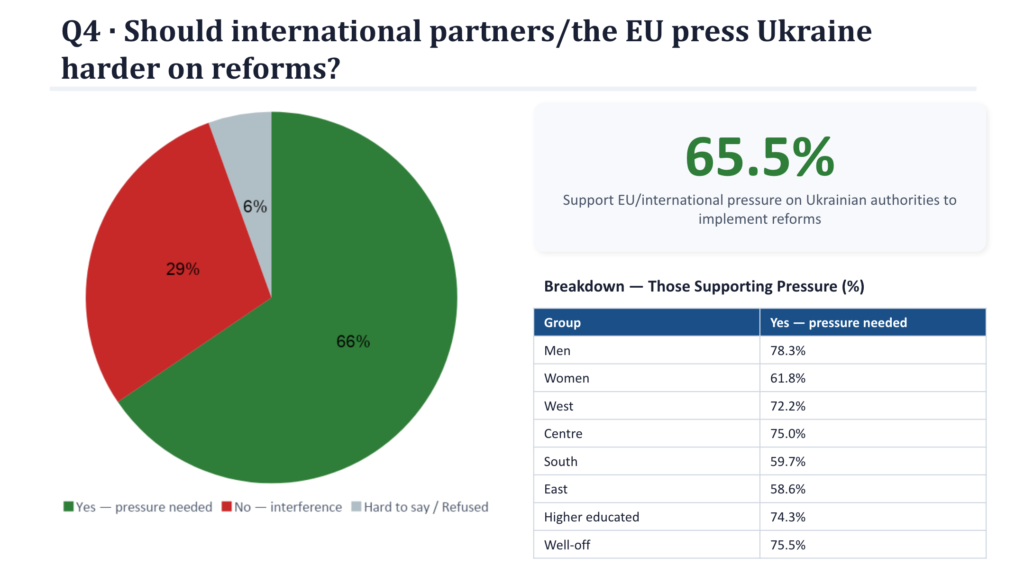
The findings indicate that a significant share of the public sees international engagement as an important driver of reform. In the judicial sphere, this includes support for the continued participation of international experts in judicial governance and selection processes, including competitions to the High Qualification Commission of Judges (HQCJ). Moreover, this obligation is part of the Kachka-Kos reform list.
External Incentives Seen as Important for Reform Progress
The survey also suggests that Ukrainians view external incentives as an important factor in sustaining reform efforts. Only 24.2% believe the government would maintain the current pace of reform if international partners reduced the financial and political conditionality often associated with reform support.
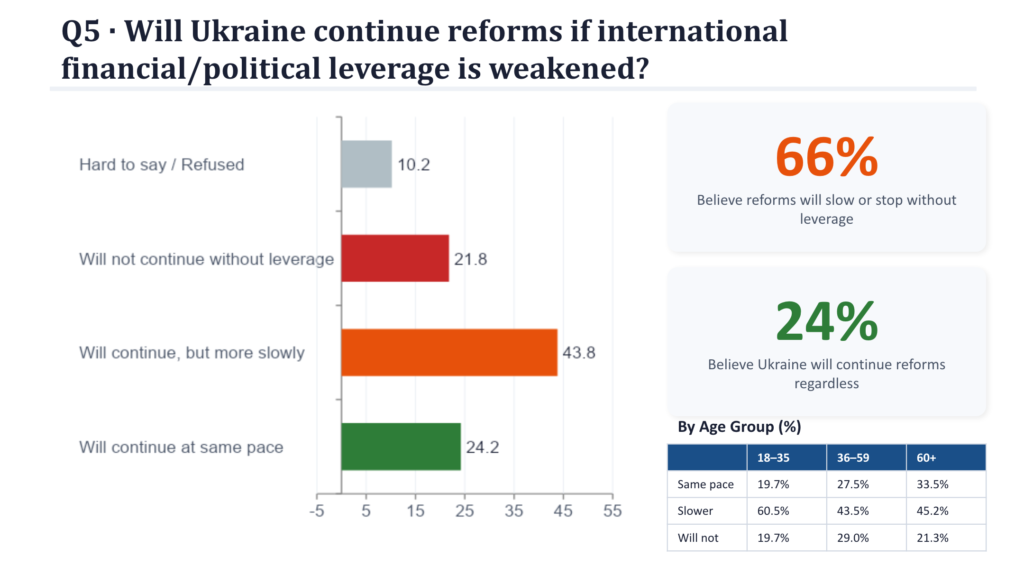
Meanwhile, 43.8% expect reforms would continue but at a slower pace, while 21.8% believe reform efforts would stall altogether in the absence of such incentives. Overall, nearly two-thirds of respondents (65.6%) associate either the pace or continuation of reforms with ongoing international engagement and support.
Methodology
A set of questions on reform issues was included at the request of the DEJURE Foundation in the survey Public Opinion and Attitudes of Ukraine’s Population, conducted by the Kyiv International Institute of Sociology (KIIS) in May–June 2026.
Fieldwork took place from 7 May to 3 June 2026 using computer-assisted telephone interviews (CATI). The survey sample included 2,007 adult Ukrainian citizens residing in government-controlled territories at the time of the survey.
Residents of temporarily occupied territories and Ukrainian citizens who left the country after 24 February 2022 were not included in the sample.