New rules bring new risks. What the draft law on the selection of HCJ members changes
The government’s draft law submitted to the Venice Commission for consideration, in addition to a new procedure for forming the HQCJ, also substantially changes the procedures for electing (appointing) members of the High Council of Justice (HCJ). The proposed changes may create new risks for the selection competitions.
Telling in itself is the way the public learned about the new version of the draft law. Its text was not published on Ukrainian government resources. It became available on the Venice Commission’s website.
The mandate of international experts in the Ethics Council is not extended
First of all, the draft law ignores the issue of extending the mandate of the international experts on the Ethics Council (EC), which vets candidates for the HCJ for compliance with the criteria of professional ethics and integrity. The mandate of the international experts on the EC expires in November 2027.
Extending international participation is critically important for ensuring the transparency and independence of the HCJ selection competitions.
Different bodies will vet candidates’ documents
The draft law removes the HCJ Secretariat from the initial vetting of candidates for compliance with the requirements of the law.
Under the new procedure, candidates under the quotas of the congresses of judges and of attorneys and of the conference of prosecutors will submit their documents directly to the body that convenes the respective congress or conference (for example, the Council of Judges for candidates under the judicial quota). It is precisely this body that will check the documents and decide whether a candidate meets the requirements of the law.
At present, the initial vetting is carried out by the HCJ Secretariat. This ensures a uniform approach to applying the formal requirements to candidates. After the changes, different bodies will be able to interpret identical requirements differently — for example, regarding the counting of professional experience. This creates a risk that an unwanted candidate could be filtered out even before the Ethics Council’s vetting.
Assessment of professional competence
The draft law introduces a new stage in the selection of HCJ members — an interview to assess a candidate’s professional competence. At present, a similar interview is envisaged only in the selection of candidates under the President’s quota.
The draft law proposes extending this approach to the other quotas. The interview will be conducted by the body that convenes the respective congress or conference (the CoJ, the Bar Council, the Council of Prosecutors), and for the parliamentary quota — by the relevant committee of the Verkhovna Rada. Based on its results, the respective body will adopt a decision on each candidate and forward it to the congress, conference or parliament, which will then elect the HCJ member.
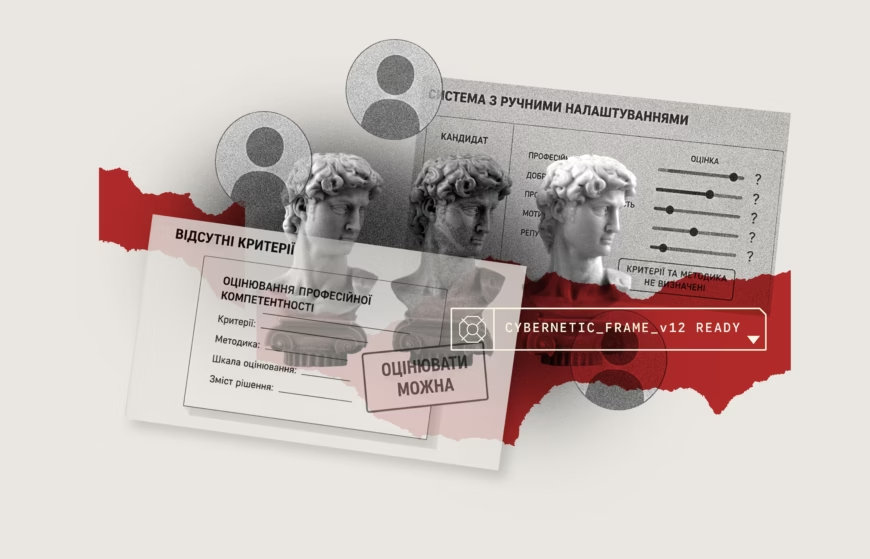
Professional competence is one of the criteria for selecting HCJ members, so assessing it separately looks logical in itself. The problem lies in exactly how the government proposes to conduct such a review. The draft law does not establish the criteria for this assessment or its substance, and does not even specify the content of the decision that is to be adopted following the interview.
This gives the respective bodies extraordinarily broad discretion and may place candidates in unequal conditions. An unwanted candidate can be asked difficult questions, including on topics that are not directly related to the work of an HCJ member, and be given a negative assessment, while for a desired candidate the interview may turn into a “warm bath.” And the decision of the body that conducted the interview will obviously also influence the subsequent vote at the congress (conference) or in parliament.
There is another question: how competent these bodies themselves are to assess a person’s readiness to work specifically as an HCJ member. For example, do members of the Bar Council or the Council of Judges know enough about the specifics of the HCJ’s work, disciplinary procedures and judicial selection to assess a candidate’s professional competence?
Doubts on this score have already arisen in practice. In particular, the Bar Council initiated disciplinary proceedings against members of the HQCJ and the HCJ in situations where they were exercising their powers. This casts doubt on such bodies’ understanding of the specifics of judicial governance procedures and integrity vetting.
A far better and more open mechanism could be the completion of a written assignment. Such a model already exists in the selection of Constitutional Court judges. It would be advisable to hold it before the integrity vetting: first screen out candidates who have not demonstrated the required level of knowledge, and only after that vet the integrity of candidates, which requires far more resources than a written examination. Moreover, such an examination should be conducted by a single body — for example, the Ethics Council — under the same rules for candidates under all quotas.
All Ethics Council materials are handed over to the electing bodies
Another risky innovation is the transfer to the body appointing or electing HCJ members (for example, the congress of judges or of attorneys) of all documents and information gathered by the Ethics Council during the vetting of candidates.
First of all, the purpose of transferring materials on candidates who have already dropped out of the competition for failing to meet the integrity criterion is unclear. The Ethics Council adopts reasoned decisions on them. The electing body can no longer return such candidates to the competition or appoint them, yet it will receive confidential information about them.
However, even with regard to candidates who remain in the competition, transferring all the collected materials is excessive. Vetting professional ethics and integrity is the task of the Ethics Council, while the task of the electing bodies is to choose the best among the candidates who have passed this vetting. If necessary, the law could be supplemented with a requirement to provide more detailed reasoning for the Ethics Council’s decisions on recommended candidates.
This is especially risky because of the number of people involved in electing HCJ members: the congress of judges comprises almost 300 delegates, while the All-Ukrainian Conference of Prosecutors may number more than 500 delegates. At the same time, the draft law does not determine who exactly within such a body will have access to the confidential materials, to what extent and under what rules. In particular, will taxpayer identification numbers, data on place of residence, income, property, bank accounts and other information about a candidate and their relatives be handed over? Nor have sufficient safeguards been established against their further dissemination.
Ultimately, this may create a chilling effect: the awareness that confidential information about a candidate and their close ones may end up in the hands of an undefined and potentially very wide circle of people is capable of significantly reducing the number of people willing to apply for the HCJ competition.
Electronic submission of documents is abolished for the parliamentary quota
Finally, for candidates for HCJ membership under the Verkhovna Rada quota, the draft law proposes eliminating the possibility of submitting documents electronically. They will be able to be submitted only in paper form — in person or by mail.
The draft law does not explain why the already existing electronic method of submitting documents should be abandoned. Such a change looks like an obvious step backwards and effectively a return of the competition procedure to the “Stone Age” instead of simplifying and digitalising it.