NGOs call on the President and the Verkhovna Rada to urgently fill vacancies in the Constitutional Court of Ukraine
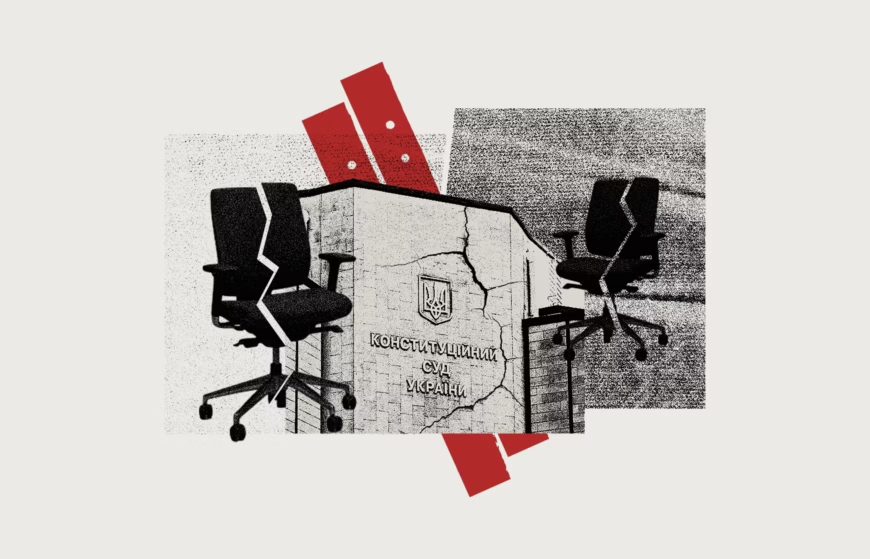
The Constitutional Court of Ukraine is a key actor in defending the Basic Law and an important part of the system of checks and balances. A politically dependent or dysfunctional Constitutional Court (the Court/CCU) can create serious risks to the balance of power and the rule of law. The Court’s capacity to operate stably, independently, and at full strength is therefore a matter of the state’s institutional resilience. Under the legal regime of martial law, without elections or a political reset, the CCU must remain part of an effective system for protecting the constitutional order.
Following the reform, Ukraine introduced a new competitive procedure for selecting CCU judges involving the Advisory Group of Experts (AGE), which includes Ukrainian lawyers and international experts. This model has helped reduce political influence over the composition of the Court and ensure that candidates are assessed on the basis of professionalism and integrity.
However, the new procedure can effectively fulfil its purpose only if all its stages take place within reasonable timeframes and the candidates selected are considered promptly by the appointing bodies.
Today, judicial vacancies at the CCU remain unfilled by all three appointing bodies. In October 2025, the Verkhovna Rada failed to appoint any of the candidates selected by the AGE, forcing the competition for two vacancies to be relaunched. The President of Ukraine has appointed two judges, but since the start of 2025, has not filled another vacancy despite the availability of candidates recommended by both the AGE and the selection commission. No new competition for this vacant position has been announced. Under the quota of the Congress of Judges of Ukraine, there is a shortage of candidates who pass integrity vetting.
The Constitutional Court is meant to consist of 18 judges, but 5 positions are currently vacant. Formally, 13 judges are enough for the CCU to operate, but a quorum in the Grand Chamber requires at least 12, meaning even the temporary absence of a few judges could block the adoption of decisions. If the vacancies are not filled by November 2026 and March 2027, when the terms of two more judges expire, the Court could lose its quorum again.
Timely filling of vacancies at the Constitutional Court is one of the priorities in the areas of anti-corruption and the rule of law on Ukraine’s path to the European Union. Delays in competitions or appointments therefore carry consequences not only domestically, but also for European integration.
In this regard, we call on the authorities responsible for appointing judges of the Constitutional Court of Ukraine to take the following steps:
- The President of Ukraine to urgently fill the vacant position of Constitutional Court judge from among the candidates already selected through the competitive procedure, or announce a new competition for this position.
- The Verkhovna Rada of Ukraine to urgently consider candidates from the Advisory Group of Experts’ rating list and fill the vacant positions of Constitutional Court judges within the parliamentary quota.
- The Congress of Judges of Ukraine to urgently take all necessary measures to hold a new selection of candidates for the vacant positions of Constitutional Court judges under the judicial quota, and ensure the openness, competitiveness, and proper quality of this process.
This statement is open for signature by civil society organisations.
- DEJURE Foundation
- Civil Network OPORA
- Anti-Corruption Center “MEZHA”
- All-Ukrainian Association “Automaidan”
- Anti-Corruption Action Center (AntAC)
- Institute of Mass Information (IMI)
- National Interests Protection Network “ANTS”
- Transparency International Ukraine
- NAKO – Independent Anti-Corruption Commission
- NGO “Women’s Veteran Movement”
- Centre for Economic Strategy
- “Public Control” Platform
- Expert Organisation StateWatch
- NGL.media / Lviv Group NGO
- NGO “Independent”
- CHESNO Movement
- Charitable Organisation “Woman Can”
- International Charitable Foundation “Ukrainian Public Health Foundation”
- NGO “Genealogical Community ‘Arkhisovist'”
- All-Ukrainian NGO “Boyko Ethnological Society”
- NGO “ZORAKS”
- All-Ukrainian NGO “Women’s Consortium of Ukraine”
- NGO “Chervonyi Huber”
- NGO “Regional Development Agency of the Siverskyi Region of Ukraine”
- Ukrainian Capital Markets Association
- NGO Youth Organisation “Vzaiemodiia”
- NGO “Modern World of Youth”
- Odesa Regional Organisation of the All-Ukrainian NGO Committee of Voters of Ukraine (CVU)
- Civic Partnership “For Transparent Local Budgets!”
- Civic Platform “New Country”
- NGO “Kremenchuk Anti-Corruption Center”
- NGO “Center for Reforms and Local Development”
- NGO Centre of Policy and Legal Reform (CPLR)
- NGO “Ukrainian Association of Education Researchers”
- NGO “Vyshche”
- UkraineNow.org
- DiXi Group
- Center for Civil Liberties
- NGO “Crimean Tatar Resource Center”
- Anti-Corruption Headquarters
- NGO “Dyvna Ukraina”
- NGO “Bilozerka Center for Regional Development”
- NGO “Rivne Center ‘Social Partnership'”
- NGO “Coalition of Cultural Actors”
- NGO “Communications for Change”
- NGO “Zero Waste Lviv”
- NGO “Incubator of Democratic Initiatives”
- NGO “PERFECT ART GROUP”
- NGO “CULTURAL ASSEMBLY”
- NGO “Institute of Dialogue, Mediation, and Alternative Dispute Resolution”
- NGO “RIPO Patriot”