One year after Vovk’s dismissal: will the Supreme Court restore a symbol of corruption to the bench?

March 18 marked one year since the High Council of Justice (HCJ) dismissed Pavlo Vovk from his position as a judge. This decision became a landmark for the judicial system, as Vovk has long symbolised judicial corruption, political influence, and the use of courts for personal interests.
How did Vovk maintain his influence?
Just a few years ago, Vovk’s dismissal seemed almost impossible. Recordings made by NABU in Vovk’s own office revealed his influence over the former composition of the HCJ. In the so-called “Vovk’s tapes,” he described, among other things, his ability to influence the HCJ to ensure that judges of the District Administrative Court of Kyiv (DACK) close to him would avoid accountability. Among them were Yevhenii Ablov and Bohdan Sanin. The recordings also referred to the organisation of artificial complaints against disloyal DACK judges to keep them under control.
Following the publication of the recordings, the Prosecutor General filed a motion to suspend Vovk and other DACK judges from administering justice. However, the HCJ at the time refused. The HCJ claimed that the NABU recordings were part of an information campaign aimed at undermining the authority of the judiciary.
What changed after the HCJ reset?
The situation shifted after the HCJ was reconstituted with the involvement of international experts. This made it possible to dismiss Pavlo Vovk and to initiate disciplinary proceedings against dozens of other judges. One year ago, the HCJ not only dismissed Vovk but, over more than two years of its work, also submitted motions to dismiss over 50 judges, including representatives of the DACK.
Why is Vovk’s case still unresolved?
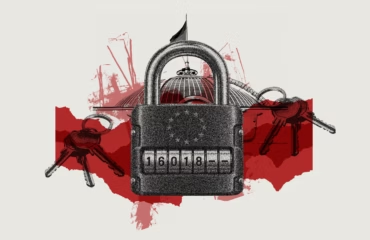
At the same time, the risk of Vovk’s return to the judiciary remains. He is currently seeking reinstatement through the Supreme Court. His main argument is that materials from criminal proceedings, including the results of covert investigative actions, allegedly cannot be used in disciplinary proceedings.
However, both the practice of the HCJ and the case law of the Supreme Court allow the use of such materials in disciplinary cases. If the Supreme Court departs from this approach in Vovk’s case, the consequences will extend far beyond his individual situation. Such a ruling could open the door to the reinstatement of around 50 other judges whose dismissals also relied on materials from criminal proceedings. Moreover, it could effectively block future accountability for judges caught by law enforcement accepting bribes or committing other crimes, but not yet dismissed. This includes DACK judges Ablov, Keleberda, and Pohribnichenko, as well as Lviv judges Artymovych and Malekh, who are implicated in a $1 million bribery case.
Vovk’s attempt to return to the bench goes far beyond a single personal case. The Supreme Court’s decision will determine whether the results of the HCJ reset are preserved and whether judicial reform will have real consequences for judges of low integrity.
The next hearing in Pavlo Vovk’s case is scheduled for April 9. Public attention and scrutiny will be critical to preventing the worst-case scenario.