The Council of Judges Nominates Low-Integrity Candidates Again: Who Will Select Judges for the New Administrative Courts?
On May 1, the Council of Judges of Ukraine (CoJ) published a list of nominees for the Expert Council, which will vet candidates for judicial positions in the two new administrative courts.
Unfortunately, the CoJ has consistently nominated low-integrity candidates to key selection bodies. Among past examples are: Yurii Triasun, who released from custody a Berkut officer suspected of killing three Euromaidan protesters; Yaroslav Romaniuk, head of the Supreme Court under Yanukovych; and Volodymyr Kuzmenko, implicated in the infamous “Vovk tapes”.
This time was no different: the COJ submitted a list of nine nominees, five of whom raise serious integrity concerns.
-
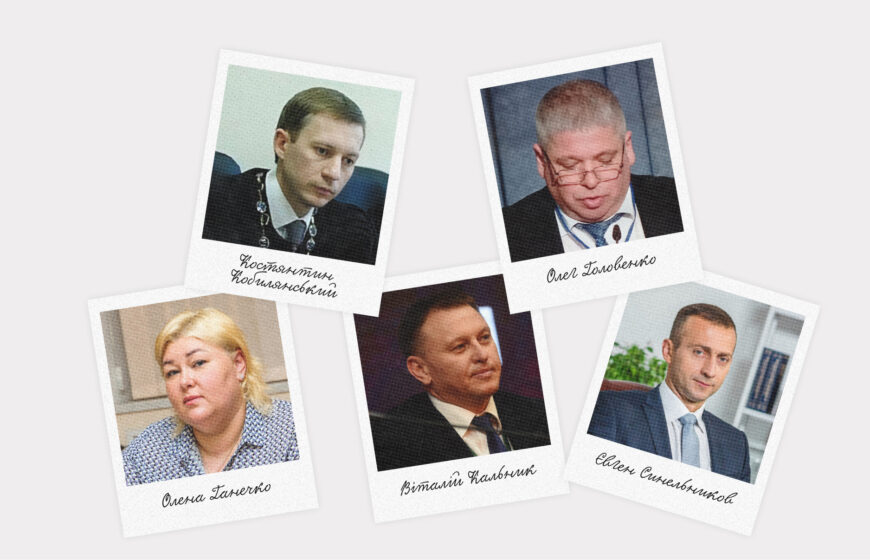
Olena Hanechko – judge of the Sixth Administrative Court of Appeal, CoJ member.
She participated in the COJ working group that developed the Unified Indicators for Evaluating Judicial Integrity and Ethics. However, both the High Qualification Commission of Judges (HQCJ) and the Public Integrity Council (PIC) have raised doubts about her own integrity. Hanechko has issued controversial rulings in high-profile cases, including dismissing a prosecutor’s motion to detain Dmytro Firtash’s stepson Serhii Kalynovskyi, who allegedly caused a fatal car accident and fled abroad. She has also failed to properly declare assets and was among 47 judges the President requested the HCJ dismiss for violating their oath due to corruption concerns. Read more in the PIC’s opinion and the material.
-
Oleh Holovenko – judge of the Kyiv District Administrative Court, CoJ member.
Also part of the COJ working group on integrity indicators. He failed his qualification assessment at the HQCJ but avoided dismissal thanks to the old HCJ. Holovenko’s track record includes inconsistencies in asset declarations, politically motivated rulings, and ties to individuals implicated in the “Vovk tapes.” He appears to have helped the DACJ judges obstruct the HQCJ’s work, notably by filing a lawsuit against HQCJ member Tetiana Veselska.
-
Vitalii Kalnyk – judge of the Dnipropetrovsk District Administrative Court, CoJ member.
His asset declarations raise serious concerns, particularly the undervaluation of assets and doubts over the legitimacy of his income. Between 2013 and 2018, his parents officially earned about UAH 2.5 million but acquired significantly more expensive property (apartment, car, etc.), which was then transferred to the judge’s use. He has also issued rulings while not physically present at work. More details in the PIC’s opinion.
-
Kostiantyn Kobylianskyi – judge of the District Administrative Court of Kyiv, CoJ member.
Kobylianskyi and his family own high-value assets disproportionate to their official income, according to PIC’s opinion. His father held a high-ranking position during the Yanukovych era and was a former member of the old High Council of Justice. Kobylianskyi defended his dissertation under Serhii Kivalov, and his thesis abstract contains plagiarised sections from Kivalov’s article.
He is closely associated with Yevhen Ablov, another figure from the “Vovk tapes”, even attending Ablov’s birthday party. HQCJ members present at that event later gave Kobylianskyi a favourable assessment. He is also among the 180 judges shielded by the Supreme Court’s ruling in the Vitalii Usatyi case. More details available here.
-
Yevhen Synelnykov – judge of the Supreme Court.
As part of a judicial panel, he issued a ruling that endangered freedom of speech by declaring information about HCJ member Pavlo Hrechkin as “untrue”. MPs Dmytro Lubinets and Andrzej Klymchuk had called Hrechkin an “odious HCJ member”, but the Supreme Court ruled this was a factual statement rather than an opinion. The ruling, which DEJURE Foundation previously analysed, risks undermining freedom of expression by categorising opinions as falsehoods.
Once again, the Council of Judges is putting forward candidates with serious integrity concerns, clearly aiming to preserve the status quo within the judiciary.
This list also gives a preview of who the CoJ might nominate to the new Selection Commission for HQCJ members, should Parliament fail to extend the current Commission’s mandate, which includes international experts.
We hope the HQCJ understands the critical importance of an independent and professional Expert Council and will not allow questionable candidates to be appointed.