The Supreme Court in the shadow of scandals: corruption, obstruction of reform, and a Russian connection
The article was originally published on pravda.com.ua.
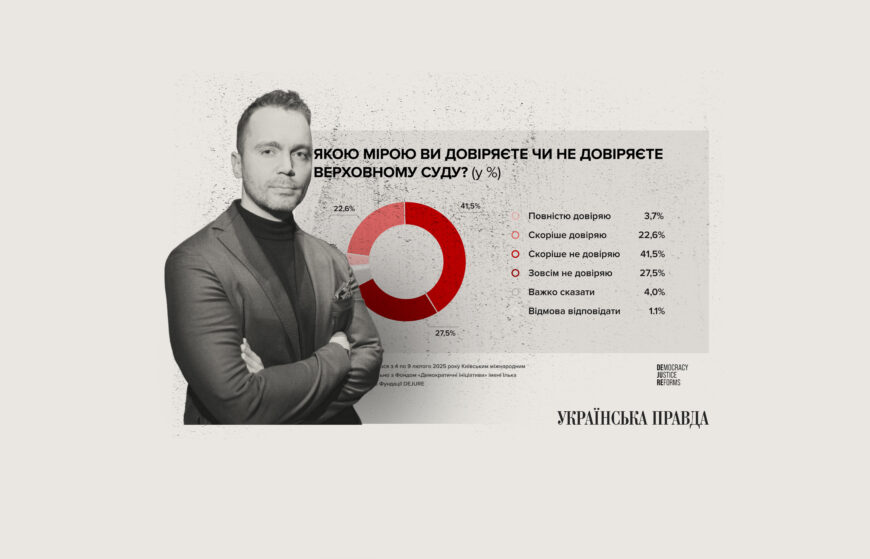
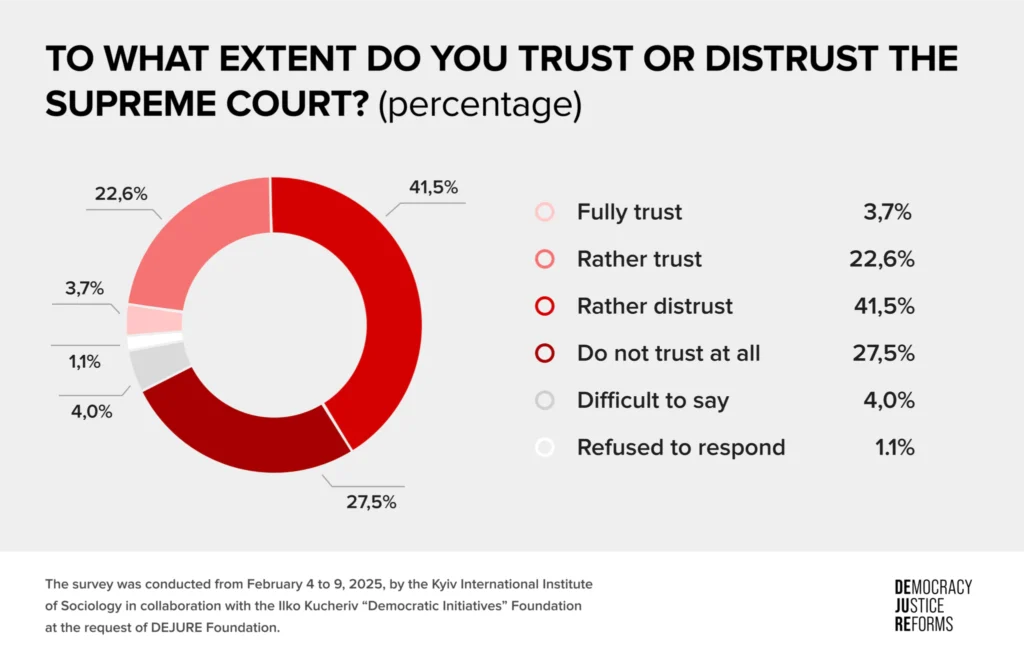
In 2025, Ukrainians’ distrust of the Supreme Court reached 69%, as shown by a sociological survey conducted by the DEJURE Foundation. Among the main reasons for their negative attitude toward the judicial system, Ukrainians cite corruption, judges’ dependence on politicians and oligarchs, and insufficient judicial integrity. These results once again confirm the urgent need to reform the Supreme Court and renew its composition.
The Supreme Court’s problems can be divided into the following categories:
- corruption scandals;
- harmful rulings that undermine judicial reform;
- security threats, including Russian passports held by judges.
The DEJURE Foundation examines the Supreme Court’s core problems, how they affect the country’s agenda, and analyzes why Ukraine’s highest judicial body needs renewal.
“The Supreme Court’s black day” — the largest bribe in history
Back in the spring of 2023, anti-corruption authorities exposed Supreme Court Chief Justice Vsevolod Kniaziev taking a bribe of nearly 3 million dollars. That day was called “a black day in the history of the Supreme Court.”
According to the investigation, Kniaziev asked for the bribe to be sorted into 13 black envelopes containing various amounts. It remains unclear whether all 13 judges received envelopes with money and what arrangements they had with Kniaziev. The case has not been brought to a conclusion.
From public sources, it became known that searches were conducted at the homes of at least two Supreme Court judges — 50,000 dollars were found in the possession of judge Zhanna Yelenina and 50,000 dollars in the possession of judge Iryna Hryhoriieva. Neither has been served with a notice of suspicion. Lawyers from the DEJURE Foundation filed a complaint against these judges with the High Council of Justice. In 2024, the HCJ opened a disciplinary case, but it has not been heard for more than a year.
The names of the remaining judges for whom Kniaziev prepared the envelopes are unknown. They continue to work at the Supreme Court, issuing the most important rulings — including ones that derail judicial reform and obstruct European integration. We will discuss them in more detail below.
Ukrainian justice with a Russian passport
In September 2022, a journalistic investigation into the Russian passport held by Bohdan Lvov, the former head of the Commercial Court of Cassation within the Supreme Court, caused a major public outcry.
Bohdan Lvov became head of the Commercial Court of Cassation within the Supreme Court despite warnings from the Public Integrity Council. He subsequently also assumed the position of Deputy Chief Justice of the Supreme Court. With a Russian passport, Bohdan Lvov had access to state secrets and issued rulings in the name of Ukraine.
After Lvov’s exposure, then-Chief Justice Kniaziev sent a request to the Security Service of Ukraine (SBU) asking it to check all Supreme Court judges for foreign citizenship. However, the SBU appears to have deliberately sabotaged this review. Only three months after the journalistic investigation did the Security Service of Ukraine publicly report that it had found no Russian citizenship in the case of Vsevolod Kniaziev. No reports were made about any other Supreme Court judges who were additionally checked.
The Russian passport of retired judge Valentyna Simonenko, which she had obtained in 2003, also became known through journalists — in 2023. Previously, the Public Integrity Council had reported that Simonenko had ties to occupied Crimea. Activists also established that in 2015, the judge had obtained an individual Russian tax identification number from the Inter-district Inspectorate of the Federal Tax Service No. 1 in Sevastopol. Activists even organised a protest outside the Presidential Administration against her appointment to the Supreme Court. Yet these grounds proved insufficient for the SBU to check Simonenko for foreign citizenship. And in 2018, President Poroshenko appointed her as a judge of the Civil Court of Cassation within the Supreme Court.
It appears that the SBU is either deliberately concealing information about Russian citizens within the Supreme Court or is unable to investigate this independently, since Ukraine has no effective mechanism for checking candidates and judges for the possession of a foreign state’s passport. In response to a request from the DEJURE Foundation, the SBU stated that it “continuously checks” individuals for foreign citizenship. How this is done with respect to judges — including those with access to state secrets — is unknown. The risk of justice being administered at the Supreme Court by Russian citizens therefore persists, which confirms the need to vet sitting judges in order to avoid a repetition of the situations involving Lvov and Simonenko.
More than half of the Supreme Court judges raise integrity concerns
The first attempt to create a new Supreme Court in 2016 failed long before the Kniaziev scandal. This is hardly surprising, since the selection procedure at the time was entirely a sham — a significant number of judges lacking integrity obtained positions on the “new” court despite numerous objections and demands from the PIC.
A quarter of the judges appointed to the Supreme Court at that time had previously received a negative opinion from the Public Integrity Council. And regarding approximately 50% of them, the PIC provided information that could indicate a low level of integrity — including, among others, former Chief Justice Vsevolod Kniaziev. Despite this, by 2019, the Supreme Court was fully staffed.
Now the court’s reputation and public trust continue to collapse spectacularly. More than 51% of sitting Supreme Court judges may lack integrity as of 2025, as indicated by negative opinions and information from the Public Integrity Council. Experts from the DEJURE Foundation analysed available data on 153 currently serving justices of the Supreme Court. Of these, 34 have received negative opinions from the PIC, while for 44 others there is information that may indicate a lack of integrity — including, for example, journalistic reporting on a candidate’s connections with Russians, certain questions regarding asset declarations or judicial rulings, and so on.
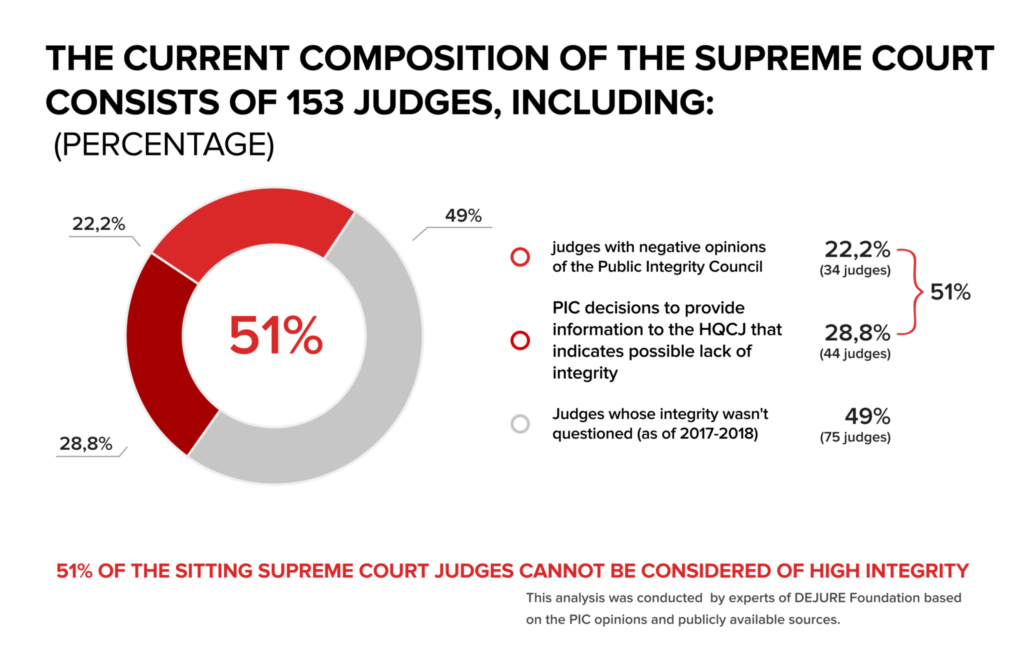
Given recent scandals involving Supreme Court judges, this figure may be significantly higher. A striking example is Supreme Court judge Serhii Zhukov, who, according to journalists, lives in an undeclared estate worth 1 million dollars.
More about Supreme Court judges and their other notable conduct is presented by the DEJURE Foundation in the special project “The Supreme Court unmasked: corruption, resistance to reform, and Russian passports.“
How the Supreme Court undermines judicial reform
Opponents of cleansing the Supreme Court often turn a blind eye to the court’s scandal-ridden judges and instead point to its supposedly effective work in developing consistent judicial practice. However, it is already clear that the Supreme Court has taken a firm stance against reform and against progress on European integration. This is confirmed by the Supreme Court’s recent rulings on dismissals, the qualification assessment of judges lacking integrity, and other matters.
The renewal of the judicial system — through qualification assessment of judges, disciplinary proceedings, authorisation of investigative measures against a judge in criminal cases, and competitions for judicial appointments — depends on the reformed High Qualification Commission of Judges of Ukraine and the High Council of Justice.
At the same time, the decisions of these two bodies are already landing before the Supreme Court, on which the outcome of the reform now depends. Unfortunately, the Supreme Court’s practice shows that judicial cleansing is currently under threat.
The DEJURE Foundation has analysed Supreme Court rulings that imperil the entire progress of judicial reform. Below are just a few of the most damaging examples.
- Saving the low-integrity judges: qualification assessment
180 judges lacking integrity may be reinstated as a result of the Grand Chamber of the Supreme Court’s ruling in the case of judge Usatyi. That ruling put at risk the previous qualification assessments of all those falling within that number.
Among them are judges recently caught taking bribes — for example, Serhii Burkhan — as well as judges of the notoriously known District Administrative Court of Kyiv, Kostiantyn Kobylianskyi and Dmytro Kostenko, and others. These judges possess assets exceeding their declared income, helped the authorities suppress protests during the Revolution of Dignity, obtained judicial appointments through family connections, and en masse released drunk drivers from liability. All of them have PIC opinions finding a lack of integrity, yet they successfully passed interviews before HQCJ panels (of three members). Under the law, the full composition of the High Qualification Commission of Judges is required to complete the procedure for assessing their fitness for office.
In the Usatyi case, the Grand Chamber ruled, without adequate justification, that despite the existence of a negative PIC opinion concerning a judge, the final determination during his qualification assessment rests with the HQCJ panel alone — provided its decision was adopted before 30 December 2023 (when amendments to the law were introduced, on which the Grand Chamber relied in its ruling). Such an abrupt departure from the Supreme Court’s longstanding prior practice contradicts the law and, more importantly, the goal of judicial reform — the cleansing of judges lacking integrity.
It is noteworthy that this ruling attracted the attention of international partners and was mentioned in the recent European Commission report on Ukraine. In the Commission’s words, “the court departed from its previous practice and put at risk the qualification assessment of judges with the involvement of the Public Integrity Council.” Such large-scale documents do not usually single out one specific ruling for comment. This illustrates just how significant and dangerous the Supreme Court’s position is.
- A place in the system for the low-integrity judges: selection for judicial office
As a result of a Supreme Court ruling, candidates who enjoy travelling to Crimea and the occupied territories may become judges, as occurred in the case of judge Oleksandra Shulika. Such trips are always risky, since enemy intelligence services actively recruit Ukrainians. However, the Supreme Court held that such trips are insufficient grounds for rejection unless the candidate’s explicit support for Russian occupation can be demonstrated. The Supreme Court’s practice in the Shulika case gives candidates with similar backgrounds a clear path to becoming newly appointed judges.
- Retirement with honours as a lifeline
The Supreme Court has created a dangerous loophole by allowing judges who lack integrity to retire with honours and receive substantial lifelong payments, without undergoing the mandatory qualification assessment. This effectively contradicts a key accountability mechanism within the judicial reform framework.
In this way, the Supreme Court shielded judge Hanna Andriienko from accountability — she had delayed the consideration of 49 drink-driving cases. The court effectively compelled the High Council of Justice to consider her resignation application, even though the HCJ should have addressed the question of her dismissal on the recommendation of the HQCJ. Andriienko will now receive approximately 75,000 hryvnias per month, plus at least another 400,000 hryvnias as a one-time severance payment.
The Supreme Court also “gifted” an honourable retirement to the notoriously known former head of the Kyiv Court of Appeal, Anton Chernushenko, who was exposed for taking a bribe back in 2015. Chernushenko was suspected of interfering with the automated assignment of cases and of issuing knowingly unjust rulings. But the case was closed. The judge then fled to the Russian Federation, and only in 2018 did the previous HCJ dismiss him for absenteeism. In 2022, Anton Chernushenko challenged this decision before the Supreme Court — and won. The Grand Chamber judges concluded that Chernushenko’s dismissal had not been sufficiently justified, and that the judge had been absent from work solely because of “criminal prosecution and a desire to avoid the arrest and detention that were authorised at the time.” As a result, Chernushenko gained the prospect of a substantial lifelong pension — at our expense.
The cleansing of the Supreme Court is an urgent necessity
The corruption scandals, rulings, and other shortcomings in the Supreme Court’s work have not gone unnoticed by the public or by international partners. Europeans have not for the first time emphasized the need to cleanse the Supreme Court. This is also addressed in the latest European Commission report on Ukraine for 2024, which clearly states that the procedure for selecting Supreme Court judges must be changed through new legislation and uniform criteria for assessing judicial integrity. International partners expect the Ukrainian authorities to enshrine this in new legislation to be adopted “as soon as possible.” This will also advance the core goal of the reform — the cleansing of the judiciary. Yet at present, there has been no progress in this direction whatsoever.
What needs to be done so that the country’s highest judicial body works in Ukraine’s interests:
- Verify the integrity of sitting Supreme Court judges in order to eliminate corruption risks and restore public trust in justice — through integrity declarations covering their entire lifetimes. Such verification must be mandatory. This is also emphasised by the European Commission in its report on Ukraine.
The verification should be conducted by the High Qualification Commission of Judges and the Public Council of International Experts, which is composed exclusively of representatives of international donors. This model demonstrated its effectiveness during the vetting of candidates for the High Anti-Corruption Court in 2018. At that time, the panel of six international experts ensured a high standard of selection and guaranteed that there were no serious doubts about the integrity of the candidates appointed to the court.
If there are well-founded doubts about a judge’s truthfulness, the HQCJ must refer the matter to the High Council of Justice for priority consideration of disciplinary proceedings against that judge. The HCJ then dismisses the judges found to lack integrity from their positions. - Select candidates of integrity for vacant Supreme Court positions through a transparent and open competition.
The number of judges at the Supreme Court is declining — over the past few years, a number of them have already left. Currently, approximately a quarter of positions are vacant (as of 2025, there are 151 Supreme Court judges). The effective functioning of Ukraine’s highest judicial body depends on two interrelated components: the cleansing of the current bench and the recruitment of new judges — the latter alone will not be sufficient for deep reform.
Cleansing through the vetting of sitting judges, combined with a transparent competition for vacancies, will not cause the Supreme Court to collapse. On the contrary, it creates an opportunity to swiftly remove judges with low integrity who are doing everything in their power to avoid accountability.
The competition must take place under new rules. It must be an open and transparent selection process with the participation of the Public Council of International Experts. The key role of international experts on judicial selection and judicial governance bodies is now the “gold standard” for selections and assessments. Ultimately, the stronger the voice of international representatives or civil society — rather than judges themselves — the better the outcome. This lesson must be heeded to prevent the next Lvovs and Kniazievs from occupying these positions.
However, the Ukrainian authorities appear to have decided to simulate reform a second time instead of cleansing the Supreme Court. In April 2025, the Cabinet of Ministers submitted to the Verkhovna Rada draft law No. 13165, which reduces the vetting of Supreme Court and other high court judges to a mere formality. What the draft law proposes is an even worse version of Supreme Court reform than what Ukrainians already went through in 2016–2019.
Ukraine’s capacity and development depend directly on a genuine renewal of the Supreme Court and on filling it with judges who will act in the interests of Ukrainian society and in accordance with EU requirements: with integrity, professionalism, and independence. Without reform of the Supreme Court, there will be neither rule of law nor justice in Ukraine. And our future and EU membership will be placed at risk, while the support of international partners will wane in the absence of results.