Yermak failed to whitewash his reputation through the Bar association — NABU and SAPO arrived first
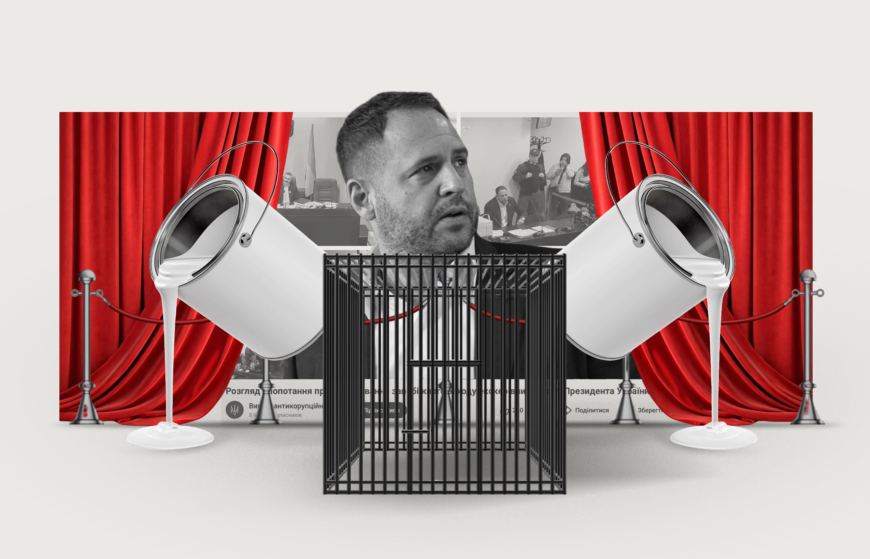
On May 11, 2026, former Head of the Presidential Office and lawyer Andriy Yermak received a notice of suspicion from NABU and SAPO for the legalisation of more than UAH 460 million allegedly laundered through corruption schemes involving Energoatom. Today, on May 14, at 9:00 a.m., the High Anti-Corruption Court imposed a preventive measure on Andriy Yermak — two months of pre-trial detention with the alternative of bail set at UAH 140 million (the prosecutors’ motions referred to UAH 180 million).
Neither connections nor attorney status protected Yermak from a suspicion notice from NABU and SAPO. At the same time, the DEJURE Foundation had previously expressed concern that attorney status and its use in working with military personnel could serve as a tool for improving the public image.
Read on to learn what is known about the laundering of UAH 460 million and how Yermak used his attorney status to rehabilitate his reputation.
What is Yermak suspected of?
On the evening of May 11, 2026, NABU and SAPO officially announced the exposure of an organised group allegedly involved in the laundering of more than UAH 460 million through operations connected to the construction of the “Dynastiya” cottage complex in Kozyn, Kyiv region. A notice of suspicion was served on “one of its members — the former Head of the Office of the President of Ukraine.”
Following the notice of suspicion, NABU launched urgent investigative actions and filed a motion to seize assets related to the case. As of May 12, investigative actions were ongoing. NABU detective Oleksandr Abakumov had previously stated publicly that Yermak may appear in the case materials under the alias “The Surgeon.” Yermak denied all charges: “I have no house whatsoever.” When journalists asked about the alias “The Surgeon” appearing in case materials, he replied: “My name is Andriy Yermak, I have no other name.”
The “Dynastiya” case is part of Operation “Midas” — an investigation that NABU conducted over 15 months and gathered more than a thousand hours of intercepted communications. According to investigators, the organised group controlled procurement at Energoatom and allegedly systematically demanded kickbacks of 10–15% of the value of each contract from contractors. The funds obtained through criminal means were allegedly used to finance the construction of “Dynastiya” through affiliated companies. A telling detail from the intercepted communications: in October 2023, during massive strikes on energy infrastructure, the individuals allegedly discussed raising the kickback percentage during work on energy infrastructure facilities.
Against this backdrop, Yermak’s activity in the Bar association — which began several months before the notice of suspicion was served — appears particularly telling.
9 out of 100: Ukraine’s anti-corruption system faces its biggest test
The ruling by the High Anti-Corruption Court, as well as the work of NABU and SAPO in this case, is unprecedented in scale and political resonance. It was precisely the coordinated work of these institutions that made it possible to advance the investigation this far and secure the selection of a preventive measure. At the same time, in our previous materials, we documented attempts to reduce the role of international experts in the Bar reform process, as well as initiatives to restructure the High Council of Justice, which could weaken external oversight and protection of anti-corruption bodies. This is the key thing those in power are trying to get rid of.
Importantly, this is not only the position of civil society. European Commissioner Marta Kos publicly emphasised that the main directions of reform being monitored by European capitals are highlighted in the “Kachka-Kos plan.” And Ukraine itself set the deadline: the plan is designed for 2026. Retaining international experts in the selection process for the High Qualification Commission of Judges and the High Council of Justice is a direct point in this plan. Yet over three of the twelve months allocated for the plan’s implementation, the “Membership Check” consortium — which includes DEJURE — recorded only 9 points out of 100. Without fulfilling these obligations, there is neither EU trust nor genuine movement toward membership.
How Yermak whitewashed his reputation
On March 3, information emerged that the head of the Ukrainian National Bar Association, Lidiia Izovitova, had issued an order to create a new committee, which was headed by Andriy Yermak. It was named the Committee on the Protection of Victims of Armed Aggression Against Ukraine, Compensation Mechanisms, and Euro-Integration Legal Support for Recovery.
Following this, Yermak very quickly began to increase his activity within the Ukrainian National Bar Association. He regularly appeared at public events alongside Izovitova, while the National Bar Association was actively concluding memoranda and agreements with structures affiliated with military personnel.
These included a memorandum of cooperation with the Military Ombudsman, the National Guard of Ukraine, and the Coordination Headquarters on Prisoner of War Affairs. A meeting also took place with the Deputy Minister of Veterans’ Affairs. The stated purpose was legal consultations, responses to violations of the rights of military personnel and their families, and the drafting of legislation.
Simultaneously, a media campaign began. Yermak visited frontline areas accompanied by well-known figures (including Sean Penn). Journalists recorded his statements about lawyers working in military brigades and his intentions to provide legal support to military personnel. At that time, he and several other attorneys announced that they wished to communicate directly with military personnel, gather their concerns, and provide legal assistance.
Yermak sought to whitewash his public image through the topic of protecting military personnel. To do so, he aligned himself with individuals and environments that carry a positive reputation — such as Olha Reshetylova, who has a strong reputation in human rights and civil society circles and became Military Ombudsman in 2025. For Yermak, cooperation with such individuals creates the desired information backdrop: it establishes his image as someone engaged in helping military personnel and war victims.
Attorney status as cover for meetings with officials
An investigation by Ukrainska Pravda showed that even after his dismissal, Yermak continued to meet with influential officials. These included Zelensky’s advisor on strategic issues and former Minister of Strategic Industries Oleksandr Kamyshyn. Kamyshyn himself was unable to clearly explain to journalists what the conversation was about.
Yermak also met with National Security and Defence Council Secretary Rustem Umerov. When journalists asked about the substance of the meeting, the answer was as vague as possible: they talked “about life, work, and events in Ukraine.”
The new National Bar Association committee gave Yermak a universal formal basis for such contacts. The committee’s name and mandate are worded so broadly that virtually any topic could fall under it — assistance to the military, international cooperation, and issues of national recovery.
Possible plans — a political springboard?
It appeared that Yermak’s ambitions extended far beyond legal practice. His activity around the protection of military personnel may also have served as a springboard for a return to high-level politics. After all, if Yermak had genuinely wanted to systematically help military personnel, he would hardly have chosen the Ukrainian National Bar Association as his vehicle.
The National Bar Association has been led by Lidiia Izovitova for many years — public materials contain references to her connections with Viktor Medvedchuk. And throughout the full-scale war, the association has not become an institution that systematically supports military personnel. Instead, it has pursued attorneys who themselves went to serve.
For example, representatives of the Ukrainian National Bar Association filed disciplinary complaints against attorney-servicemembers Illia Kostin and Artem Donets. There is evidence that Artem Donets and other attorney-servicemembers were systematically targeted. Through disciplinary decisions and administrative actions, some had their certificates temporarily revoked and were stripped of the ability to provide pro bono defence to their fellow servicemembers, limiting access to legal assistance for defenders. Thirteen complaints were filed against Kostin. The reason for the conflict is straightforward — they openly criticise the association’s leadership. The military attorneys themselves stated that the National Bar Association shows no interest in their problems. Likewise, the association demonstrates no systematic support for the Armed Forces.
Courts twice ordered the National Bar Association to disclose information about its assistance to the army. In response, the association stated that it had transferred approximately 10 million hryvnias, but confirmed this with only a single payment receipt of 345,000 hryvnias dated February 28, 2022. No other evidence was provided.
Moreover, attorney-servicemember Artem Donets sent inquiries to the General Staff, the Ministry of Defence, the Security Service of Ukraine, the National Police, and other agencies asking whether they had received any assistance from the National Bar Association or Bar councils. All responded that they had received no support whatsoever.
Bar reform is not merely about fulfilling EU recommendations in the context of accession preparation — it is also a matter of national security. In the annual reports of the European Commission and civil society over the past three years, it has been underlined that Ukraine needs transparent selection procedures for the Bar self-governance bodies, independent disciplinary mechanisms, and international monitoring in order to reduce the risks of political and corrupt influence on the legal community. The current case highlights these risks: when Bar institutions and related bodies remain opaque, it creates vulnerability to the exploitation of statuses and contacts by high-ranking officials — which, in wartime, transforms from a reputational issue into a matter of national security.
The EU Ambassador to Ukraine commented on the case, noting that the proceedings at the High Anti-Corruption Court during wartime demonstrate the resilience of anti-corruption institutions.
***
The Yermak case concerns not only his individual conduct. It is an examination of the anti-corruption architecture built with the involvement of international partners and defended by civil society. NABU, SAPO, and the High Anti-Corruption Court have demonstrated that they are capable of operating even against the “untouchable.”
But the resilience of these institutions is neither self-evident nor permanent. Last year there were attempts to weaken NABU and SAPO through personnel and legislative manipulation.
For the anti-corruption system to remain effective, the rest of the judicial infrastructure must be reformed. We need an independent Supreme Court, a decent Prosecutor General, a reformed State Bureau of Investigations — all bodies that either remain under question themselves or have been used to exert pressure on NABU and SAPO. The Bar reform is much needed, so that attorney status cannot serve as cover for schemes. And international experts are also needed to return to the selection process for the High Qualification Commission of Judges and the High Council of Justice — because it was precisely this that once made possible the emergence of the independent detectives, prosecutors, and judges who are conducting this case today.