A new attack on NABU and SAPO: Vlasenko brings back his investigative commission
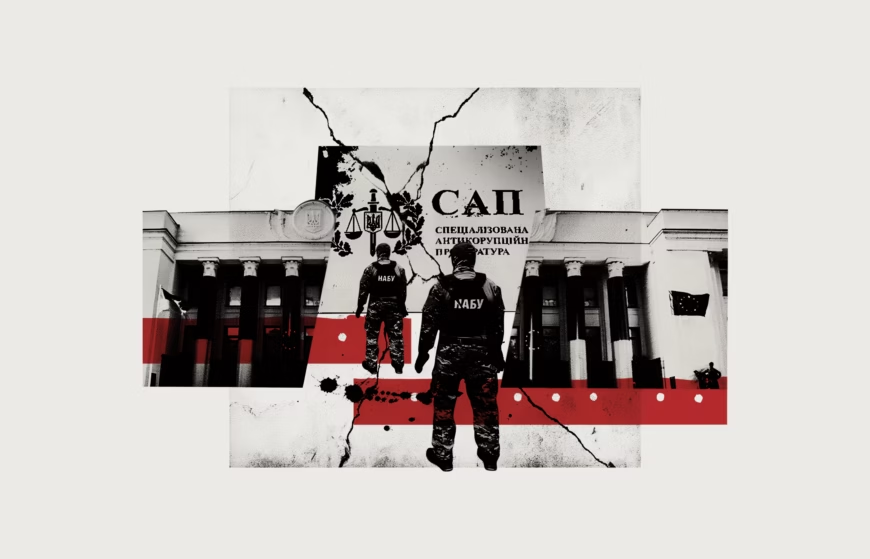
On 27 August, MP Serhii Vlasenko registered draft resolution No. 15568 proposing the establishment of a new Temporary Investigative Commission (TIC). In effect, this would restore the work of the Vlasenko–Buzhanskyi TIC, whose mandate expired on 19 June 2026.
In the explanatory note, Vlasenko explicitly describes the new commission as a “logical continuation” of the previous one. One of its main tasks, he says, would be to identify corruption risks within NABU and SAPO, whose representatives did not attend the meetings of the previous TIC.
The commission’s mandate would also cover the examination of the courts, the High Council of Justice (HCJ), the High Qualification Commission of Judges (HQCJ), the Public Integrity Council (PIC), the Ethics Council, the Public Council of International Experts (PCIE), civil society organisations, and even the media and their managers and employees — in fact, virtually everyone who investigates or reports on high-level corruption or participates in competitive selection procedures. Such a broadly defined mandate creates a risk of political pressure on anti-corruption institutions, judicial governance bodies, civil society, and journalists.
The Office of the President gave the green light — and Servant of the People provided the majority and quorum.
Of the eight proposed members of the new TIC, five represent the Servant of the People party: Maksym Buzhanskyi, Oleksandr Tkachenko, Halyna Tretiakova, Maksym Dyrdin, and Maksym Pavliuk. Buzhanskyi is again proposed as deputy chair of the commission.
Thus, it is the political support of the largest parliamentary faction, headed by Davyd Arakhamia, that gives the initiative a realistic chance of moving forward, as it would be technically very difficult to establish the TIC without the support of Servant of the People.
Given the limited autonomy of the “mono-majority” and the track record of the previous commission, there is reason to believe that the green light for another attack on NABU and SAPO may once again have come from Bankova Street. Apparently, the latest investigations involving representatives of the Office of the President were not well received.
The TIC also includes representatives of the former Opposition Platform – For Life (OPZZh) and the Restoration of Ukraine parliamentary group. The latter’s representative was delegated with the signature of Antonina Slavytska, a figure implicated in the so-called “Vovk’s tapes.”
The Verkhovna Rada did not consider the previous TIC’s reports.
In its reports, the previous TIC, led by MP Vlasenko, accused members of the Public Integrity Council of “legal nihilism.” At the same time, the Verkhovna Rada’s Rules of Procedure Committee identified a number of shortcomings precisely in the TIC’s six-month and final reports.
The Committee explicitly noted that neither the law nor the Rules of Procedure provide for the establishment of a 24-member “expert group” under a TIC; they only allow for the engagement of individual experts and specialists. In addition, the Committee recalled that an official report must be based on the principles of objectivity and political impartiality.
In other words, Vlasenko’s claims that the previous TIC operated in a “systematic” and “lawful” manner represent the TIC’s own assessment, rather than a conclusion reached by parliament. The Verkhovna Rada considered neither its six-month report nor its final report.
Compliments for the SBI and attacks on NABU and SAPO.
The final report of the previous TIC reveals double standards in its treatment of different law enforcement agencies. The Commission described the State Bureau of Investigation (SBI) as an open and transparent institution in which it had not identified a single case of deliberate concealment of corruption. It also praised the National Police for its “most open and constructive approach.”
These compliments are particularly telling against the backdrop of the Mindich tapes and recordings from Operation Themis. In the tapes, Oleksandr Tsukerman expresses his personal belief that “deals can be made with the SBU, the cops, and the SBI,” whereas “it is very difficult to make a deal with NABU.”
The same sentiment can be heard in recordings from Operation Themis. Iryna Mudra says:
“We are really scared of NABU and SAPO. You cannot find out anything from them. But understanding what is happening at the SBI or the National Police is easy.”
Maksym Mykytas sums it up:
“I tell everyone: the SBU and the National Police are bullshit. But if NABU comes after you, there are no options left.”
At the same time, the report cites as evidence of “systemic corruption risks” within NABU and SAPO such matters as NABU’s informal communication style, international professional events involving representatives of NABU, SAPO, and the High Anti-Corruption Court (HACC), and the failure of the heads of the two institutions to attend TIC meetings.
Political Context
NABU and SAPO — the very institutions that Vlasenko proposes making some of the main subjects of the new TIC — investigated proceedings involving the leader of his parliamentary faction, Yuliia Tymoshenko. Curiously, MP Vlasenko did not identify corruption risks in the neighbouring office, where, according to the investigation, a parcel allegedly contained money intended to be distributed to MPs in exchange for votes. Of course, Yuliia Tymoshenko’s guilt, if any, can only be established by a court.
Now, a representative of her faction is proposing to make NABU and SAPO two of the main subjects of the new TIC. This does not prove Vlasenko’s motives, but it creates an obvious risk of political retaliation: institutions that investigated the activities of the faction’s leader are now being proposed for enhanced parliamentary scrutiny at the initiative of her ally.
The DEJURE Foundation calls on MPs not to support draft resolution No. 15568.
The Servant of the People faction and its leader, Davyd Arakhamia, should publicly explain why they are providing the majority and quorum required for a commission whose previous activities were critically assessed by the European Commission and were accompanied by violations of the law, pressure on judicial governance bodies, and unsubstantiated accusations against NABU, SAPO, HACC, the HCJ, the HQCJ, and the PIC.
Parliamentary oversight is necessary to establish facts, identify genuine problems, and facilitate their resolution. It cannot become an instrument of political retaliation against independent anti-corruption institutions, judicial reform, and civil society.