Four years of the full-scale war and a failed attempt at revenge: how the “Vovk” court prepared Yanukovych’s return
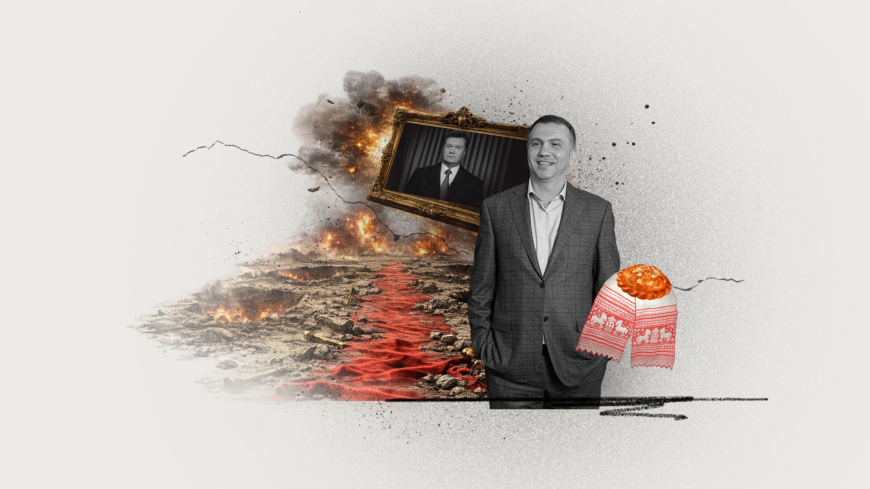
Four years ago, Russia believed it would be able to seize Kyiv in three days. While the occupiers were preparing to terrorise Ukraine’s civilian population with weapons, the District Administrative Court of Kyiv (DACK) was preparing legal cover for such actions.
Pro-Russian political forces in Ukraine intensified attempts to rehabilitate Viktor Yanukovych and worked on the idea of restoring him to the presidency. The now-liquidated DACK, headed by judge Pavlo Vovk, planned to reinstate the fugitive in office. On February 16, just days before the full-scale invasion, the court was scheduled to consider a case based on Yanukovych’s own claim.
How it happened
Fugitive president Yanukovych filed two lawsuits. The first, dated December 30, 2021, through manipulation of the automated case-assignment system (40 out of 43 judges were excluded from the distribution), ended up with Yevhenii Ablov. Yanukovych challenged the parliament’s decision, declaring that he had withdrawn himself from office. On January 5, Ablov accepted the claim for consideration and opened proceedings. The judge decided to examine the case under simplified procedure, without summoning the parties. However, such a procedure is used only for simple cases that have no public interest. Ablov’s decision, however, could have been issued at any moment when needed.
The second claim of the traitor-president was accepted by DACK judge Ihor Kachur, who scheduled a hearing for February 16, 2022. Kachur did not recuse himself from the case, although he had previously served as Deputy Minister of Industrial Policy in Yanukovych’s government and as a member of the Central Election Commission that declared Yanukovych elected president in 2004.
At first, consideration of one of the claims was suspended because it should have been heard by the Supreme Court rather than DACK. Moreover, the time limits for such claims had long expired. Under procedural law, a person has six months to challenge a decision. Instead of closing the case and forgetting it like a bad dream, judge Kachur granted the fugitive 10 days to amend the defective claim so that it would fall under the jurisdiction of the District Administrative Court of Kyiv.
One return did not happen — another must be prevented
On April 20, judge Kachur terminated the proceedings due to missed deadlines and the absence of any motion justifying the delay. The next day, judge Ablov issued a similar ruling. This happened 20 days after the Kyiv region had been fully liberated from the occupiers, when it became clear that Russia would not succeed in capturing Kyiv. At the beginning of the full-scale invasion, the work of DACK had also been blocked by the Security Service of Ukraine. According to then-Deputy Head of the Presidential Office Andrii Smyrnov, the SBU acted preventively, including by technically cutting off access to the Unified State Register of Court Decisions.
The court itself was liquidated in December 2022. Today, its former head, Pavlo Vovk and six other judges of the liquidated DACK are accused of creating a criminal organisation aimed at taking control over key judicial governance bodies. Vovk himself was dismissed only in 2025, but he now has serious chances of returning to office due to a decision of the Supreme Court. On April 9, the Grand Chamber of the Supreme Court will consider Vovk’s case and may restore him to the bench.
Vovk and his colleagues from DACK, including Kachur and Ablov, are defendants in the so-called “Vovk tapes” — materials from covert investigative actions published by the National Anti-Corruption Bureau of Ukraine (NABU). If the Supreme Court reinstates Vovk, this will also secure positions for his DACK colleagues. The Grand Chamber of the Supreme Court may declare inadmissible the use of materials from criminal proceedings in disciplinary cases, despite the established practice of the High Council of Justice and the Supreme Court itself. This could call into question the dismissal of everyone involved in the NABU investigations, as well as other judges caught taking bribes.
Despite clear evidence of links between DACK judges and the enemy, they continue to receive money from the state budget. Over the past three years, UAH 157 million has been spent on payments to them. At a time when the country has been living through the fourth year of full-scale war and every hryvnia must work for defence and recovery, such spending cannot be considered justified.
The DEJURE Foundation honours and remembers the fallen heroes with respect and gratitude. We thank every man and woman in the Defence Forces for our lives and independence. History must not repeat itself, and the judicial system must be cleansed of everyone who works for the enemy.