From Telegram channels to “databases of offenders”: how judicial reform is attacked
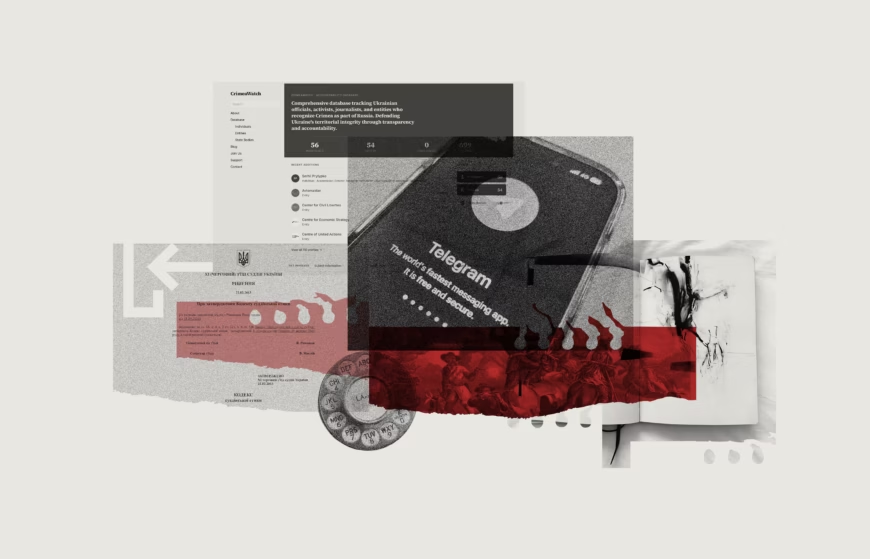
For years, Telegram channels, personal blogs and individual media outlets have been discrediting civil society organizations that promote judicial reform. Now similar manipulations have appeared on the anonymous English-language website CrimeaWatch.
In 2024, the civic initiative Holka examined more than 21,000 reposts from nearly 60 Telegram channels. Almost 30 of them were creating an information environment against judicial reform and discrediting judges of integrity, members of the High Council of Justice and civil society organizations. Among the targets were the DEJURE Foundation and Mykhailo Zhernakov.
Back in 2022, the Security Service of Ukraine reported that some of these channels were controlled by Russian special services and used to destabilize the situation in Ukraine.
Glavcom described how participants in this pro-Russian network called civil society activists “Soros piglets,” attributed support for Hitler to Roman Maselko, attacked judges of integrity and spread fakes about Mykhailo Zhernakov. These messages appeared in anonymous channels, personal blogs and media outlets, and then reinforced one another through reposts.
Now a similar manipulation has been published by the anonymous English-language website CrimeaWatch. The site presents itself as a database of Ukrainians and organizations allegedly involved in recognizing Crimea as part of Russia. It already contains 95 profiles of individuals and organizations.
CrimeaWatch operates on a domain that, as recently as January 2022, hosted a Russian online store. The current domain registration began in January 2026, and the initiative’s Facebook page was created in June 2026.
This does not prove a link between the initiative and Russian special services, but the current project does not disclose its authors and does not explain who bears editorial responsibility for its publications.
In the DEJURE profile, the site used a real fact: Mykhailo Zhernakov coordinated the second composition of the Public Integrity Council and voted for its Integrity Indicators. CrimeaWatch then claimed that this document supposedly equates trips to occupied Crimea with trips to Russia, thereby allegedly asserting that Crimea is part of the Russian Federation.
The Public Integrity Council document itself says the opposite. It refers separately to the Russian Federation and to the temporarily occupied territories of Ukraine, and in particular calls Crimea directly “the Autonomous Republic of Crimea or another temporarily occupied territory of Ukraine.”
The Code of Judicial Ethics requires judges to observe high standards not only in the administration of justice but also in their extrajudicial conduct, and expressly states that judges voluntarily assume more substantial ethical restrictions. This is precisely what the Public Integrity Council relied on when it assessed trips by judges, as holders of state power, to occupied territory of Ukraine without urgent necessity. Despite this, and without any evidence, the DEJURE Foundation was effectively accused of committing a crime under Article 110 of the Criminal Code of Ukraine — Encroachment on the territorial integrity and inviolability of Ukraine.
CrimeaWatch is yet another anonymous source attacking participants in judicial reform according to a long-familiar scheme: it takes a real fact, substitutes its meaning and declares the manipulation a proven violation.
Despite such attacks, we will continue to expose the substitution of facts and will continue to demand changes in the judicial system.