Shadow Report: Civil society assesses justice and anti-corruption reforms on Ukraine’s path to the EU
Shortly after the start of Russia’s full-scale invasion, Ukraine was granted EU candidate status. Since then, the country has implemented a series of key reforms — including the relaunch of the High Qualification Commission of Judges (HQCJ) and the High Council of Justice (HCJ) in 2023. But has Ukraine lost momentum over the past year? This is the central question raised in a new report by civil society organisations. Without genuine reforms and the preservation of their achievements, there can be no independent institutions — the foundation of Ukrainian democracy. Strong institutions and continued reforms are also essential for effective defence, security, and progress toward EU membership.
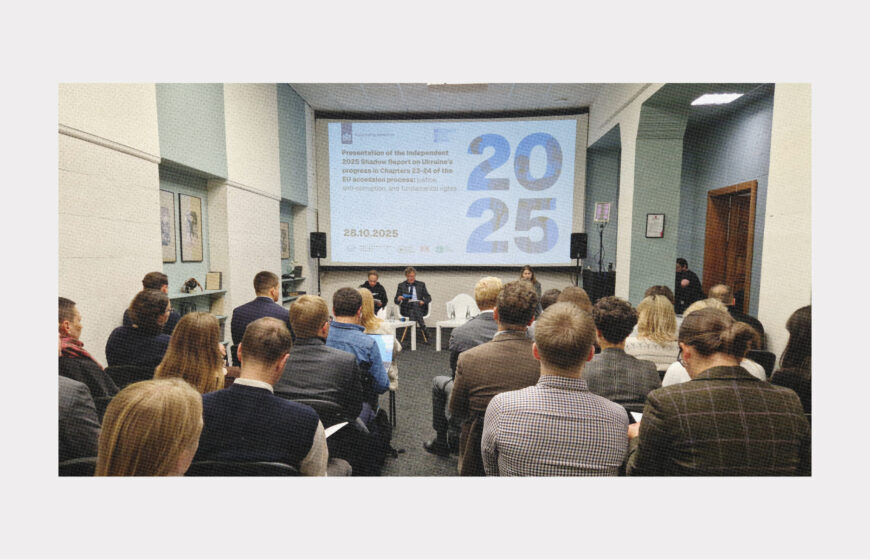
On October 28, the DEJURE Foundation, Anti-Corruption Action Centre, Automaidan, Anti-Corruption Centre “MEZHA”, Institute of Mass Information, and the Media Initiative for Human Rights presented a report evaluating reforms in the fields of justice, anti-corruption, and fundamental rights.
This is the second independent shadow report by Ukrainian civil society on Chapters 23 and 24 of Ukraine’s EU accession negotiations. In it, Ukrainian anti-corruption and human rights organisations assess the government’s progress and identify key challenges that could slow down the country’s European integration process.
“73% of Ukrainians want the EU to continue pressing their government to ensure reforms do not stop. Despite accession talks being blocked by Orbán’s veto, the EU must fully use all available tools — and develop new ones — to maintain reform momentum. This is especially crucial in the context of recent attacks on NABU and public protests in July,” said Mykhailo Zhernakov, one of the report’s authors and Executive Director of the DEJURE Foundation.
Ukraine has already made notable progress in building independent anti-corruption institutions and cleaning up its judiciary. However, the report’s authors emphasise that sustaining this progress requires political will — both in Kyiv and in Brussels.
“We need to work systematically and coordinate priorities across sectors. We’ve invested heavily in reforming the judiciary — with mixed but tangible results. Yet other parts of the legal system remain unreformed. The bar, for instance, plays a crucial role in upholding human rights, but many in its leadership are still connected to Medvedchuk. The authorities have tolerated this for years,” said Yaroslav Yurchyshyn, Chair of the Parliamentary Committee on Freedom of Speech, during the report’s presentation.
In mid-October, civil society organisations also presented the English-language version of the Shadow Report in Brussels to representatives of EU institutions and member states.
The report was prepared with the support of the Embassy of the Kingdom of the Netherlands under the MATRA program. The views expressed in the publication are those of the authors and do not necessarily reflect the position of the Embassy.
Read the full text of the independent Shadow Report on Chapters 23–24.