Six candidates for the CCU are already at the AGE’s final stage. There are serious questions about one of them
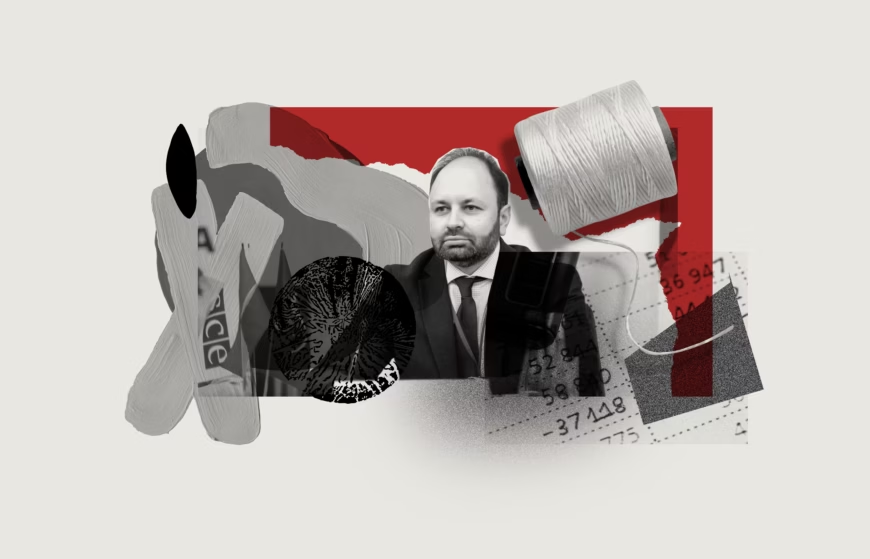
Today, candidates for the Constitutional Court of Ukraine (CCU) under the quota of the Congress of Judges of Ukraine sat a written assessment of their level of competence in the field of law. The Advisory Group of Experts (AGE) admitted 6 of the 12 candidates to this stage, all of whom successfully passed the integrity check:
- Rasim Babanly – Chief of Staff of the Supreme Court;
- Oksana Klymenko – professor at the Kyiv National University of Trade and Economics;
- Oleksii Klymenko – prosecutor at the Prosecutor General’s Office;
- Oleksii Kravchuk – judge of the High Anti-Corruption Court;
- Andrii Savchak – judge of the Peremyshliany District Court of Lviv Oblast;
- Petro Saliuk – judge of the Khmelnytskyi Circuit Administrative Court.
As for Mykhailo Smokovych, no decision was taken because the number of votes required by law was not reached. Although the candidate did receive 4 votes in favour, he was not supported by at least two international members of the AGE, and so he ceased to take part in the competition.
Of all the candidates, the one who raises the greatest doubts as to his suitability for the future post is Rasim Babanly, Chief of Staff of the Supreme Court.
During the interview, the members of the AGE paid no attention to the discrepancy between the candidate’s assets and his income, to the refusals to release public information in response to requests, or to his academic misconduct.
A gifted apartment
In 2010, the Babanly family bought a two-room apartment for USD 172,500. It was registered in the mother’s name, but the candidate himself handled everything to do with the purchase: he signed the documents, negotiated with the developer and supervised the works.
Babanly was unable to give a clear explanation of who exactly paid for the apartment. As he put it, “mostly my mother’s money, it seems.” The candidate claims that his parents saved up the money for it, yet he produced no documents confirming those savings. As the AGE established, the parents’ official income over the past 13 years amounted to around USD 77,000 — half the price of the apartment.
When the conversation turned to his father’s sources of income and to explanations of where the rest of the sum had come from, the candidate asked for the live broadcast to be stopped because of the sensitivity of the information. As a result, the central question — where the family got the money for the apartment — was discussed without viewers. The public has no way of verifying the candidate’s explanations.
A land plot and an unfinished mansion
In 2018, Babanly bought an apartment in Kyiv for around USD 87,000. On the day of the transaction, his brother “gifted” him the funds under two contracts, one of which matched the price of the apartment exactly.
According to the candidate, his brother received USD 280,000 in 2017 from the sale of a land plot in the Holosiivskyi district of Kyiv. Besides the plot itself, there was an unfinished house of 1,000 square metres on it. Because of rising prices in 2007, the construction works were halted. Ten years later the unfinished building was sold after all, as a land plot, since the property had never been commissioned. Today the house has been completed, and a private school operates there.
This property, too, was allegedly financed by the father, with money from the sale of a house in Ternopil. However, at the interview, the candidate provided neither the amount of that sale nor any documents confirming the origin of the funds.
Where did the money come from?
According to Babanly, almost all the real estate was paid for by his parents. But this is where the arithmetic fails to add up.
As we noted above, between 1998 and 2010 the parents earned around USD 77,000 — a pre-tax sum that does not take into account the family’s ordinary living expenses over those 13 years.
At the same time, the candidate named at least USD 240,000 in spending on real estate: around 172,500 on the apartment, 15,000–20,000 on the land plot in the Holosiivskyi district and another 50,000 or so on building the house there. In other words, the parents’ official income covers only about a third of this spending.
What other questions were skipped
Babanly was also not asked about the suspected plagiarism in the dissertations he defended in 2010 and 2019. He was asked about Russian sources, but the most important concern — the breach of academic integrity — was effectively passed over.
In our view, both dissertations contain plagiarism, self-plagiarism and procedural violations.
His candidate of sciences dissertation contains entire paragraphs borrowed word for word from the work of a Russian researcher with no reference to the source.
In his doctoral monograph, two co-authored articles have been copied almost in full, with references given for only one or two paragraphs out of dozens of copied pages. In addition, 12 of his own previously published articles have been copied — self-plagiarism, which the Law “On Education” defines as a breach of academic integrity and a form of deception. Borrowing on this scale casts doubt on the very existence of the monograph as a separate piece of scholarly work.
At the interview, the AGE also set aside the candidate’s stance on access to public information. In 2023, the Secretariat of the Verkhovna Rada Commissioner for Human Rights drew up three administrative offence reports against Babanly — over refusals by the Supreme Court, signed by him, to provide data on judicial remuneration and a copy of the personal record card of a Supreme Court judge.
All of these matters go to integrity, to the transparency of the origin of his assets, and to his attitude towards the rules that a judge of the Constitutional Court is required to observe. The AGE’s decision to admit Babanly to the next stage therefore casts doubt on how thoroughly his integrity was checked.
We are now awaiting the results of the competence assessment of all the candidates. It is from those who pass this stage that the Congress of Judges will shortly elect two new CCU judges.