The Supreme Court of Kravchenko — Preserving the Old Ways
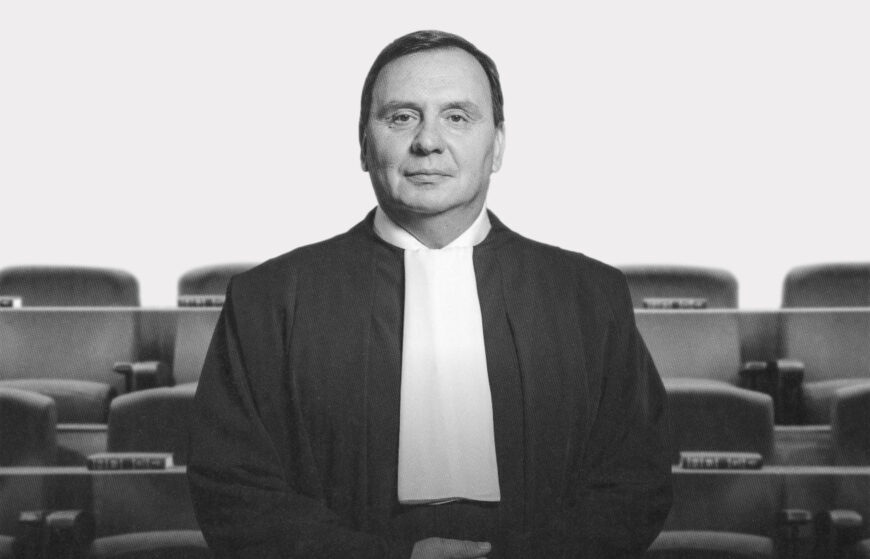
Stanislav Kravchenko became the President of the Supreme Court (SC) after his predecessor, Vsevolod Kniazev, was caught taking a record-breaking bribe of $2.7 million in May 2023. Searches were conducted on 18 judges of the Grand Chamber of the Supreme Court, and even four of them were found with marked bills, but only Kniazev has been accused so far. Of course, he couldn’t make the “necessary” decision single-handedly in a collegial body.
Judge Kravchenko, a representative of the old judicial elite, or rather the “judicial mafia”, was supposed to be a stabilizing factor in the activities of the Supreme Court. However, even during the election of the new President, judges complained about the insufficient time to prepare for the elections. Information leaked that candidate Kravchenko promised apartments to Supreme Court judges for their votes during the war.
To understand whether such practices are standard behavior of the head of the SC, one should analyze the historical path of Stanislav Kravchenko to the highest judicial position.
Politically Motivated Release of a Journalist’s Killer
Judge Kravchenko began his career in the village of Odyntsi in the Chernihiv region in the late 1980s. After Ukraine gained independence, Kravchenko worked as a legal advisor, notary, and judge intern until he became a judge of the Kozeletskyi District Court of the Chernihiv region in 1993.
In August 2002, Stanislav Kravchenko moved to the capital to take the position of a judge at the Kyiv Court of Appeals. Practically immediately, Kravchenko received a service apartment of 93.9 square meters in 2003 (judge’s dossier, p. 220), which he later privatized on January 21, 2007. Thus, the judge acquired an apartment in Kyiv.
Interestingly, in the same year, the judge showed maximum loyalty to then-president Kuchma, who was sharply criticized by journalist Georgiy Gongadze. According to Ukrainska Pravda, Stanislav Kravchenko was one of the judges who, on November 5, 2003, released Gongadze’s killer, Oleksii Pukach (head of external surveillance at the Ministry of Internal Affairs of Ukraine). The court replaced Pukach’s detention with written recognizance, allowing him to flee and hide until 2009, when he was caught and sentenced to life imprisonment.
The General Prosecutor’s Office began to show interest in the police officers who were monitoring Gongadze. In July 2003, Pukach ordered his subordinates to destroy the materials with the surveillance logs for July, August, and September 2000, knowing that these documents were to be seized by investigators. Pukach was first detained in October 2003 for destroying evidence.
It may be a coincidence, but Pukach was suspected because, in August 2003, he received a new three-room apartment in an elite building in Kyiv for his loyalty to those who gave criminal orders.
It is unknown what materials the prosecutor’s office provided to the court to argue their position, but even from the text of the first instance court’s ruling on Pukach’s detention, it was evident that the court considered the accused capable of influencing witnesses — his former subordinates, obstructing the establishment of the truth in the case and hiding from the investigation.
Serhii Osyka, Pukach’s lawyer, once said about this process: “At the time, Pukach did not agree to turn anyone in, causing everything to fall apart. Then ‘the issue was resolved’ in the court — believe me, very serious people were involved in releasing Pukach because the order most likely came from the President.”
It is not known with whom the issue was resolved regarding Pukach, but Kravchenko was definitely part of the panel of judges who made this decision. Whether the service apartment received in 2003 influenced this decision can only be known by the judge himself. However, for example, the Yanukovych administration compensated the scandalous DACK judges with apartments in Kyiv for their decisions to ban peaceful assemblies on the Maidan. These judges were later expected to legitimize the occupation of Ukraine in 2022.
Loyalty to the Yanukovych Regime
In 2011, Kravchenko was promoted to a judge of the High Specialized Court of Ukraine for Civil and Criminal Cases (HSC).
After Yanukovych became the President of Ukraine in 2010, he systematically cleared the highest courts of disloyal judges and appointed those who were ready to cooperate with the new regime. As part of this process, Andrii Portnov, the architect of the judicial system during Yanukovych’s time, created a new court — the HSC. Portnov is known for his pro-Russian views, in particular, according to Hromadske, he managed the occupation of Crimea. Obviously, the position in the newly created court required judges to be unconditionally loyal to Yanukovych and his political force. Despite this, Kravchenko constantly denied knowing Portnov.
Concealment of a Case Reviewed by the ECHR
Against the backdrop of failed attempts to cleanse the judicial branch after the Revolution of Dignity, Kravchenko first became the Deputy Head of the HSC in 2014 and then took the position of Head of the Criminal Court of Cassation in the new unreformed Supreme Court.
Notably, the heads of all four cassation courts within the new Supreme Court were exclusively the previous heads of the old high specialized courts, which were liquidated with the start of the new Supreme Court’s work. The appointment of the vast majority of the new Supreme Court heads from among the former leaders of the high specialized courts, in regard to whom there were serious integrity concerns from the Public Integrity Council (PIC), may indicate their “advancement” during the competition specifically to lead the cassation courts.
During the competition for the Supreme Court, experts noted manipulations with test and practical tasks and ignoring the PIC’s position, from which judge Kravchenko also received a negative opinion.
The PIC, in particular, drew attention to the fact that when submitting the integrity declaration for 2015, the judge confirmed that he had not made decisions individually or as part of a panel of judges, as provided for by Article 3 of the Law of Ukraine “On Restoring Trust in the Judiciary of Ukraine.” However, according to the PIC’s verification, Kravchenko participated in the appellate procedure of case No. 11-a-1646/08 in the panel of judges of the criminal chamber of the Kyiv Court of Appeals, the decision of which was subject to consideration by the European Court of Human Rights (ECHR) (Case “A.V. v. Ukraine”). The ECHR, in its decision, noted the violation of the Convention for the Protection of Human Rights and Fundamental Freedoms by the court. The ECHR, in particular, stated: “When the applicant first provided confession statements, he did not have access to a counsel… In view of the facts, the Court sees no compelling reason for restricting the applicant’s right to counsel at the time of the events. Furthermore, the Court considers that such restriction violated the applicant’s right to defense.”
Thus, judge Kravchenko provided false information in the integrity declaration, as he did not indicate that he participated in making decisions with violations of the Convention for the Protection of Human Rights and Fundamental Freedoms.
Judges are obliged to be interested in the practice of the ECHR, especially considering the relatively small number of cases concerning Ukraine. Kravchenko, working in a court mentioned in the decision, especially in a criminal case, should have checked whether this decision concerned the very case in which he participated.
During the competition for the Supreme Court, judge Kravchenko emphasized his strength as an experienced and intelligent judge by mentioning his knowledge and experience seven times on one page of the motivational letter. Despite this, the judge did not take sufficient measures to correctly fill out the integrity declaration. Meanwhile, the PIC easily found this case.
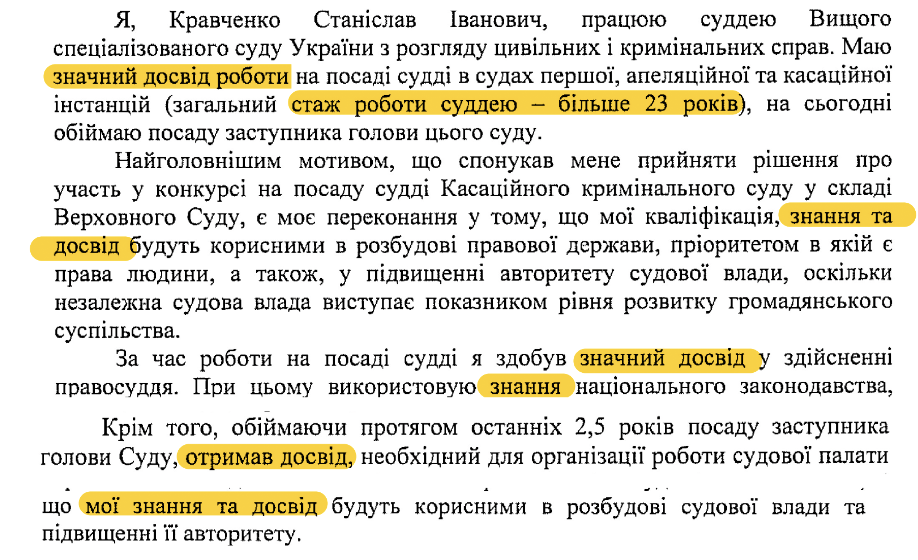
Caption: In his motivation letter submitted during the Supreme Court competition, Judge Kravchenko highlighted his extensive experience and knowledge seven times.
Questionable Savings
In 2016, electronic property declarations were introduced. For the first time, judges had to declare their savings. Interestingly, Judge Kravchenko declared in 2015 $70,000 in cash for himself, $300,000 for his wife, and another $10,000 for his student daughter. The total declared savings amounted to $385,000. At the same time, the income of the wife, a private notary, for the last three years was ₴50-100 thousand, and the daughter’s income for the last two years was only ₴12 thousand in scholarships.
A deeper analysis allows us to calculate that from 2002 to 2015, the judge and his family received an official pre-tax income of $660,000. At least $100,000 was spent on Mazda and Toyota cars, another $130,000 on taxes. We can also calculate the declared expenses for property maintenance from 2003 to 2014 ($10,000), daughter’s education in 2011-2012 ($7,500), plus at least two more years of education that did not make it into the declarations ($6,300). Calculating these separate expense items already nearly matches the declared income. Additionally, there is actual data on the judge’s and his family’s trips abroad for several weeks each year. Also, expenses on food, gasoline, clothing, mobile phones, other electronics, household appliances, furniture, jewelry, watches, property rental by the notary, or the cost of purchasing real estate for notarial services by the judge’s wife, salaries for assistants, etc., are not taken into account. Such expenses should indeed be significant, considering that, for example, in 2008, the judge’s wife, a notary, had to incur related costs to earn approximately $110,000, a substantial sum in Ukraine at that time.
The incredible ability of Judge Kravchenko and his wife to save money requires additional attention and explanations from the judge. Also, most of the family’s income came from the earnings of the wife-notary, whose business began to decline sharply since 2012.
Bribery of Supreme Court Judges During the Election of the President
After the previous head of the Supreme Court, Vsevolod Kniazev was caught with a record-breaking bribe of $2.7 million, the question arose of electing a new head of the Supreme Court. During his election, according to BBC, Kravchenko promised free apartments in exchange for votes in his favor to judges who already had salaries ranging from ₴300-400 thousand per month: “He told the judges at the meeting something like this — apartments are provided by judicial guarantees, so we need to fight for them, and I will do it. Essentially, he promised free apartments. However, this is a prohibited trick in court.” Previous Presidents of the Supreme Court, as BBC notes, had the opposite position — with salaries of ₴300-400 thousand per month, judges were advised to buy housing themselves.
Stanislav Kravchenko did not specifically respond to the accusations voiced in the press during the elections but said that he “rejects all insinuations.” In an interview with Ukrinform, Kravchenko noted: “This issue was raised at a meeting of the Administrative Court of Cassation. One of the judges asked about providing apartments. I replied that the law provides for the provision of judges with service housing, the norms of the law should be observed, and we cannot ignore them. But we need to consider the realities of life: martial law, financial and economic capabilities. We do not have the ability to issue apartments to judges; I cannot promise what does not exist in nature.”
Recall that Kravchenko himself received a service apartment in Kyiv of 93.9 square meters back in 2003, which he privatized in 2007.
Sabotaging the Dismissal of a Judge with a Russian Passport
All the heads of the liquidated high specialized courts successfully passed the competition for the new Supreme Court and became the heads of the cassation courts according to their specialization. One of such heads was Bohdan Lvov, the head of the Commercial Court of Cassation within the Supreme Court. In 2022, journalists discovered Lvov’s Russian passports, a Russian tax number, and undeclared real estate transactions in Moscow using these documents. The then President of the Supreme Court, Kniazev, expelled Bohdan Lvov from the composition of the court after the Security Service of Ukraine (SBU) confirmed information about his Russian citizenship. After that, a representative of the old corrupt judicial elite tried to reinstate his position. Lvov likely could use old connections and influence, and received a first-instance decision in his favor.
On January 9, 2024, the day before the court hearing on reinstating judge Lvov to the Supreme Court, the new President of the Supreme Court, Stanislav Kravchenko, stated in an interview that Bohdan Lvov was expelled from the staff due to a “subjective decision of the then President of the Supreme Court, Vsevolod Kniazev.” Such statements not only worsened the Supreme Court’s position as a defendant in the case before its consideration but also potentially violated paragraph 2.4 of the Bangalore Principles of Judicial Conduct and Article 17 of the Code of Judicial Ethics.
In particular, paragraph 72 of the commentary to the Bangalore Principles states that “during the review proceedings in which a judge is a party in an official capacity, such a judge should not comment on the case unless it is related to the proceedings.”
Kravchenko’s quote from the same interview: “Indeed, the mentioned case is under consideration in the Kyiv District Administrative Court, hearings have already taken place, and as far as I know, the court is in the deliberation room, so it would be inappropriate for me to comment on this now… I have no right to comment on something now so that it does not look like influencing the court.”
[You said if you disagree with the KDAC decision, you will appeal…] “If the decision is in favor of Kniazev (and after all, he then represented the Supreme Court, that is, in favor of the Supreme Court) — of course, there is no point in filing an appeal.”
Under public pressure, the Supreme Court still filed an appeal, and on June 12, 2024, the Sixth Administrative Court of Appeal ruled that Lvov’s dismissal as lawful and in a separate ruling once again emphasized Lvov’s Russian citizenship after it was confirmed by the SBU.
However, during the appeal hearing, it seemed that the Supreme Court was not interested in winning the case, and the real defendant was the SBU. The representative of the Supreme Court could not clearly answer any of the judges’ questions, in particular when the SBU filed a motion to admit evidence in the case, she said: “At the court’s discretion… for me personally, it does not matter.” And throughout the hearing, she repeatedly said: “Do you need my personal opinion or the opinion of the Supreme Court?”
Thus, Kravchenko supported his long-time friend from the commercial jurisdiction and Russian citizen Bohdan Lvov and maximally distanced himself from his predecessor by saying that the decision to dismiss Lvov was personally Kniazev’s, hinting that the Supreme Court had nothing to do with it and he might have acted differently. Despite the inaction of the Supreme Court representatives during the appeal hearing, public outcry and the firm position of the SBU prevented Russian citizen judge Lvov from reinstating his position as the head of one of the cassation courts within the Supreme Court.
Opposition to Effective Corruption Investigations
The 2017 Lozovyi amendments to Ukraine’s Criminal Procedure Code imposed stricter limits on pre-trial investigations and detention terms, increased procedural burdens on prosecutors, and required court approval for exhumations, drawing criticism for hindering investigations.
According to the Anti-Corruption Action Centre, the Supreme Court and its President, Stanislav Kravchenko, are actively opposing the abolition of the “Lozovyi amendments.” This is not surprising, as Kravchenko was part of the panel of judges of the Joint Chamber of the Criminal Court of Cassation within the Supreme Court, which made a very questionable decision regarding the application of the “Lozovyi amendments” to combined cases in which proceedings were initiated both before and after the adoption of the amendments.
Such active opposition of the Supreme Court and personally Kravchenko directly contradicts the position of the European Commission, which in its report (p. 32) pointed out to Ukraine the need to abolish the “Lozovyi amendments” and introduce reasonable pre-trial investigation deadlines.
Blocking Judicial Reform and Cleanse of the Judiciary
Recently, more and more questions have arisen about the decisions of the Grand Chamber of the Supreme Court, headed by Kravchenko. During Kniazev’s bribery case in 2023, searches were conducted on 18 judges of the Grand Chamber of the Supreme Court. In December 2023, two more judges with integrity issues were elected to this final judicial link, including judge Stupak, whose lies in property declarations were confirmed by NABU and the new composition of the HQCJ. Stupak was saved from responsibility by the HCJ and the Supreme Court itself, which refused to punish her.
Such a composition of the Grand Chamber of the Supreme Court interfered with the powers of the new composition of the HCJ and practically forced the judicial self-governance body to submit a proposal to the President to appoint judge Oleksandra Shulika to a vacant position, whom the HCJ did not recommend for appointment due to trips to Crimea after the occupation.
The Grand Chamber of the Supreme Court, by its decisions, undermines the procedure for the qualification assessment of “five-year judges.” Judges appointed for the first time for five years underwent the first stage of the interview with the HQCJ. However, those who received negative opinions from the PIC had to undergo a second interview with the full composition of the HQCJ to complete the procedure. However, MP Roman Babii tried to create a “loophole” to leave these judges with integrity issues in office. With the resumption of the HQCJ’s work, it has already sent 4 such judges for dismissal, as Babii’s law did not indicate that they had already passed the qualification assessment. These include judges Inna Otrosh Jr. (owner of unexplained million-dollar assets), Andrii Kluchnyk (judge who imprisoned a Maidan protestant), and Natalia Sharko (after the occupation, applied to the so-called “court” created by the occupiers).
Conclusions
Indeed, Stanislav Kravchenko brought “stability” to the Supreme Court, but in fact, he preserved the old judicial ways in a court formed through a dubious selection procedure and a high percentage of judges with integrity issues. 75% of the SC judges received negative opinions or information that could indicate low integrity from the PIC, including Vsevolod Kniazev, judges Lvov and Simonenko with Russian citizenship, judge Stupak, and others deemed having low integrity by the PIC, including Kravchenko himself. The old judicial elites moved from the liquidated courts and continued to work without changing approaches, and now they effectively oppose the updated HQCJ and HCJ in cleaning the judiciary.
The final point in the procedures for both the qualification assessment of judges and the dismissal of judges by the HCJ for disciplinary offenses remains the Supreme Court, the Grand Chamber of which, headed by Kravchenko, organically covers up the integrity issues of representatives of the judiciary.
We have reached the point from which we started — the renewal of the Supreme Court is necessary. Only this time, it must be real and not formal, with an integrity check of current judges and an open and competitive selection for vacant positions with the participation of international experts. Otherwise, all other stages of judicial system reform, such as the reboot of the HCJ and HQCJ or the cleansing of the judiciary through qualification assessment, will tread water, and we will return to the same point from which we started.