Pressure on a member of the High Council of Justice: the Maselko case as a diagnosis for the Bar

The Qualification and Disciplinary Commission of the Bar (QDCB) of Zakarpattia Region has held High Council of Justice (HCJ) member Roman Maselko disciplinarily liable for alleged violations of legal ethics. In practice, Maselko received a warning. However, the very existence of such a decision signals a return to old practices — bodies of bar self-governance appear ready to serve as instruments of retaliation against officials whose attorney licenses are suspended but who hold public office.
What is the “discipline” about?
The Bar Council of Ukraine filed a complaint against Roman Maselko, alleging “interference with advocacy,” “violation of legal ethics,” and “exceeding authority.” Maselko acted in his capacity as a member of the HCJ during the integrity review of a judicial candidate — attorney Oleksandr Vikhrov. Following the review, Maselko concluded that Vikhrov had numerous integrity concerns, after which the HCJ refused to approve his appointment.
Eleven out of fifteen members of the High Council of Justice supported Maselko’s proposal. The Bar Council of Ukraine, however, did not remain silent. The body described the review of Vikhrov as “interference in advocacy” and initiated disciplinary proceedings against Maselko in his capacity as an attorney. The High Council of Justice twice stated that such decisions and statements by the Bar Council regarding Maselko were unacceptable. In particular, in its decision of 29 January 2026, the HCJ stressed:
“Under such circumstances, the actions of the Bar Council of Ukraine do not indicate protection of a violated right, but rather the expression of its own evaluative judgments regarding the activities of a member of the High Council of Justice, which in substance constitutes a form of pressure and interference with the exercise of his powers.”
Assessment of the decision
Although the decision of the QDCB of Zakarpattia Region consists of seven pages, the justification of Maselko’s alleged violations takes… one paragraph.
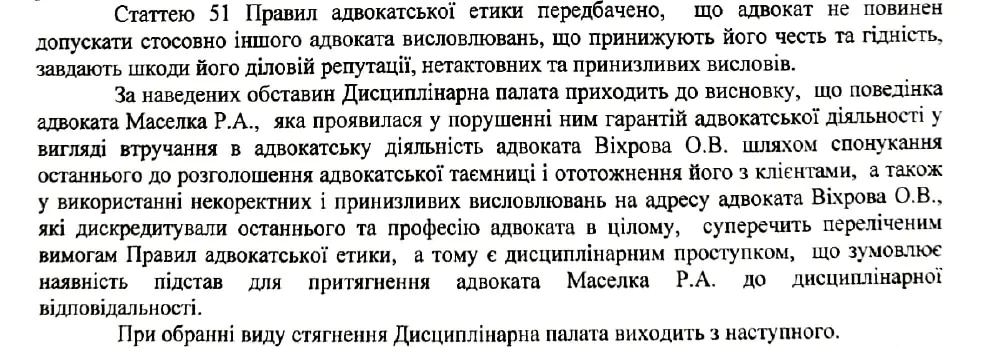
Photo: Facebook / Roman Maselko
That paragraph contains only general wording without any reasoning or explanation. The QDCB accuses Maselko of using inappropriate and offensive language toward attorney Vikhrov, yet provides no concrete examples and no independent assessment.
The actions of the QDCB are not merely an attack on a particular HCJ member. They amount to an evaluation of the HCJ’s activity as a whole, undermining the authority of the institution and discrediting the administration of justice.
The Bar Council of Ukraine and the Zakarpattia QDCB effectively issued their own unsolicited assessment of a decision supported by eleven HCJ members and already in force. Moreover, Maselko acted within his mandate, performing his duty to collect and verify information regarding the integrity of a judicial candidate.
An interesting detail: Zakarpattia Region ranks among the top three regions in the number of attorney licenses issued since 2013, despite being one of the smallest regions by population. This raises questions about a “favourable environment” for passing bar examinations before this particular QDCB. It was in Zakarpattia that the notorious “lawyer” Illia Kyva obtained his qualification as an attorney.
Pressure disguised as discipline
The decision of the Zakarpattia QDCB demonstrates the primitive level of argumentation used by disciplinary bodies of the Bar. All these “brush strokes” in the hands of Bar Council head Lidiya Izovitova, a long-time associate of Viktor Medvedchuk, form part of a broader picture — the struggle of unreformed institutions against renewed bodies that are cleansing the judiciary and filling it with qualified candidates. In essence, this is the punishment of an HCJ member for doing his job properly and preventing the appointment of a low-integrity candidate with influential connections. Disciplinary mechanisms are being used as the lever of such pressure. What should be a tool for responding to professional misconduct is turned into an instrument of influence. At the same time, when attorneys appear in cases involving bribery of judges, selling closed parts of the court register, or cooperation with Russian authorities, the Bar Council prefers to pretend nothing has happened.
As long as the Bar Council of Ukraine remains politicised and unreformed, it cannot credibly claim that it should replace international experts in the selection of members of key judicial institutions, including the High Qualification Commission of Judges. Against the background of these abuses, reform of the Bar is long overdue. For three years, it has effectively been stalled, and without reform, disciplinary procedures will continue to serve not as a safeguard of professional standards, but as a “whip” in the hands of bar self-governance bodies.
Reform of the Bar is one of the requirements for Ukraine’s accession to the European Union. More details on its implementation can be found in the Bar Reform Roadmap, prepared by a coalition of civil society organisations together with attorneys.