The shadow of Portnov and Medvedchuk: what does Yermak’s appointment to the Bar Association committee mean?
Source: NV.
People linked to the Portnov–Medvedchuk–Tatarov circle continue to retain influence over important processes in the country, despite the overall demand to counter hostile agents.
For many years, the Ukrainian Bar has been headed by Lidiya Izovitova, a long-time associate of Viktor Medvedchuk. Her leadership of the Ukrainian National Bar Association of Ukraine (UNBA) and the Bar Council of Ukraine (BCU) can be described as a self-seizure of power, as her term expired in 2022. She cannot be re-elected for another term, so Izovitova has not convened the Congress of Attorneys, which should have elected new leadership.
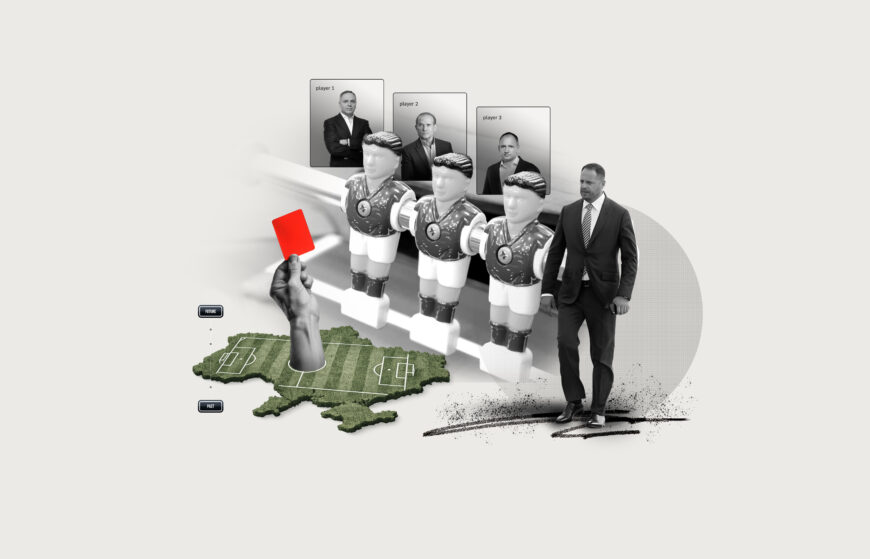
Now the ties between Medvedchuk’s associate and former Head of the Presidential Office, Andriy Yermak, have become explicit. Izovitova appointed him as head of one of the UNBA committees. This appointment is yet another confirmation that the network built by Portnov and Medvedchuk has not disappeared. One of Yermak’s closest associates, Oleh Tatarov, still works in the Presidential Office, where he oversees law enforcement and justice. Tatarov once served as a lawyer for Andriy Portnov. He is also known for his trips to Moscow after 2014 and for justifying police violence during the Revolution of Dignity (at the time, he held a senior position in the Ministry of Internal Affairs).
In other words, the shadow of Portnov and Medvedchuk is still felt at the highest levels of power. Their protégés are blocking reforms required for Ukraine’s accession to the EU. One of the priority reforms is the reform of the bar, which stalled during Yermak’s time in the Presidential Office and continues to stagnate.
The circle of people close to Lidiya Izovitova speaks for itself:
-
UNBA spokesperson Oleksii Shevchuk appeared in journalistic investigations related to the illegal transfer of more than 200 draft-age men abroad. He publicly referred to himself as an “officer” and allowed himself to threaten others with “summonses to hot spots.” Among his clients are Kiva, Onyshchenko, Korban, Dubnevych, and Rozenblat. Shevchuk systematically discredits anti-corruption bodies and publicly defends Yulia Tymoshenko and Timur Mindich after investigations by NABU and SAPO.
-
Vitalii Serdiuk is a lawyer who not only defended Yanukovych but effectively turned his law firm into a PR service for the fugitive ex-president. Serdiuk serves as deputy head of another UNBA committee.
-
Rostyslav Kravets is another figure close to Izovitova. The so-called “Vovk’s tapes” recorded how he filed lawsuits on instructions from Pavlo Vovk, the former head of the notorious District Administrative Court of Kyiv. One of the recordings captures Vovk complaining that “it’s Wednesday already, and there are still no lawsuits.”
-
A separate story concerns Izovitova’s ties with Prosecutor General Ruslan Kravchenko. It was Kravchenko who appointed Izovitova’s associate Shevchuk to the commission selecting the leadership of the Specialised Anti-Corruption Prosecutor’s Office (SAPO). More than 60 civil society organisations and media outlets called for Shevchuk’s removal from the commission, arguing that he does not meet the criteria of integrity and impeccable reputation. However, the Prosecutor General ignored these demands. Kravchenko also maintains close relations with Dmytro Borzykh, whom NABU exposed in a large-scale scheme involving the sale of confidential information from at least 100 criminal proceedings, including 30 NABU investigations. When this became public, Izovitova defended Borzykh. Kravchenko even considered Borzykh for a senior position on his team, but this was prevented by the NABU and SAPO notice of suspicion.
The position of the Bar leadership regarding collaborators is also revealing. Dozens, possibly hundreds, of lawyers who sided with the occupation authorities or became “judges” in temporarily occupied territories remain lawyers in Ukraine. Izovitova’s deputy explains this by the alleged lack of sufficient evidence.
At the same time, the UNBA initiated disciplinary proceedings against lawyers serving in the military, claiming an “incompatibility of professions.” This was even justified by arguing that lawyers who took up arms without suspending their licenses had found a “loophole for additional income.”
Meanwhile, the UNBA leadership opposes the renewed High Qualification Commission of Judges and the High Council of Justice (HQCJ and HCJ), initiates proceedings against members of these bodies — Roman Maselko, Roman Sabodash, and Ruslan Sydorovych — and has blocked for more than four years the competition to the HCJ under the lawyers’ quota. The Bar leadership also consistently rejects the participation of international experts in selection procedures, despite the fact that their involvement enabled the creation of the High Anti-Corruption Court, which has already delivered more than 200 verdicts in top corruption cases.
***
The situation with the Bar has long gone beyond the internal problems of a professional community. It concerns the fulfilment of concrete obligations to the EU and the state’s ability to dismantle systems that for years worked in the interests of a narrow circle of people — and possibly in the interests of the enemy.
The draft Anti-Corruption Strategy of the National Agency on Corruption Prevention for 2026–2030 for the first time identifies the Bar as a separate risk area and proposes instruments to reset the system: electronic voting in self-governance bodies under the principle “one lawyer — one vote,” a unified and transparent entrance exam to the profession, demonopolization of professional training, independent disciplinary bodies, open registers of decisions, and external financial audits. However, the key to a successful comprehensive reform is the reset of the Bar’s governing bodies with the participation of international experts. They must guarantee that pro-Russian, corrupt, or low-integrity lawyers will not enter the renewed Bar institutions.
Resistance to these steps shows who is interested in preserving the old model. The alliance between politicians and the Bar leadership — such as Lidiya Izovitova and Andriy Yermak — only underscores that society and the European Union must demand reforms more decisively, because they will not happen on their own.